
How the answer moves
The flow snapshot — the routes in, the body, the counter-view and the routes out.
Route 1 Locke = foundational thinker of liberal democracy → three ideas (freedom + property + constitutionalism) joined into one design for legitimate government
Route 2 western democracy = power both authorised by people and limited by law → both trace back to Locke
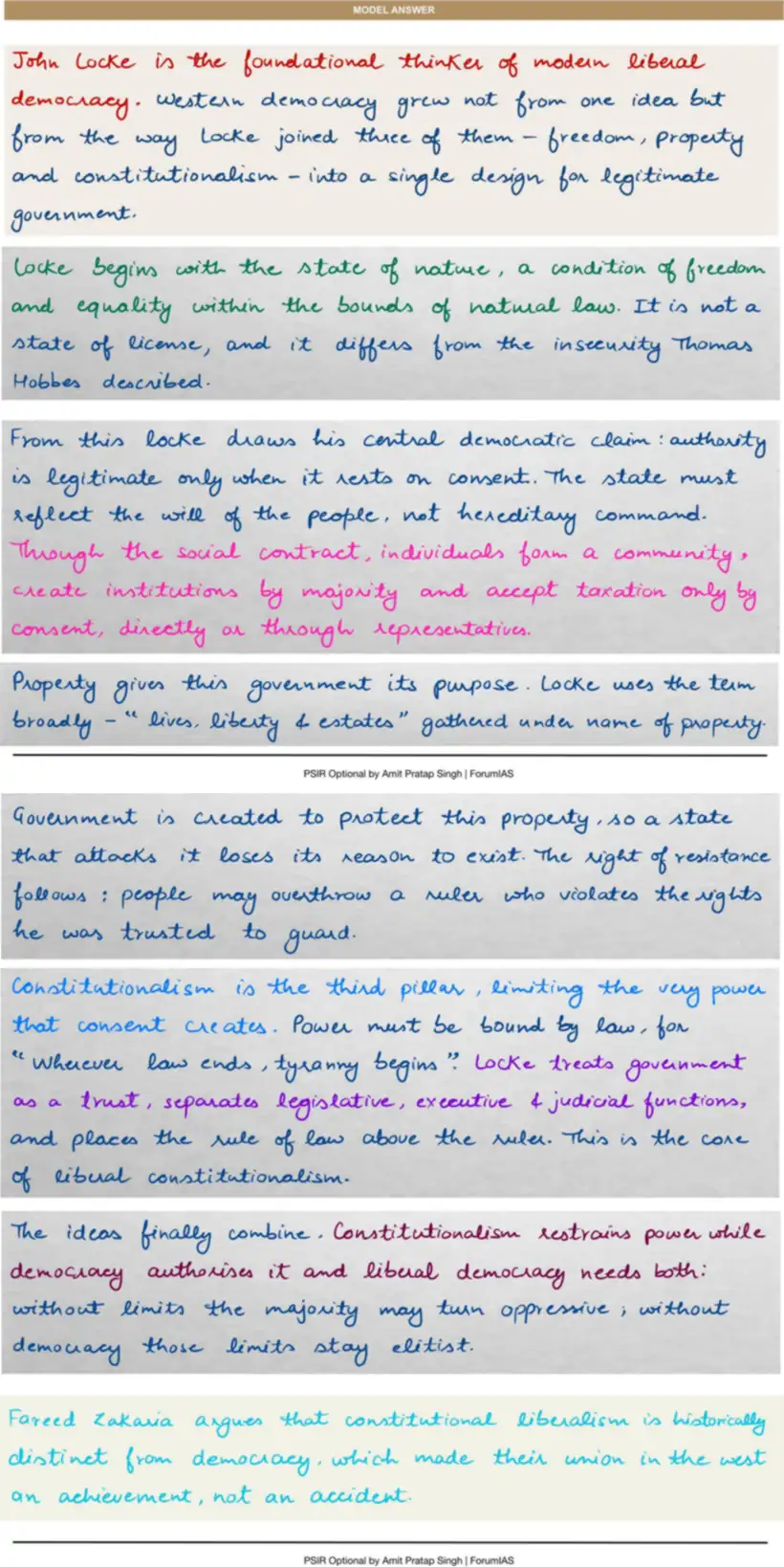
state of nature: freedom + equality within natural law, not licence, vs Hobbes → natural rights (life, liberty, property) prior to government → consent as the only legitimacy, will of people not hereditary command → social contract → community → institutions by majority → taxation by consent/representatives → [property] “lives, liberty and estates” under the general name property → not material alone, inalienable rights → government’s purpose = protect property → right of resistance → [constitutionalism] power bound by law, “wherever law ends, tyranny begins” → government as trust → separation of powers + rule of law → liberal constitutionalism → synthesis: constitutionalism restrains, democracy authorises, liberal democracy needs both
constitutional liberalism historically distinct from democracy (Zakaria) → their union an achievement, not automatic → without constitutional limits majority may oppress; without democracy limits stay elitist
Route 1 western democracy inherits Locke’s union of freedom, property, consent, representation, constitutional restraint
Route 2 government the people authorise and the law restrains — power both authorised and limited
Model answer
Handwritten, in the form it would be written in the examination hall.
Also asked on this head
Democracy — 13 questions in the Vault.
- “Representative democracy is not an absolute principle, rather a question of time, place and circumstances.” Analyze the statement. Mention the major challenges to representative democracy.
- Substantive Democracy (150 words)
- Explain briefly the elite theory of democracy.
How this is taught
The same flow snapshot, built for every head of the syllabus, with the answer written in class.
The first session of Foundation 2027 is published in full.
Six programmes across three levels.