
Examine Gandhi’s critique of ‘Modernisation’
How the answer moves
The flow snapshot — the routes in, the body, the counter-view and the routes out.
Route 1 not West-as-place but West-as-type → Hind Swaraj (1909) → ‘Satanic’
Route 2 progress mismeasured as multiplying wants, not mastering them → restraint = true civilisation
artha/kama over dharma, comfort over moral welfare, “how much to forego” → Wellock (greed, materialism, violence, loss of spirituality) → machinery: “craze for machinery, not machinery as such… supreme consideration is man” → industrialism’s costs (unemployment, alienated labour, centralisation, ruined crafts) → Kumarappa (“no industrialization without predation”) → power gathers in state + capital → citizens as passive subjects → Swaraj = decentralisation + moral autonomy
Tagore: medieval, economically limiting, isolating → Gandhi’s reply: all cultures free about the house, but no cultural slavery
Route 1 not backwardness but moral reconstruction → Swaraj, Swadeshi, Sarvodaya, trusteeship
Route 2 critique still alive in sustainability / simple-living debates
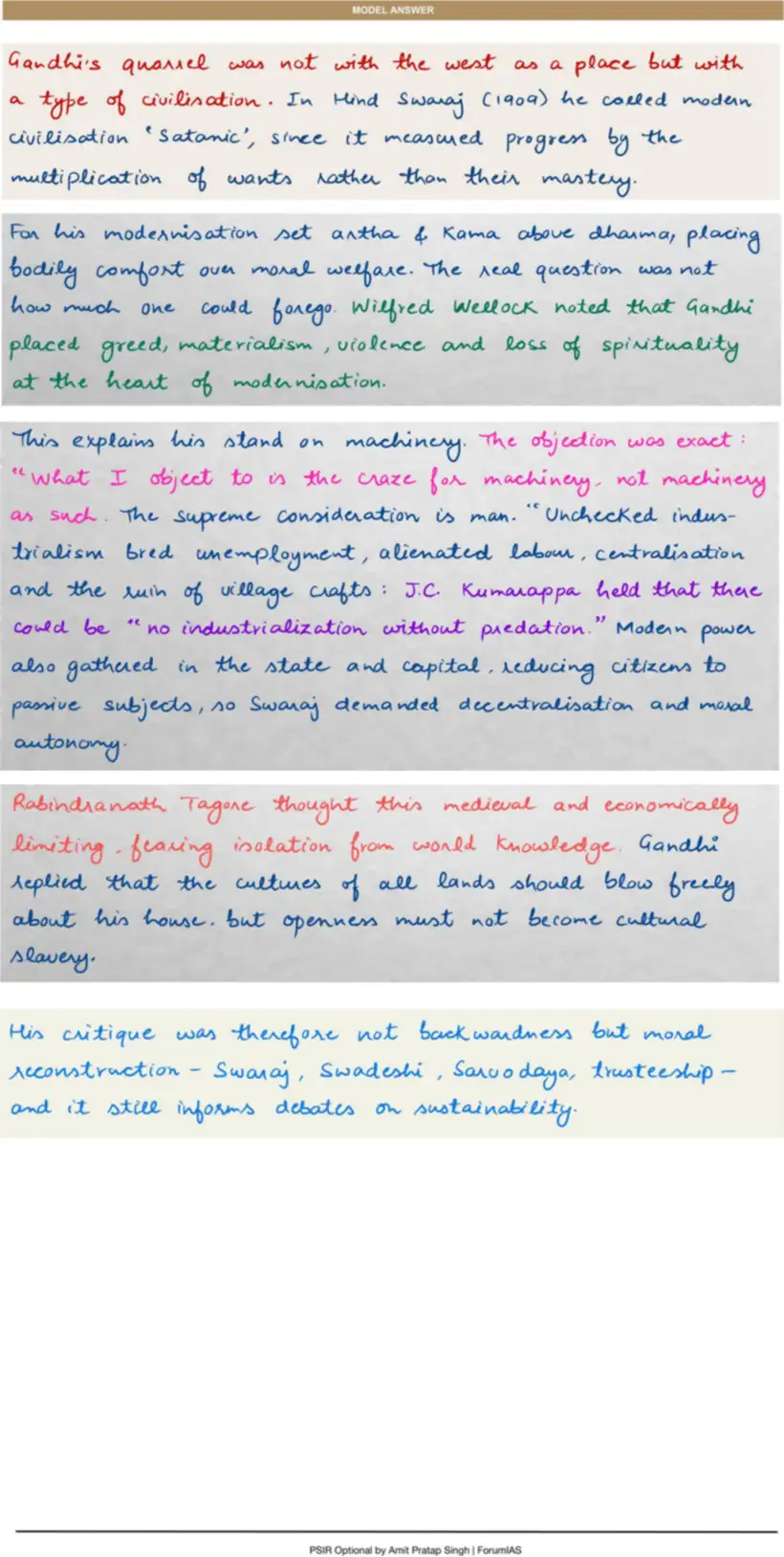
Model answer
Handwritten, in the form it would be written in the examination hall.
Also asked on this head
Indian Political Thought — 21 questions in the Vault.
- Analyze Kautilya’s Saptanga theory. How do you explain its significance in present-day politics?
- Discuss Gandhi’s approach to property in relation to trusteeship.
- Discuss B. R. Ambedkar’s views on democracy and State socialism.
How this is taught
The same flow snapshot, built for every head of the syllabus, with the answer written in class.
The first session of Foundation 2027 is published in full.
Six programmes across three levels.