
Discuss Ambedkar’s ideas on ‘annihilation of caste’.
How the answer moves
The flow snapshot — the routes in, the body, the counter-view and the routes out.
Route 1 1936 undelivered speech → radical attack on Hindu social order → caste cannot be reformed, only destroyed
Route 2 social reform must precede political reform → annihilation, not mending, of caste
caste = “division of labourers” (occupation by birth, denies choice/dignity) → rests on endogamy + purity-pollution + scriptural sanction (Vedas/Shastras/Manusmriti) → graded inequality → blocks united resistance, weakens nation → destroys public spirit/opinion/fraternity (“virtue caste-ridden, morality caste-bound”) → democracy impossible on such soil → inter-dining/inter-caste marriage useful but insufficient → socialists wrong to treat caste as secondary to class → cure: destroy religious sanction → “religion of rules” to “religion of principles” → law as disinfectant → casteless order on liberty–equality–fraternity
partial reform (inter-dining, inter-caste marriage) vs root destruction of religion; class-only socialist view vs caste-centred analysis
Route 1 annihilation = ending the religious-ideological basis of caste, not softening it
Route 2 replacement by casteless democratic order, “one man, one value” → Limaye’s Communist Manifesto parallel
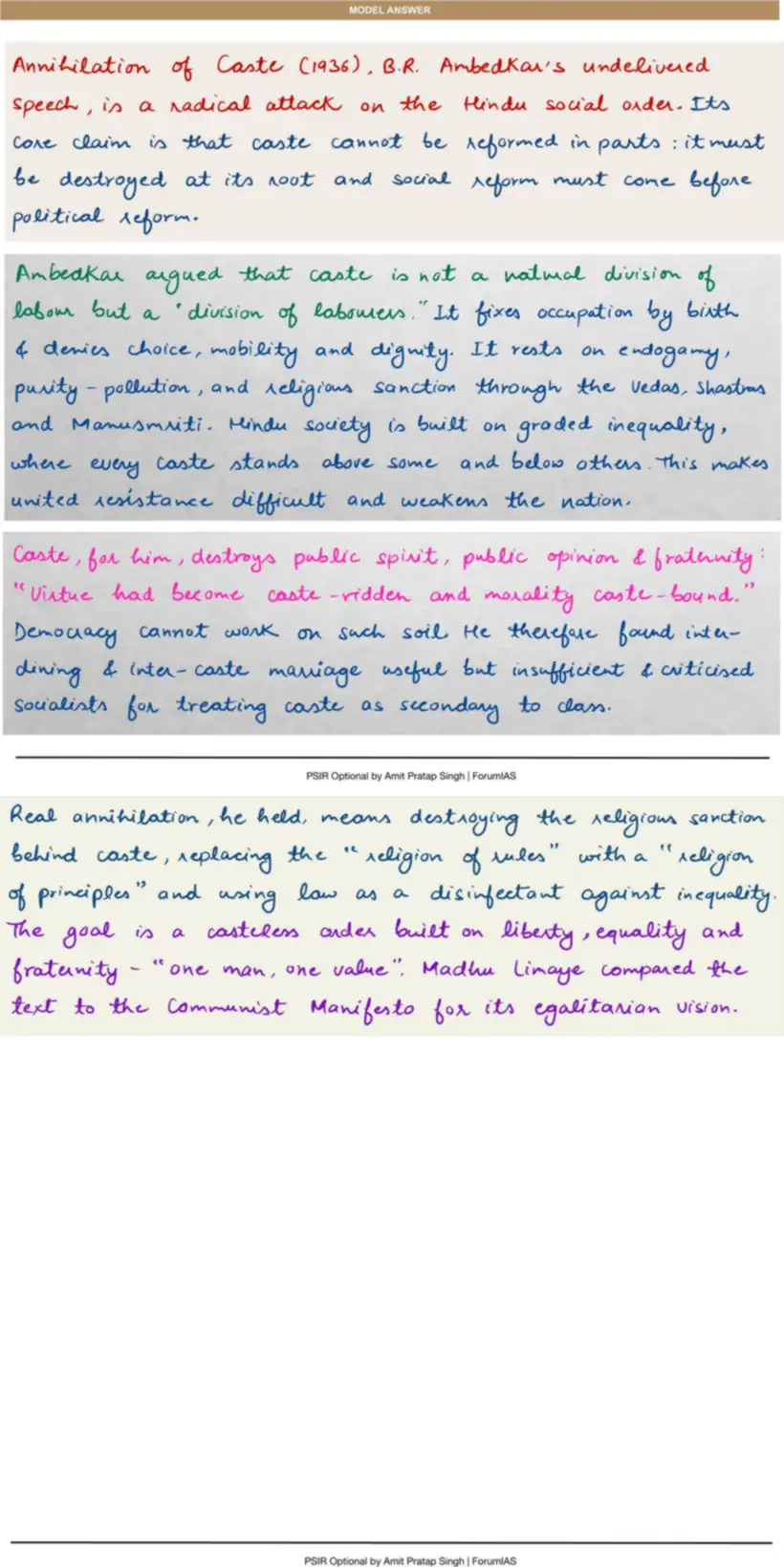
Model answer
Handwritten, in the form it would be written in the examination hall.
Also asked on this head
Indian Political Thought — 21 questions in the Vault.
- Analyze Kautilya’s Saptanga theory. How do you explain its significance in present-day politics?
- Discuss Gandhi’s approach to property in relation to trusteeship.
- Discuss B. R. Ambedkar’s views on democracy and State socialism.
How this is taught
The same flow snapshot, built for every head of the syllabus, with the answer written in class.
The first session of Foundation 2027 is published in full.
Six programmes across three levels.