
“When a nation becomes devoid of arts and learning, it invites poverty.’ (Sir Syed Ahmad Khan). In the light of this statement, assess the role of Sir Syed Ahmad Khan as a reformer in modern India.
How the answer moves
The flow snapshot — the routes in, the body, the counter-view and the routes out.
Route 1 post-1857 Muslim decline read as a crisis of learning → education the cure
Route 2 his own diagnosis: no arts/learning → poverty → reform built on this
idea into institutions → Scientific Society (1863) → Aligarh Institute Gazette → MAO College / AMU → science–faith harmony (science + Quran) → social reform via Tahzib-ul-Akhlaq (anti-superstition/polygamy, widow remarriage, women’s education) → early pluralism (two eyes of India)
post-1887 turn → opposed representative democracy / Congress / self-government → pro-British loyalism → weakened nationalism, fed separatist arguments → most criticised part
Route 1 Kopf: a nineteenth-century moderniser, not merely a communal leader
Route 2 judged by his own test (learning cures backwardness) → foundational reformer & Muslim modernist
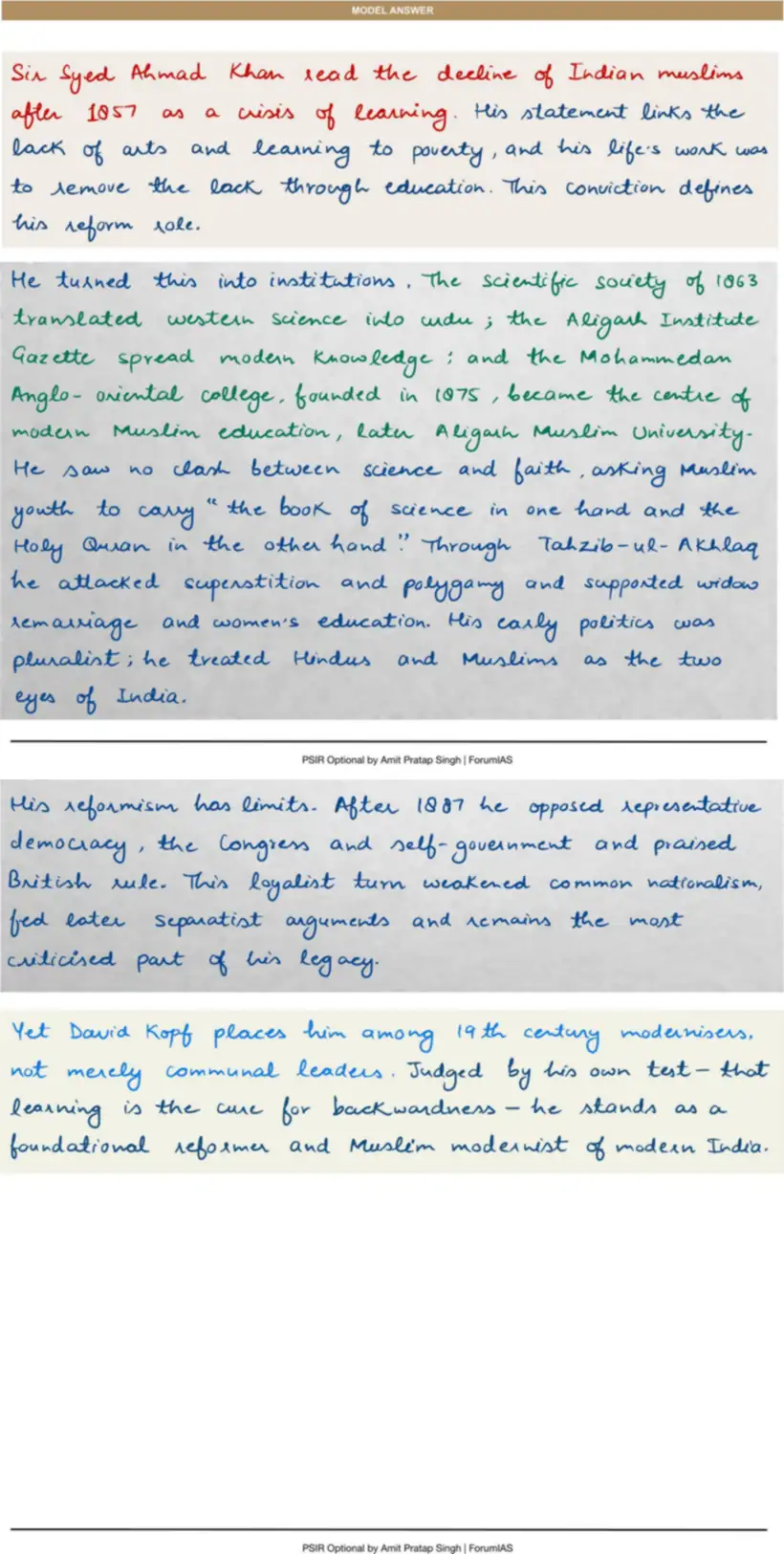
Model answer
Handwritten, in the form it would be written in the examination hall.
Also asked on this head
Indian Political Thought — 21 questions in the Vault.
- Analyze Kautilya’s Saptanga theory. How do you explain its significance in present-day politics?
- Discuss Gandhi’s approach to property in relation to trusteeship.
- Discuss B. R. Ambedkar’s views on democracy and State socialism.
How this is taught
The same flow snapshot, built for every head of the syllabus, with the answer written in class.
The first session of Foundation 2027 is published in full.
Six programmes across three levels.