
Political democracy could not last unless social democracy lay at its base – B.R. Ambedkar. Comment.
How the answer moves
The flow snapshot — the routes in, the body, the counter-view and the routes out.
Route 1 Constituent Assembly closing speech → political democracy = form only → cannot survive without a social base
Route 2 democracy ≠ elections → “associated living,” respect among equals → form vs soil
social democracy = way of life (liberty + equality + fraternity, inseparable) → trinity cannot be split (liberty w/o equality = rule of few; equality w/o liberty = no initiative; both need fraternity) → caste destroys fraternity at root → contradiction from 26 Jan 1950: one vote vs one value (political equality + social/economic inequality) → “top-dressing” on undemocratic soil → preconditions (no glaring inequality, constitutional morality, public conscience, minority protection) → society oppresses deeper than state → rights need moral/social base, not law alone
same Constitution = instrument to convert political into social democracy (FRs, DPSP, reservations); Granville Austin — “social document” → political form can build the social base, not merely wait for it
Route 1 caution holds → one vote must steadily become one value
Route 2 democracy lasts only as its social base deepens → an unfinished task
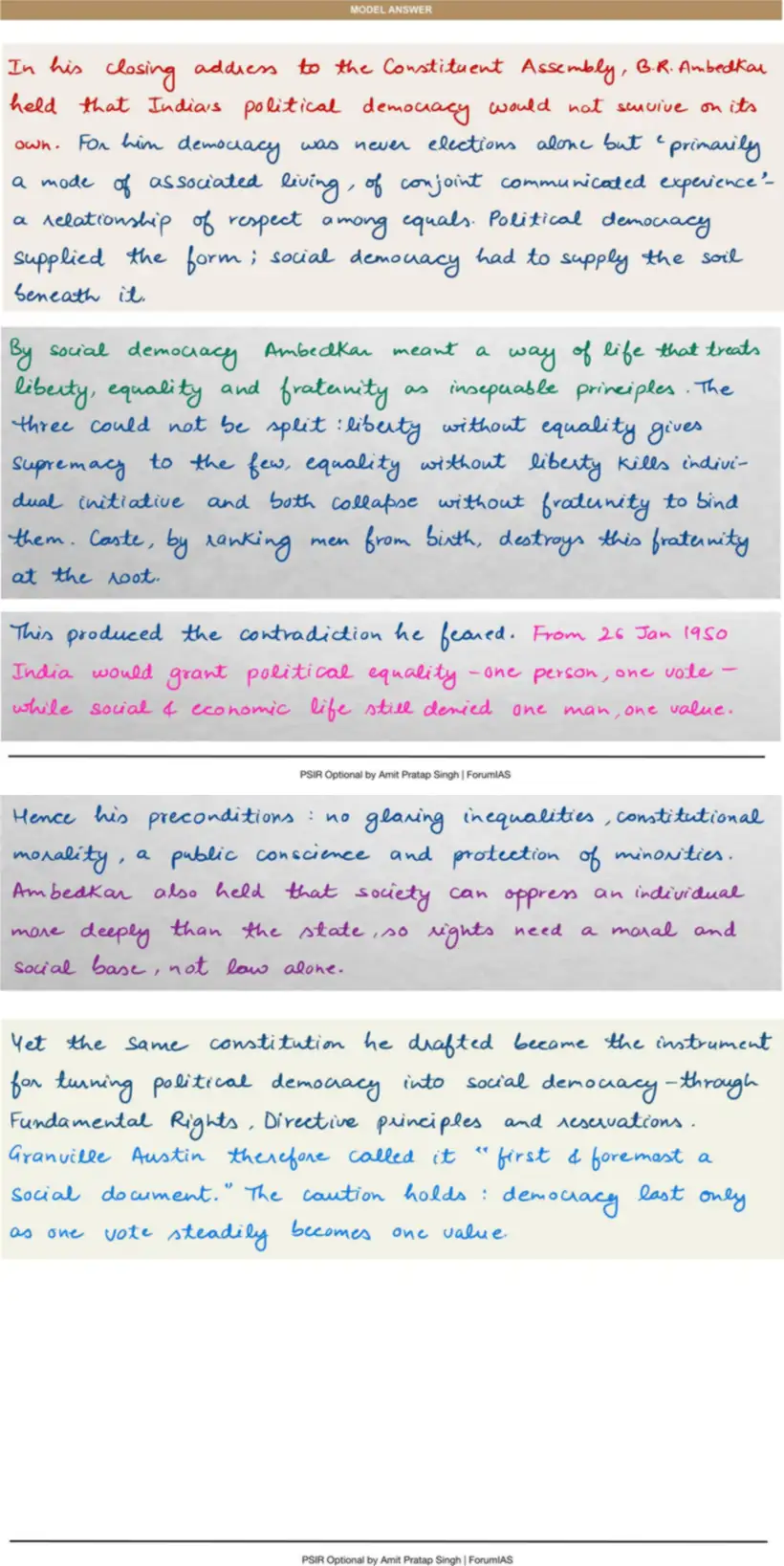
Model answer
Handwritten, in the form it would be written in the examination hall.
Also asked on this head
Indian Political Thought — 21 questions in the Vault.
- Analyze Kautilya’s Saptanga theory. How do you explain its significance in present-day politics?
- Discuss Gandhi’s approach to property in relation to trusteeship.
- Discuss B. R. Ambedkar’s views on democracy and State socialism.
How this is taught
The same flow snapshot, built for every head of the syllabus, with the answer written in class.
The first session of Foundation 2027 is published in full.
Six programmes across three levels.