
Comment on the Ambedkar’s view on constitutionalism in 150 words.
How the answer moves
The flow snapshot — the routes in, the body, the counter-view and the routes out.
Route 1 constitutionalism ≠ mere written Constitution → limited govt + rule of law + democracy + accountability → but legal-social, aimed at transforming an unequal society
Route 2 start from his legal-social premise → the text limits power, yet its real purpose is to remake society, not just regulate the state
legislature = product of social conditions → unlimited legislative power vs constitutionalism → government as public trust → public opinion as preventive check + democratic control of bureaucracy → text alone insufficient → democracy as the edifice → constitutional morality (values over caste / religion / party / hero worship) → “must be cultivated”
politics confined to constitutional methods, routine civil disobedience rejected (read by some as narrowing popular agitation) → his defence: without social democracy, constitutionalism stays fragile
Route 1 responsible government + responsible citizenry → limited in method, purposive in transforming society
Route 2 the text guarantees nothing on its own → survives only where constitutional morality and social democracy are cultivated
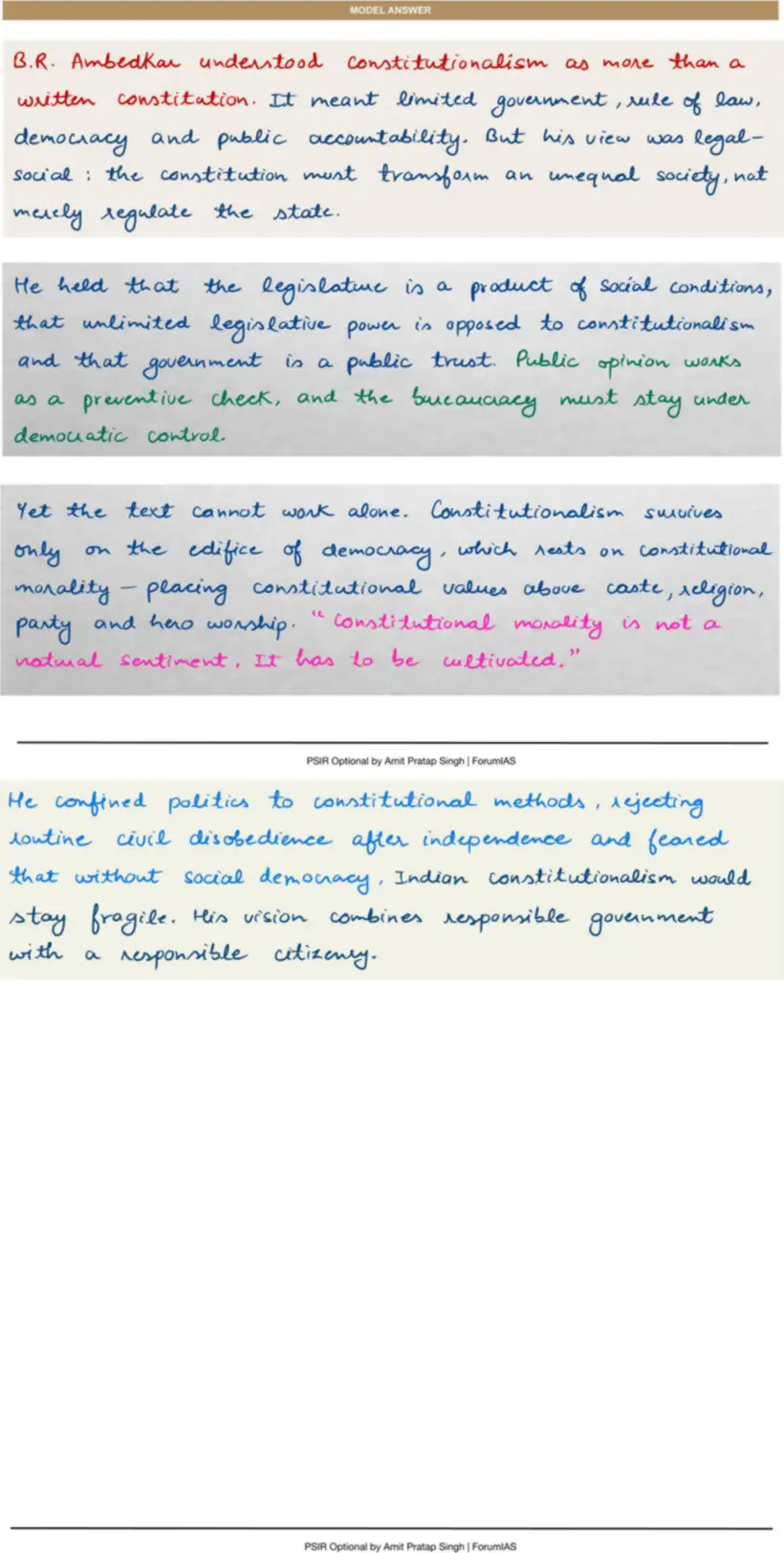
Model answer
Handwritten, in the form it would be written in the examination hall.
Also asked on this head
Indian Political Thought — 21 questions in the Vault.
- Analyze Kautilya’s Saptanga theory. How do you explain its significance in present-day politics?
- Discuss Gandhi’s approach to property in relation to trusteeship.
- Discuss B. R. Ambedkar’s views on democracy and State socialism.
How this is taught
The same flow snapshot, built for every head of the syllabus, with the answer written in class.
The first session of Foundation 2027 is published in full.
Six programmes across three levels.