
Manabendra Nath Roy’s political thought highlighted the humanistic aspects of Marxism. Discuss.
How the answer moves
The flow snapshot — the routes in, the body, the counter-view and the routes out.
Route 1 not a break with Marx → humanism drawn out from within Marxism → individual freed
Route 2 Roy’s aim = human liberation, not class power → release from exploitation, dogma, authority
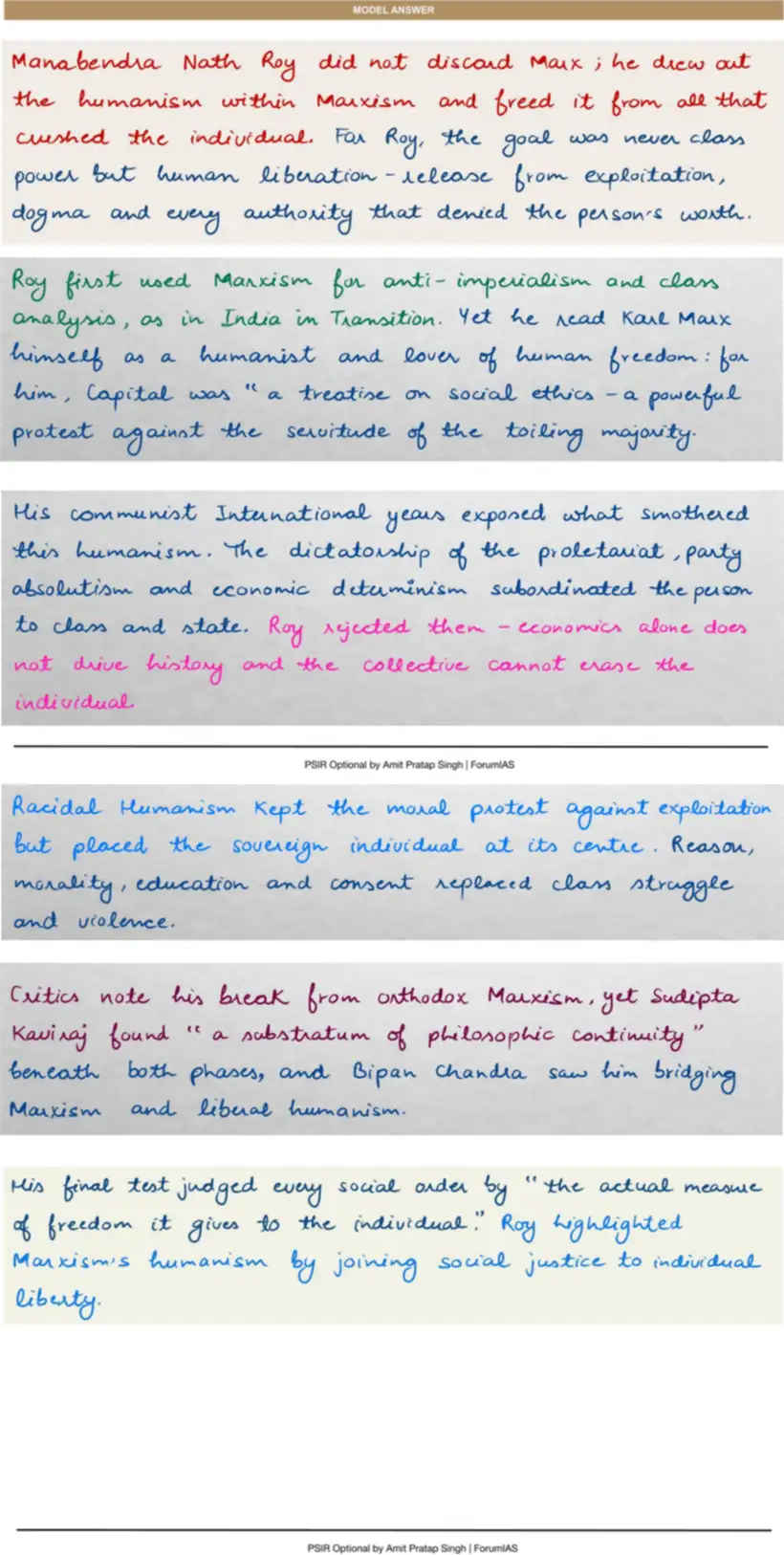
Marxist start (anti-imperialism, class analysis, India in Transition) → Marx himself a humanist → Capital as social ethics / protest against servitude → Comintern exposes what smothers humanism → rejects proletarian dictatorship, party absolutism, economic determinism → Radical Humanism: protest against exploitation kept + sovereign individual → reason, morality, education, consent over class struggle and violence
sharp rupture from orthodox Marxism vs Kaviraj’s “substratum of philosophic continuity” / Bipan Chandra’s Marxism–liberal-humanism bridge
Route 1 every social order judged by the freedom it gives the individual
Route 2 humanism of Marxism = social justice joined to individual liberty
Model answer
Handwritten, in the form it would be written in the examination hall.
Also asked on this head
Indian Political Thought — 21 questions in the Vault.
- Analyze Kautilya’s Saptanga theory. How do you explain its significance in present-day politics?
- Discuss Gandhi’s approach to property in relation to trusteeship.
- Discuss B. R. Ambedkar’s views on democracy and State socialism.
How this is taught
The same flow snapshot, built for every head of the syllabus, with the answer written in class.
The first session of Foundation 2027 is published in full.
Six programmes across three levels.