
Comment on M.K. Gandhi’s concept of Swaraj in 150 words.
How the answer moves
The flow snapshot — the routes in, the body, the counter-view and the routes out.
Route 1 Swaraj as the core of Gandhi’s thought → far more than freedom from British rule
Route 2 swa (self) + raj (rule) → rule over oneself before political independence
rejects mere transfer of power (English rule without the Englishman) → real Swaraj = capacity of all to resist abused authority, not office for a few → multidimensional: political / economic / social / cultural / spiritual → Dalton: inner freedom grounds outer freedom → practical shape: Gram Swaraj, khadi, Swadeshi, constructive programme
unlike Tilak → political freedom without social reform (Hindu-Muslim unity, end of untouchability) is incomplete
Route 1 Swaraj as civilisational alternative, not a mere change of rulers
Route 2 Swaraj as the path to Ramrajya → people’s sovereignty, welfare of the last person
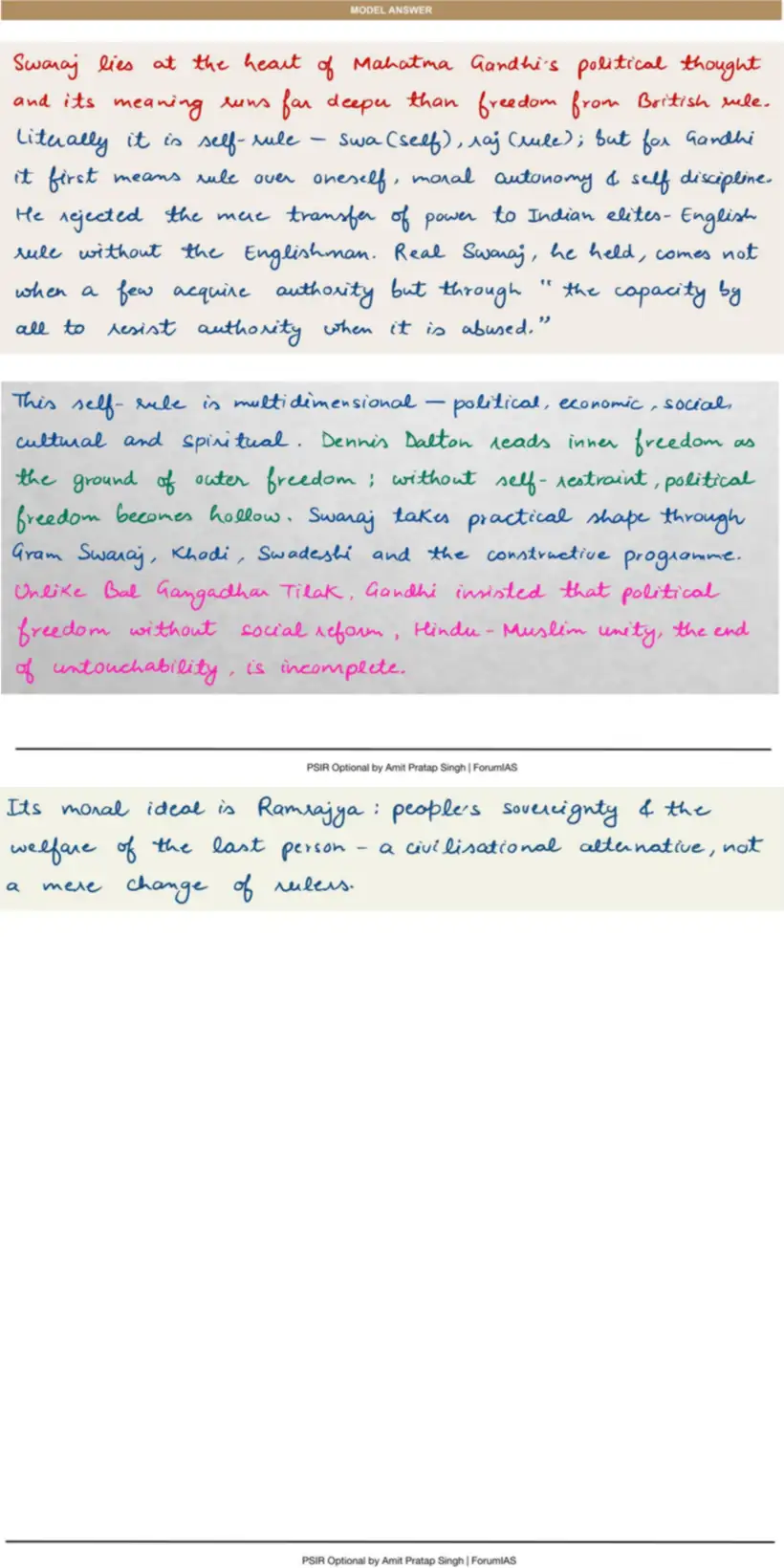
Model answer
Handwritten, in the form it would be written in the examination hall.
Also asked on this head
Indian Political Thought — 21 questions in the Vault.
- Analyze Kautilya’s Saptanga theory. How do you explain its significance in present-day politics?
- Discuss Gandhi’s approach to property in relation to trusteeship.
- Discuss B. R. Ambedkar’s views on democracy and State socialism.
How this is taught
The same flow snapshot, built for every head of the syllabus, with the answer written in class.
The first session of Foundation 2027 is published in full.
Six programmes across three levels.