
‘Liberalisation of Indian economy has not been accompanied with adequate reforms. Comment.
How the answer moves
The flow snapshot — the routes in, the body, the counter-view and the routes out.
Route 1 1991 ended License Raj → opening confined to trade & industry → complementary reforms left undone
Route 2 reform real but partial → product markets opened, institutions & factor markets untouched → statement captures the gap
1991 changes real: delicensing, tariff cuts, financial liberalisation, FDI → growth, reserves, IT/telecom/services → Ahluwalia’s defence → but no matching reform in agriculture, labour, land, credit, social sector → weak governance, slow courts, exposed regulators, bank bad loans → jobless & regionally uneven growth, vulnerable informal sector, cronyism in land/resources/PSUs → Acemoglu & Robinson: institutions decide long-run success → middle-income-trap risk
defenders’ case (Ahluwalia): real growth + falling poverty vindicate 1991 → set against incompleteness: gains stayed narrow because deeper reform never followed
Route 1 statement holds → reform partial, not misdirected → unfinished agenda remains
Route 2 Ahluwalia’s agenda — factor markets, state capacity, human capital → adequacy still pending
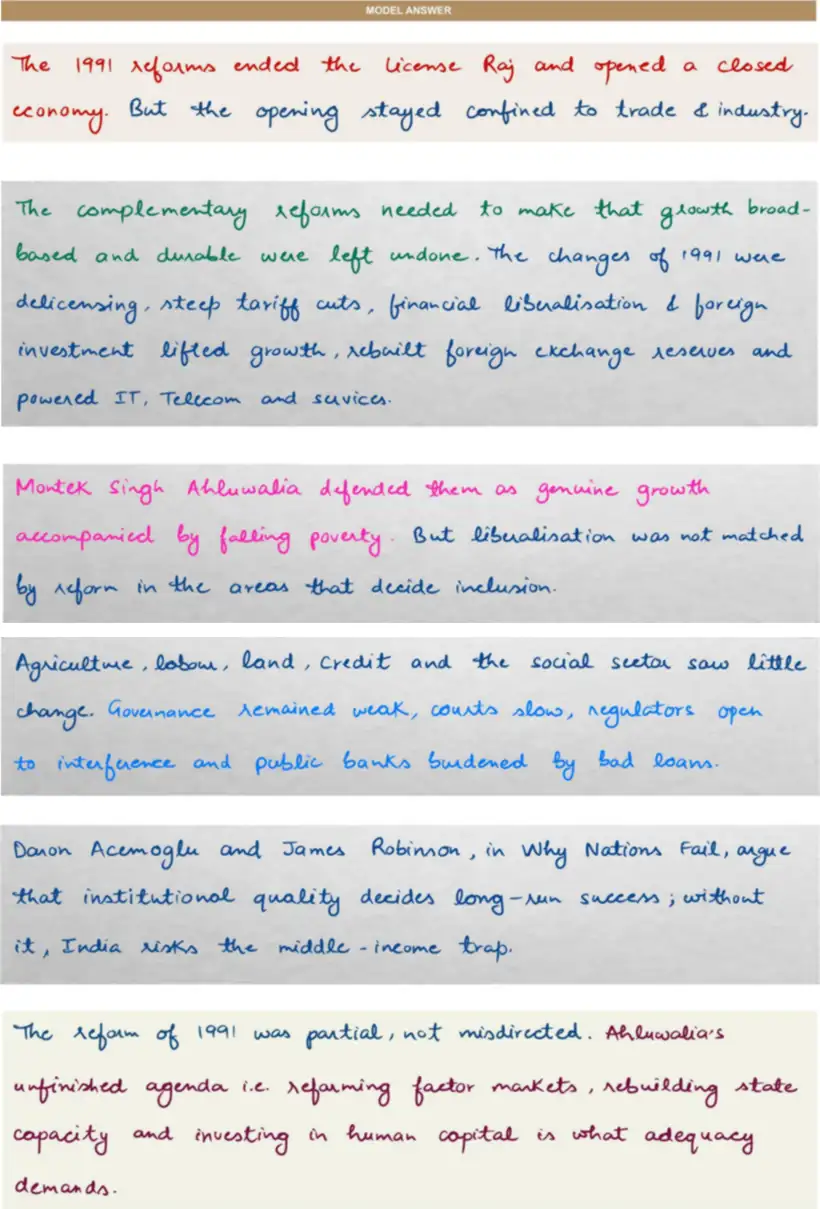
Model answer
Handwritten, in the form it would be written in the examination hall.
Also asked on this head
Planning and Economic Development — 16 questions in the Vault.
- Discuss the impact of liberalization on agriculture sector in India. (150 words)
- With reference to Nehruvian perspective of planning and economic development, examine how the early phase of economic planning in India has laid the foundation of modern...
- What explains India’s modest improvements in social development outcomes even as the rate of growth has accelerated since the initiation of economic reforms?
How this is taught
The same flow snapshot, built for every head of the syllabus, with the answer written in class.
The first session of Foundation 2027 is published in full.
Six programmes across three levels.