
Comment on the functions of District Planning Committee.
How the answer moves
The flow snapshot — the routes in, the body, the counter-view and the routes out.
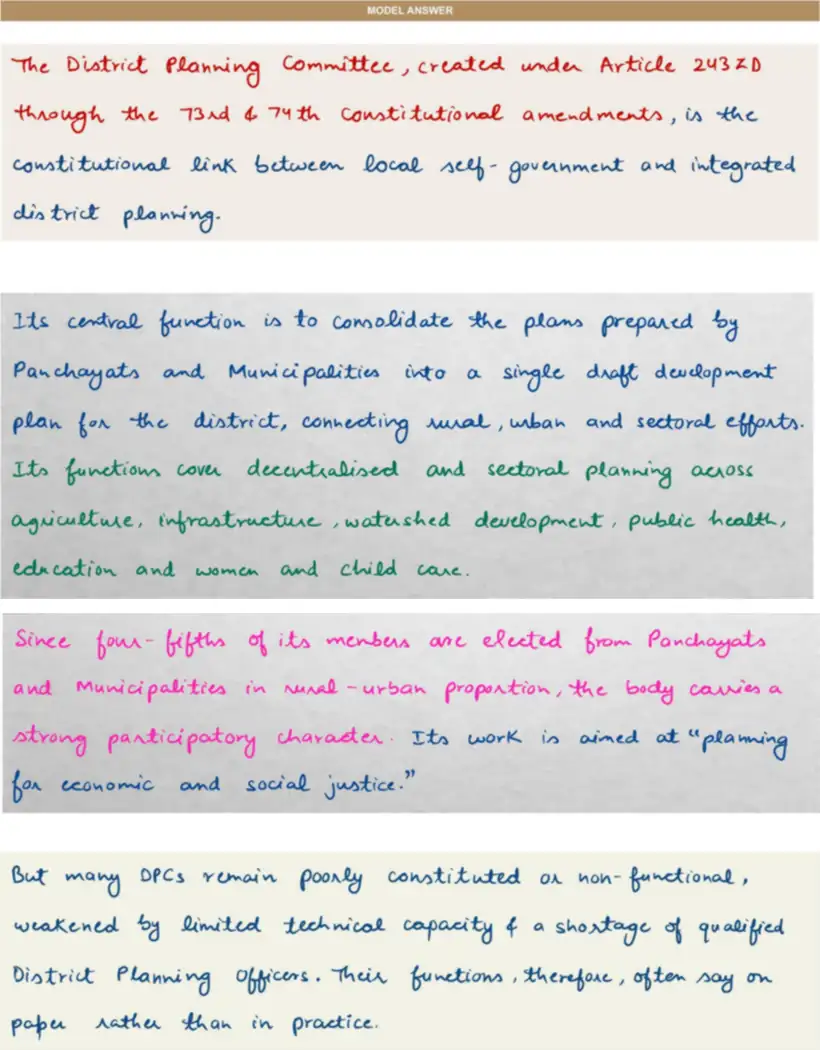
Route 1 Art 243ZD + 73rd/74th Amendments → DPC as constitutional bridge between local self-government and district planning
Route 2 core task = consolidate Panchayat + Municipal plans → one draft district development plan (rural + urban + sectoral)
decentralised + sectoral planning (agriculture, infrastructure, watershed, health, education, women–child) → spatial planning + resource sharing + environmental conservation + coordinated resource management → four-fifths elected from local bodies (rural–urban proportion) → participatory character → “planning for economic and social justice”
mandate vs reality → many DPCs poorly constituted / non-functional → weak technical capacity + no qualified District Planning Officers → functions stay on paper
Route 1 design sound → gap lies in implementation, not mandate
Route 2 functions deliver only with proper constitution + technical support → then real grassroots planning
Model answer
Handwritten, in the form it would be written in the examination hall.
Also asked on this head
Planning and Economic Development — 16 questions in the Vault.
- Discuss the impact of liberalization on agriculture sector in India. (150 words)
- With reference to Nehruvian perspective of planning and economic development, examine how the early phase of economic planning in India has laid the foundation of modern...
- What explains India’s modest improvements in social development outcomes even as the rate of growth has accelerated since the initiation of economic reforms?
How this is taught
The same flow snapshot, built for every head of the syllabus, with the answer written in class.
The first session of Foundation 2027 is published in full.
Six programmes across three levels.