
Examine the various causes of agrarian crisis in India.
How the answer moves
The flow snapshot — the routes in, the body, the counter-view and the routes out.
Route 1 visible distress (suicides, marches, migration) → crisis of profitability
Route 2 farming no longer viable → causes structural & policy-driven, not natural
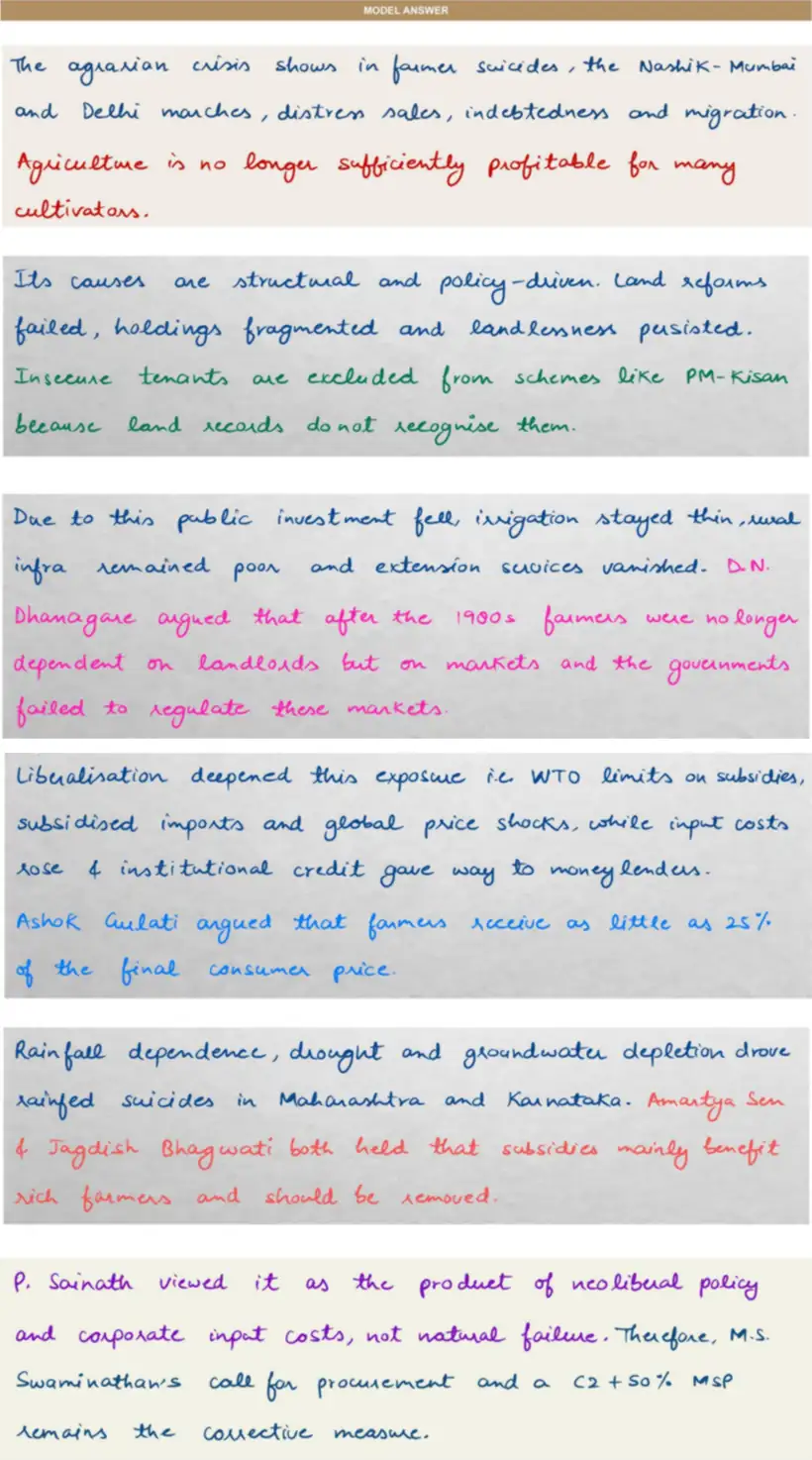
unreformed land base (failed reforms, fragmentation, tenant exclusion / PM-Kisan) → state retreat (falling investment, weak irrigation, no extension) → Dhanagare: dependence shifts landlords → markets, state fails to regulate → liberalisation exposure (WTO, subsidised imports, price shocks, input costs, moneylenders) → Gulati: farmer gets ~25% of consumer price → climate stress (drought, groundwater) → rainfed suicides Maharashtra/Karnataka
Sen & Bhagwati: subsidies mainly aid rich farmers, remove them → fault is misdirected support, not its absence
Route 1 Sainath: neoliberal policy + corporate input costs, not natural failure
Route 2 Swaminathan’s remedy: procurement + C2+50% MSP as the corrective
Model answer
Handwritten, in the form it would be written in the examination hall.
Also asked on this head
Planning and Economic Development — 16 questions in the Vault.
- Discuss the impact of liberalization on agriculture sector in India. (150 words)
- With reference to Nehruvian perspective of planning and economic development, examine how the early phase of economic planning in India has laid the foundation of modern...
- What explains India’s modest improvements in social development outcomes even as the rate of growth has accelerated since the initiation of economic reforms?
How this is taught
The same flow snapshot, built for every head of the syllabus, with the answer written in class.
The first session of Foundation 2027 is published in full.
Six programmes across three levels.