
Land reforms have failed in the eradication of rural poverty. Comment.
How the answer moves
The flow snapshot — the routes in, the body, the counter-view and the routes out.
Route 1 land reform = chief instrument of redistributive justice → charge of failure holds, but cause is implementation, not design
Route 2 four pillars: intermediary abolition + tenancy + ceilings + surplus redistribution → failure real, lies in political will, not the idea
zamindari abolition: ~20 mn became owners → but gain stops at the top (Rudolph & Rudolph: marginal tenants/labourers left out) → tenancy reform: oral tenancies went underground → ceiling laws: high ceilings, benami, exemptions, litigation → surplus never reaches landless → Kohli: state lacked capacity to confront propertied classes
Kerala & West Bengal: strong political movements → redistribution reached the poor (Varshney); Bardhan: reforms can cut poverty + raise productivity when implemented
Route 1 failure real but partial → of the will to enforce, not of the idea
Route 2 where political will existed, land reform did dent rural poverty → the gap is one of implementation
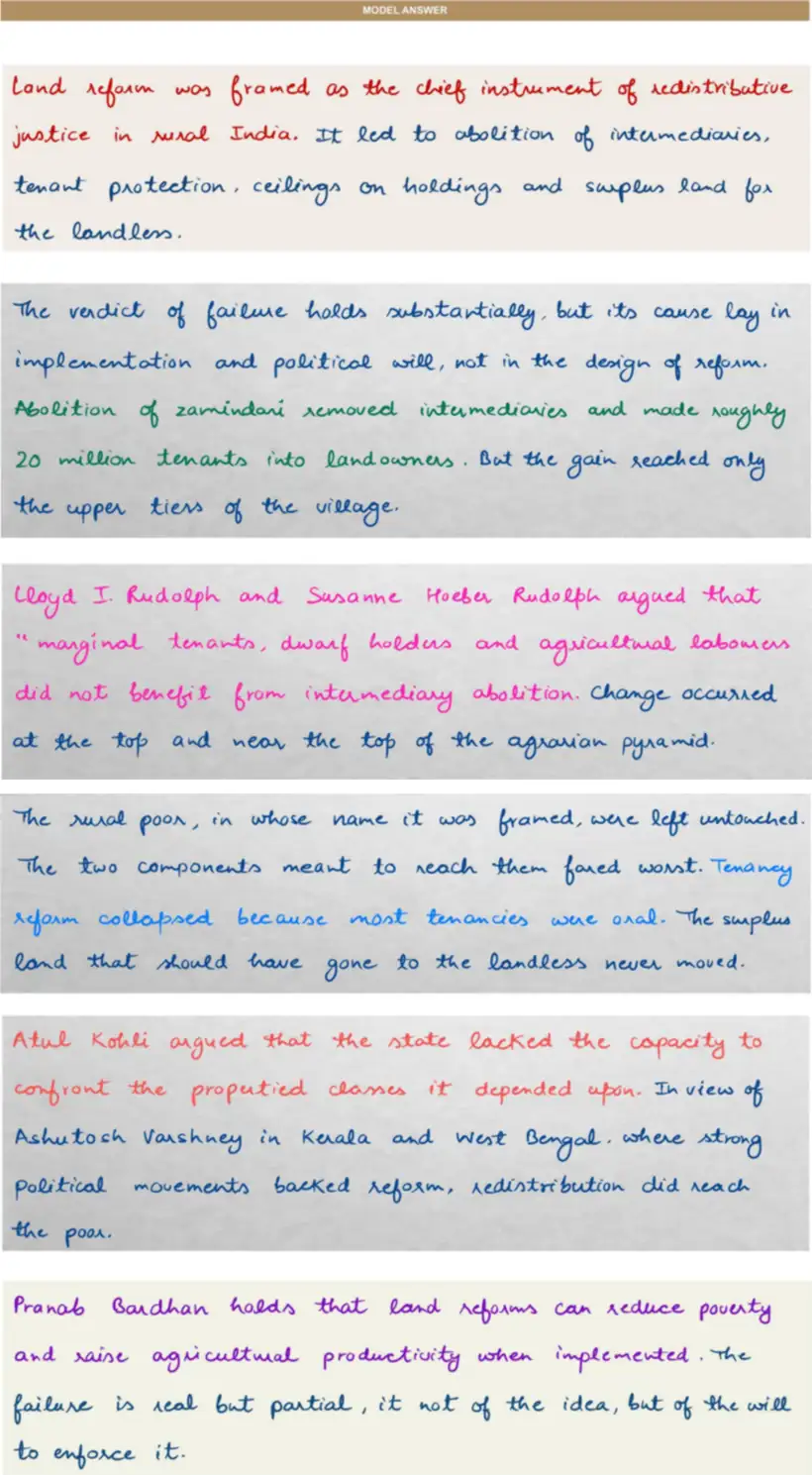
Model answer
Handwritten, in the form it would be written in the examination hall.
Also asked on this head
Planning and Economic Development — 16 questions in the Vault.
- Discuss the impact of liberalization on agriculture sector in India. (150 words)
- With reference to Nehruvian perspective of planning and economic development, examine how the early phase of economic planning in India has laid the foundation of modern...
- What explains India’s modest improvements in social development outcomes even as the rate of growth has accelerated since the initiation of economic reforms?
How this is taught
The same flow snapshot, built for every head of the syllabus, with the answer written in class.
The first session of Foundation 2027 is published in full.
Six programmes across three levels.