
Comment on the relevance of the Directive Principles of State Policy in an era of liberalization and globalization.
How the answer moves
The flow snapshot — the routes in, the body, the counter-view and the routes out.
Route 1 DPSP = Part IV, Arts 36–51 → Austin’s “conscience of the constitution” → liberalisation makes them more necessary, not redundant
Route 2 DPSP = welfare / social-justice directions to the state → post-1991 market shift puts their place in question → they gain relevance instead
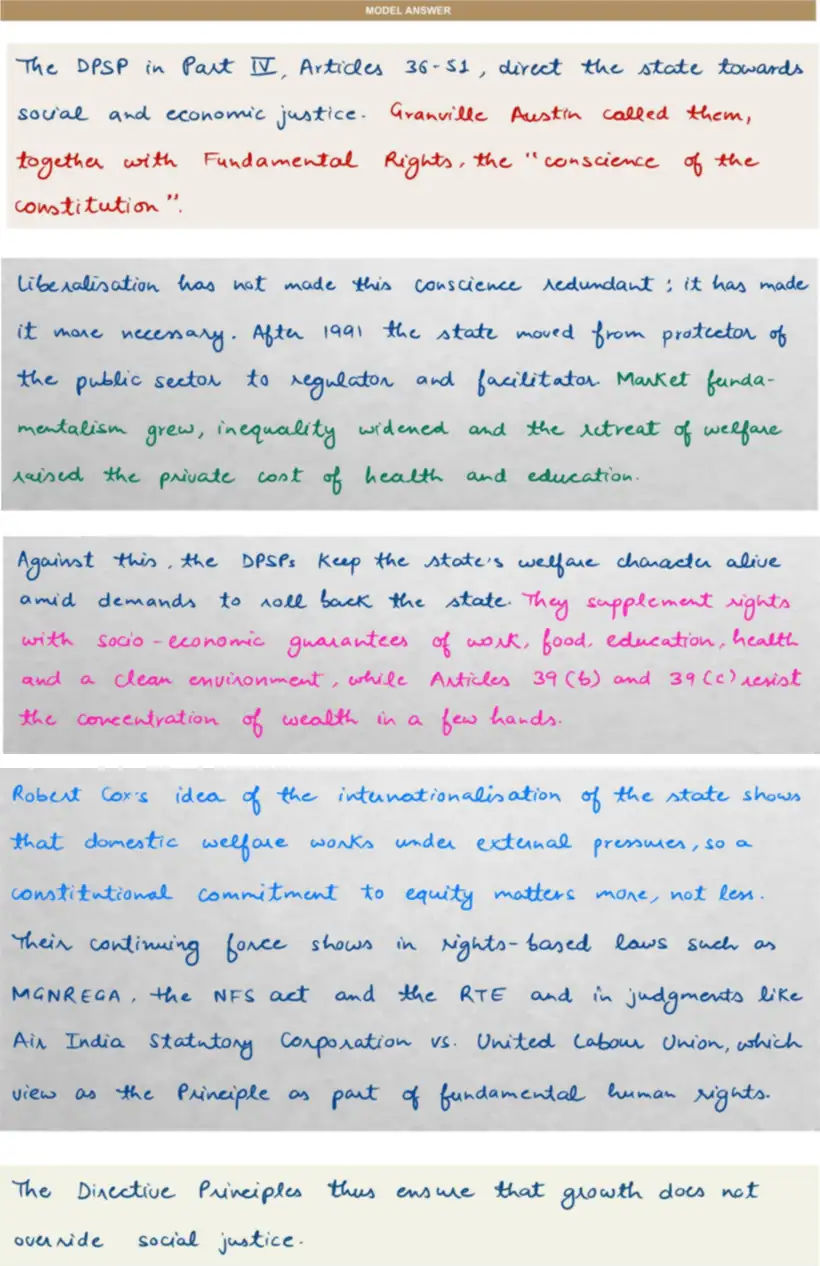
state after 1991: protector → regulator/facilitator → market fundamentalism + rising inequality + welfare retreat → DPSP hold welfare character against roll-back → supplement FRs with socio-economic guarantees (work, food, education, health, environment) → Arts 39(b)/39(c) resist wealth concentration → Cox’s internationalisation of the state → welfare under external pressure → equity matters more → proof in MGNREGA, NFSA, RTE + Air India Statutory Corporation v. United Labour Union (DPSP read as human rights)
market-fundamentalist call to “roll back the state” + welfare retrenchment → are DPSP outdated? → no: state’s retreat and widening inequality make the welfare compass more needed, not less
Route 1 DPSP ensure growth does not override social justice
Route 2 globalisation raises the stakes → DPSP keep a retreating, market-driven state tied to equity
Model answer
Handwritten, in the form it would be written in the examination hall.
Also asked on this head
Planning and Economic Development — 16 questions in the Vault.
- Discuss the impact of liberalization on agriculture sector in India. (150 words)
- With reference to Nehruvian perspective of planning and economic development, examine how the early phase of economic planning in India has laid the foundation of modern...
- What explains India’s modest improvements in social development outcomes even as the rate of growth has accelerated since the initiation of economic reforms?
How this is taught
The same flow snapshot, built for every head of the syllabus, with the answer written in class.
The first session of Foundation 2027 is published in full.
Six programmes across three levels.