
In the post-liberalization era, Indian politics is moving from ascriptive politics to developmental politics.
How the answer moves
The flow snapshot — the routes in, the body, the counter-view and the routes out.
Route 1 liberalisation brought development to the centre (jobs, growth, FDI, infrastructure, welfare) → shift real but partial
Route 2 earlier axis = caste / religion / region / birth → post-1991 economic issues now drive competition → movement incomplete
developmental turn → ideological dilution + growth agenda accepted → pocket-book voting → leaders judged on performance / inflation / jobs / welfare → turnout up, gender gap down → digital media diversifies information
ascription not gone → Kanchan Chandra: ethnicity modernised, not eliminated → caste + religious mobilisation, dynastic parties, weak representation of weaker sections, Sachar Committee
Route 1 developmental politics widened the agenda, but did not displace ascription
Route 2 shift = expansion and coexistence, not replacement
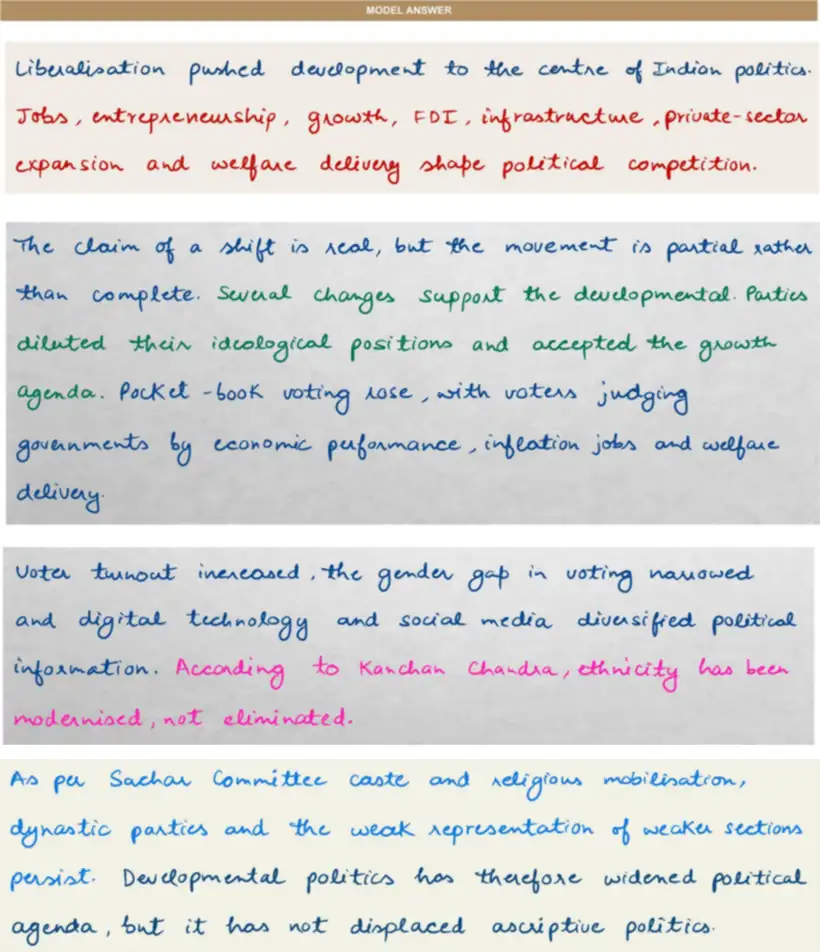
Model answer
Handwritten, in the form it would be written in the examination hall.
Also asked on this head
Planning and Economic Development — 16 questions in the Vault.
- Discuss the impact of liberalization on agriculture sector in India. (150 words)
- With reference to Nehruvian perspective of planning and economic development, examine how the early phase of economic planning in India has laid the foundation of modern...
- What explains India’s modest improvements in social development outcomes even as the rate of growth has accelerated since the initiation of economic reforms?
How this is taught
The same flow snapshot, built for every head of the syllabus, with the answer written in class.
The first session of Foundation 2027 is published in full.
Six programmes across three levels.