
The legacy of the Planning Commission still has a bearing on India’s development policies. Discuss.
How the answer moves
The flow snapshot — the routes in, the body, the counter-view and the routes out.
Route 1 Commission (1950) set state-led, long-term development template → form changed by NITI Aayog, inheritance intact
Route 2 planned development 1950–2014 defined India’s growth path → legacy outlives the institution
Five-Year Plans (1950–2014) → public sector, heavy industry, infrastructure, strategic sectors → Kothari: state authority consolidated, top-down → growth tied to land reform, poverty alleviation, social justice → Jalan & Sen: welfare, social indicators → Santhanam: centralisation weakened federalism, near-unitary functioning → Finance Commission overlap → Centre–state fiscal strain
Govinda Rao: relevance declined post-liberalisation → NITI Aayog: think tank, cooperative federalism, flexible bottom-up planning → legacy consciously reformed, not discarded
Route 1 shift is of method, not aim → state intervention, long-term strategy, welfare goals persist
Route 2 institution replaced, template inherited → legacy still bears on development policy
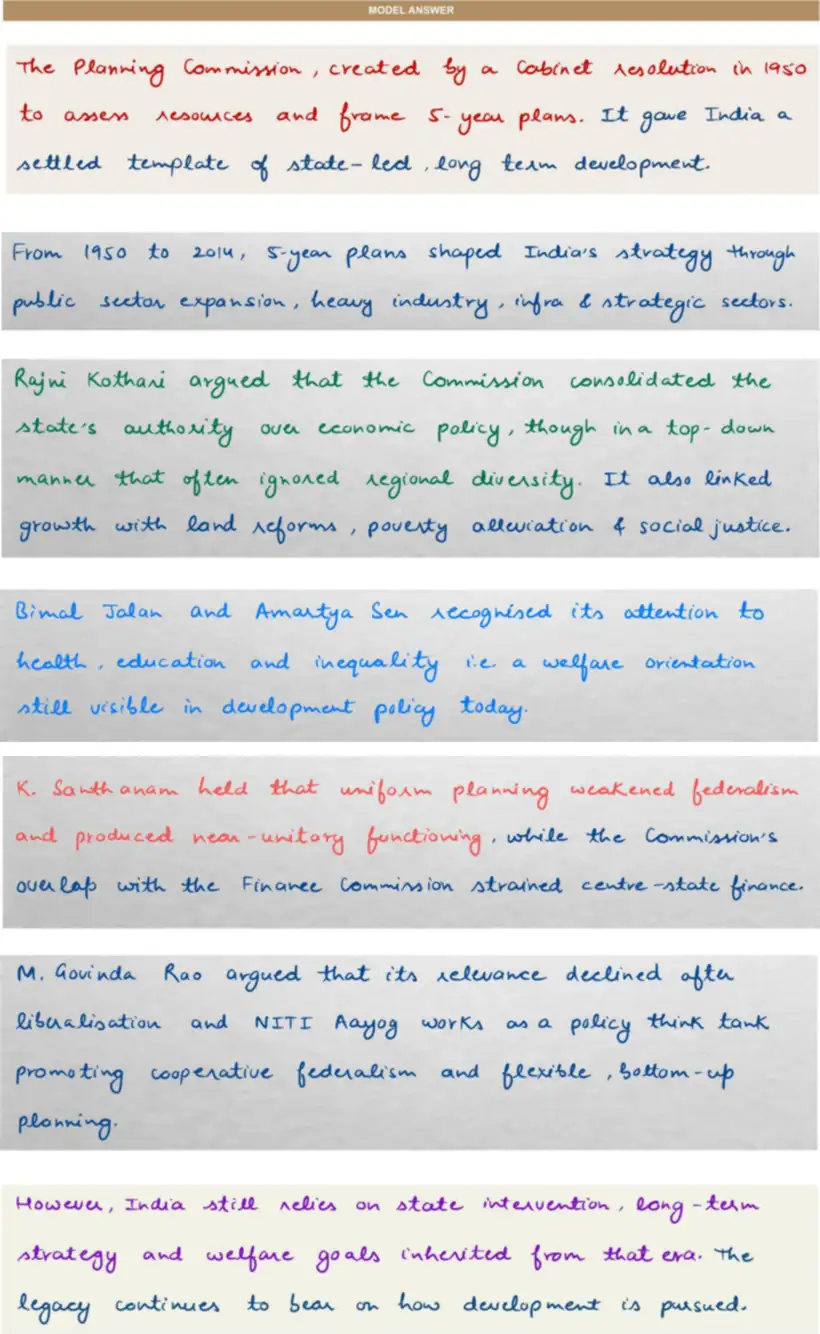
Model answer
Handwritten, in the form it would be written in the examination hall.
Also asked on this head
Planning and Economic Development — 16 questions in the Vault.
- Discuss the impact of liberalization on agriculture sector in India. (150 words)
- With reference to Nehruvian perspective of planning and economic development, examine how the early phase of economic planning in India has laid the foundation of modern...
- What explains India’s modest improvements in social development outcomes even as the rate of growth has accelerated since the initiation of economic reforms?
How this is taught
The same flow snapshot, built for every head of the syllabus, with the answer written in class.
The first session of Foundation 2027 is published in full.
Six programmes across three levels.