
What do you understand by Green Revolution? Do you think that a Second Green Revolution is needed to adequately address the agrarian challenges in contemporary India? Examine.
How the answer moves
The flow snapshot — the routes in, the body, the counter-view and the routes out.
Route 1 GR = HYV-seed + input + assured-price package (mid-1960s), Swaminathan/Borlaug → ‘begging bowl’ to ‘grain bowl’, self-sufficiency → but gains narrow, model now exhausted
Route 2 GR ended food scarcity and famine fear → yet its costs bred today’s distress → so the question is what kind of second revolution, not whether to repeat
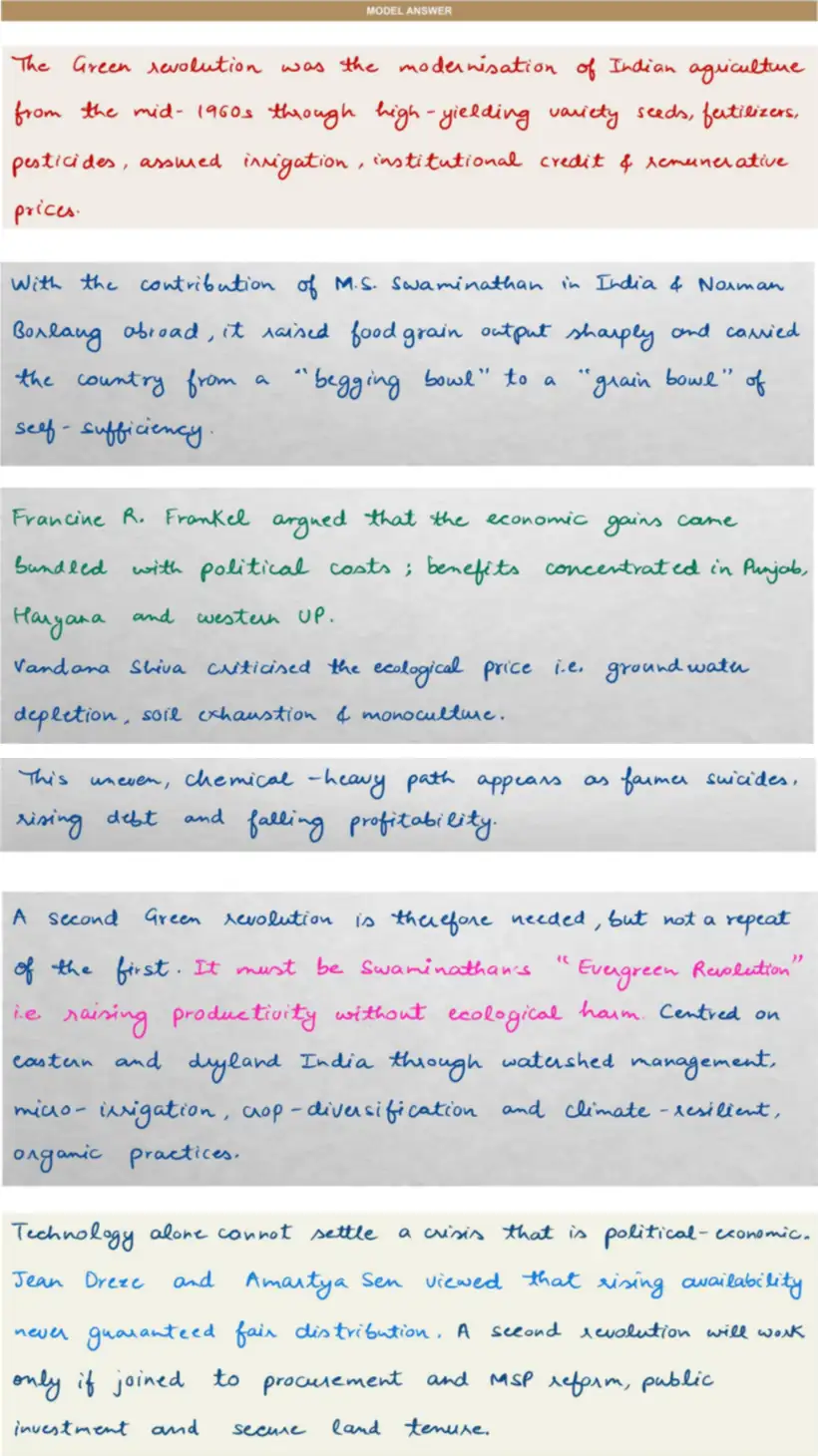
gains carried costs → Frankel: economic gains + political costs → regional imbalance (Punjab/Haryana/W-UP vs eastern + rainfed) → Shiva: ecological price (groundwater / soil / monoculture) → chemical-heavy path → today’s crisis (suicides, debt, low profitability) → SGR needed, not a repeat → Swaminathan’s “Evergreen Revolution”: productivity without ecological harm → eastern + dryland focus, watershed, micro-irrigation, diversification, climate-resilient / organic
technology alone cannot settle a political-economic crisis → Dreze & Sen: rising availability ≠ fair distribution
Route 1 yes, needed — but only as an Evergreen Revolution tied to procurement/MSP reform, public investment and secure land tenure → seeds alone insufficient
Route 2 a second revolution for eastern/rainfed India and sustainability, yet the crisis is political-economic → success rests on institutional reform, not technology alone
Model answer
Handwritten, in the form it would be written in the examination hall.
Also asked on this head
Planning and Economic Development — 16 questions in the Vault.
- Discuss the impact of liberalization on agriculture sector in India. (150 words)
- With reference to Nehruvian perspective of planning and economic development, examine how the early phase of economic planning in India has laid the foundation of modern...
- What explains India’s modest improvements in social development outcomes even as the rate of growth has accelerated since the initiation of economic reforms?
How this is taught
The same flow snapshot, built for every head of the syllabus, with the answer written in class.
The first session of Foundation 2027 is published in full.
Six programmes across three levels.