
High concentration of economic activities and consumption patterns in post-liberalisation period has
How the answer moves
The flow snapshot — the routes in, the body, the counter-view and the routes out.
Route 1 earlier mass base: Chipko / Appiko / NBA / Silent Valley → post-1991 base weakens
Route 2 liberalisation reorders priorities → growth placed over ecology → movements lose ground
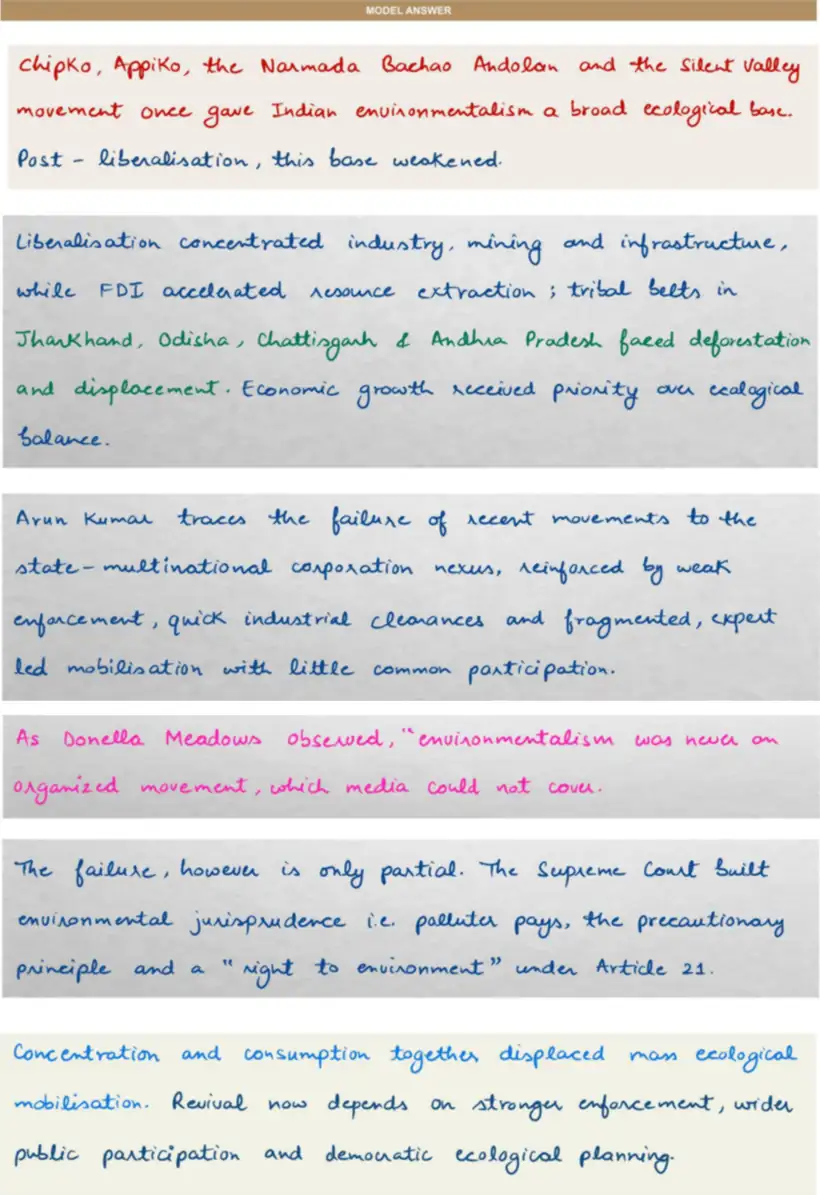
liberalisation concentrates industry / mining / infrastructure + FDI-driven extraction → tribal belts (Jharkhand / Odisha / Chhattisgarh / Andhra) → deforestation + displacement → growth prioritised over ecology → Arun Kumar: state–MNC nexus + weak enforcement + quick clearances + fragmented, expert-led mobilisation → consumption patterns: hyper-consumerism / food waste / rising Gini → Meadows: environmentalism never an organized movement, media can’t cover it
failure only partial → Supreme Court jurisprudence fills the gap → polluter pays / precautionary principle / Article 21 “right to environment”
Route 1 concentration + consumption together displaced mass ecological mobilisation
Route 2 revival needs stronger enforcement + wider public participation + democratic ecological planning
Model answer
Handwritten, in the form it would be written in the examination hall.
Also asked on this head
Planning and Economic Development — 16 questions in the Vault.
- Discuss the impact of liberalization on agriculture sector in India. (150 words)
- With reference to Nehruvian perspective of planning and economic development, examine how the early phase of economic planning in India has laid the foundation of modern...
- What explains India’s modest improvements in social development outcomes even as the rate of growth has accelerated since the initiation of economic reforms?
How this is taught
The same flow snapshot, built for every head of the syllabus, with the answer written in class.
The first session of Foundation 2027 is published in full.
Six programmes across three levels.