
Land reforms programmes led to some constitutional amendments. Comment.
How the answer moves
The flow snapshot — the routes in, the body, the counter-view and the routes out.
Route 1 land reforms to fix unequal agrarian structure at Independence → grounded in Art 39(b)/39(c) → challenged under fundamental right to property → drove amendments
Route 2 agrarian justice needed legal protection → reform laws challenged in court under property right → Constitution amended to shield them
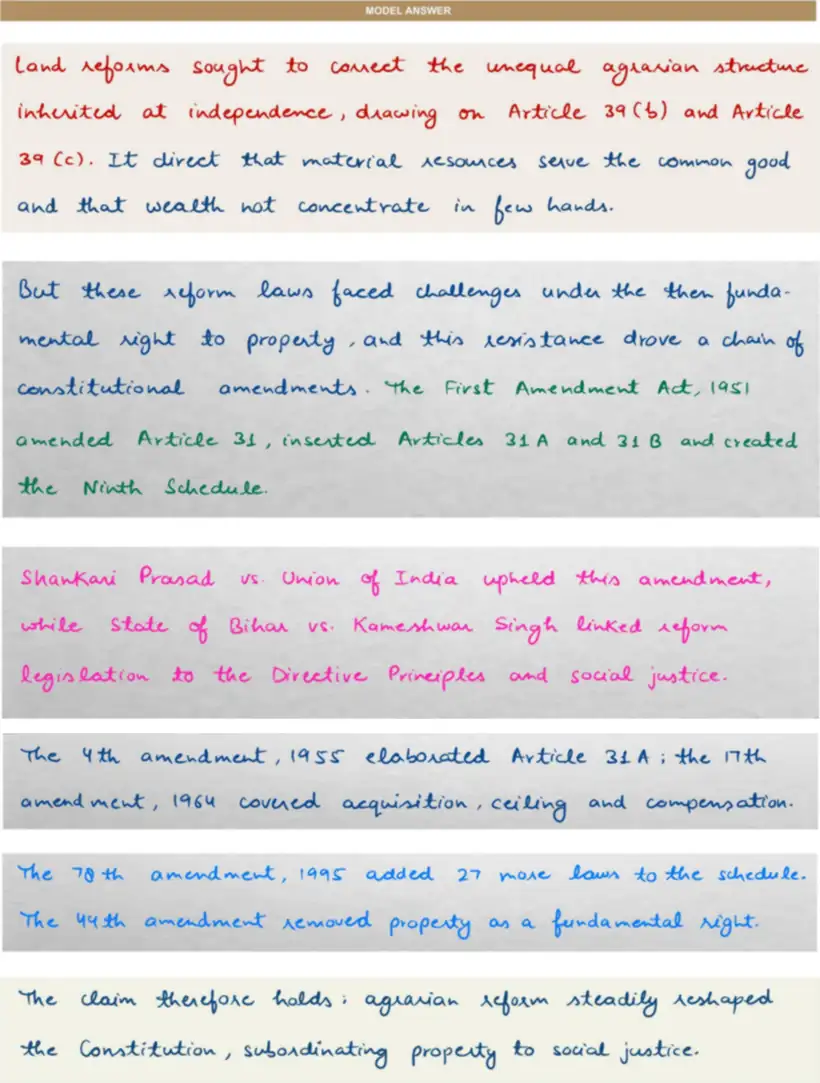
First Amendment 1951: Art 31 amended, Art 31A + 31B inserted, Ninth Schedule created, 13 state laws protected → Shankari Prasad upheld it → Kameshwar Singh linked reform to Directive Principles + social justice → Fourth Amendment 1955 elaborated Art 31A → Seventeenth Amendment 1964: acquisition, ceiling, compensation → Seventy-Eighth Amendment 1995: +27 laws to Ninth Schedule → Forty-Fourth Amendment removed property as a fundamental right
landholders’ fundamental right to property vs state’s Directive Principles and social justice → amendments settled the tension in favour of reform
Route 1 claim holds → agrarian reform steadily reshaped the Constitution
Route 2 property progressively subordinated to social justice → land reform a chief driver of early constitutional change
Model answer
Handwritten, in the form it would be written in the examination hall.
Also asked on this head
Planning and Economic Development — 16 questions in the Vault.
- Discuss the impact of liberalization on agriculture sector in India. (150 words)
- With reference to Nehruvian perspective of planning and economic development, examine how the early phase of economic planning in India has laid the foundation of modern...
- What explains India’s modest improvements in social development outcomes even as the rate of growth has accelerated since the initiation of economic reforms?
How this is taught
The same flow snapshot, built for every head of the syllabus, with the answer written in class.
The first session of Foundation 2027 is published in full.
Six programmes across three levels.