
How does NITI Aayog as a ‘policy think tank with shared vision visualize the reorganization of planning in India? Justify your answer.
How the answer moves
The flow snapshot — the routes in, the body, the counter-view and the routes out.
Route 1 2015: NITI Aayog replaces Planning Commission → not a renaming but a re-imagining of planning’s purpose
Route 2 “policy think tank with shared vision” → planning built with states, not handed down
change of role (Maira: allocation of money → persuasion of change) → change of method (shared vision of priorities with states/UTs → village plans aggregated upward → flexible, outcome- & evidence-based, data/indices/monitoring) → change of paradigm (Chimhowu: classical top-down → negotiation-based; NITI moves to second) → Mathew: name change → mind change
Balveer Arora: “imperfect clone” → federal bargaining reform incomplete → reorganisation real in design, partial in practice
Route 1 reorganisation = shift of role + method: allocator → persuader, command → shared vision
Route 2 paradigm genuinely reorganised, though fully cooperative planning still unfinished
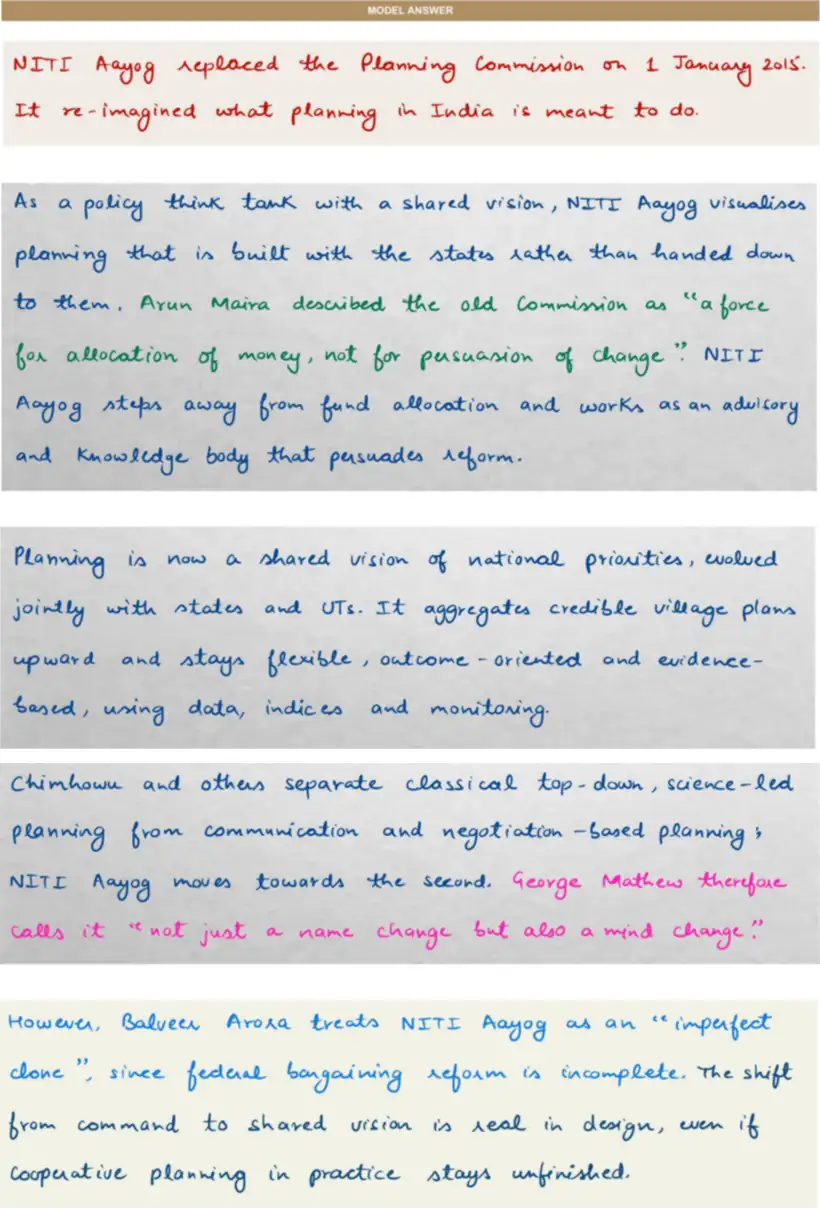
Model answer
Handwritten, in the form it would be written in the examination hall.
Also asked on this head
Planning and Economic Development — 16 questions in the Vault.
- Discuss the impact of liberalization on agriculture sector in India. (150 words)
- With reference to Nehruvian perspective of planning and economic development, examine how the early phase of economic planning in India has laid the foundation of modern...
- What explains India’s modest improvements in social development outcomes even as the rate of growth has accelerated since the initiation of economic reforms?
How this is taught
The same flow snapshot, built for every head of the syllabus, with the answer written in class.
The first session of Foundation 2027 is published in full.
Six programmes across three levels.