
The blueprint of Gram Swargaj is the key to understand the Gandhian perspective on planning. Discuss.
How the answer moves
The flow snapshot — the routes in, the body, the counter-view and the routes out.
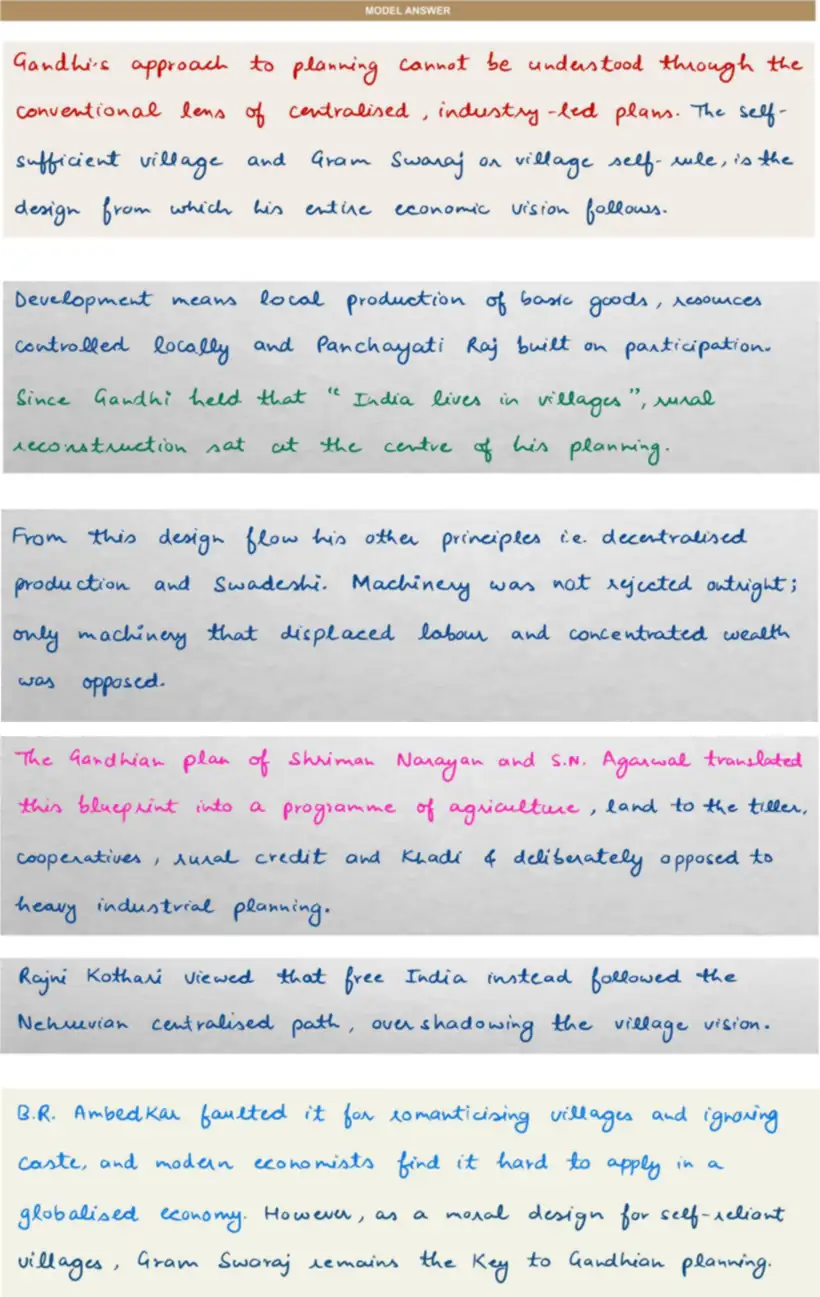
Route 1 Gandhian planning ≠ conventional centralised/industrial → self-sufficient village as the blueprint → begin here to read his planning
Route 2 Gram Swaraj = village self-rule → the master design from which his whole economic vision follows → hence the key
village as the primary unit (economy / politics / moral life) → local production + local resource control + Panchayati Raj, participation → “India lives in villages” → rural reconstruction at the centre → decentralisation / production by the masses (not mass production) / Swadeshi → machinery: only labour-displacing & wealth-concentrating opposed → Gandhian Plan (Narayan & Agarwal): agriculture, land to tiller, cooperatives, rural credit, khadi — against heavy industry → Kothari: free India took the Nehruvian centralised path, village vision overshadowed
Ambedkar: romanticises villages, ignores caste → modern economists: hard to apply in a globalised industrial economy
Route 1 not an industrial plan but a moral design for self-reliant villages → Gram Swaraj the interpretive key
Route 2 limits notwithstanding → the village republic remains the lens for reading Gandhian planning
Model answer
Handwritten, in the form it would be written in the examination hall.
Also asked on this head
Planning and Economic Development — 16 questions in the Vault.
- Discuss the impact of liberalization on agriculture sector in India. (150 words)
- With reference to Nehruvian perspective of planning and economic development, examine how the early phase of economic planning in India has laid the foundation of modern...
- What explains India’s modest improvements in social development outcomes even as the rate of growth has accelerated since the initiation of economic reforms?
How this is taught
The same flow snapshot, built for every head of the syllabus, with the answer written in class.
The first session of Foundation 2027 is published in full.
Six programmes across three levels.