
The changing socio-economic profile of our legislators does not augur well for the health of Indian democracy. Comment.
How the answer moves
The flow snapshot — the routes in, the body, the counter-view and the routes out.
Route 1 Burke’s microcosm = the yardstick → judge the change against it → verdict: social gain, economic-criminal danger
Route 2 “does not augur well” only half-true → social widening deepens democracy; money + crime weaken its quality
widening recruitment pool → OBC / backward-caste entry ends upper-caste + lawyer + foreign-educated dominance → Yadav: plebeianization / democratic upsurge → House nearer Burke’s microcosm → but presence ≠ responsiveness for lower orders → upper castes still over-represented, women ~14%, Muslims below share → turn to economic-criminal profile → crorepati dominance (93% above ₹1 cr) → wealth filters entry → ADR: ~46% of 18th LS face criminal cases → Vaishnav (When Crime Pays): costly elections + local problem-solvers → SC: termite to democracy
against the pessimism → social broadening is a genuine democratic gain (microcosm met, Yadav’s upsurge) → threat lies not in who enters but in money + crime
Route 1 statement half-true → social broadening augurs well; money-and-crime capture does not
Route 2 keep the widening, curb the muscle + money that distort it → representation must become responsiveness
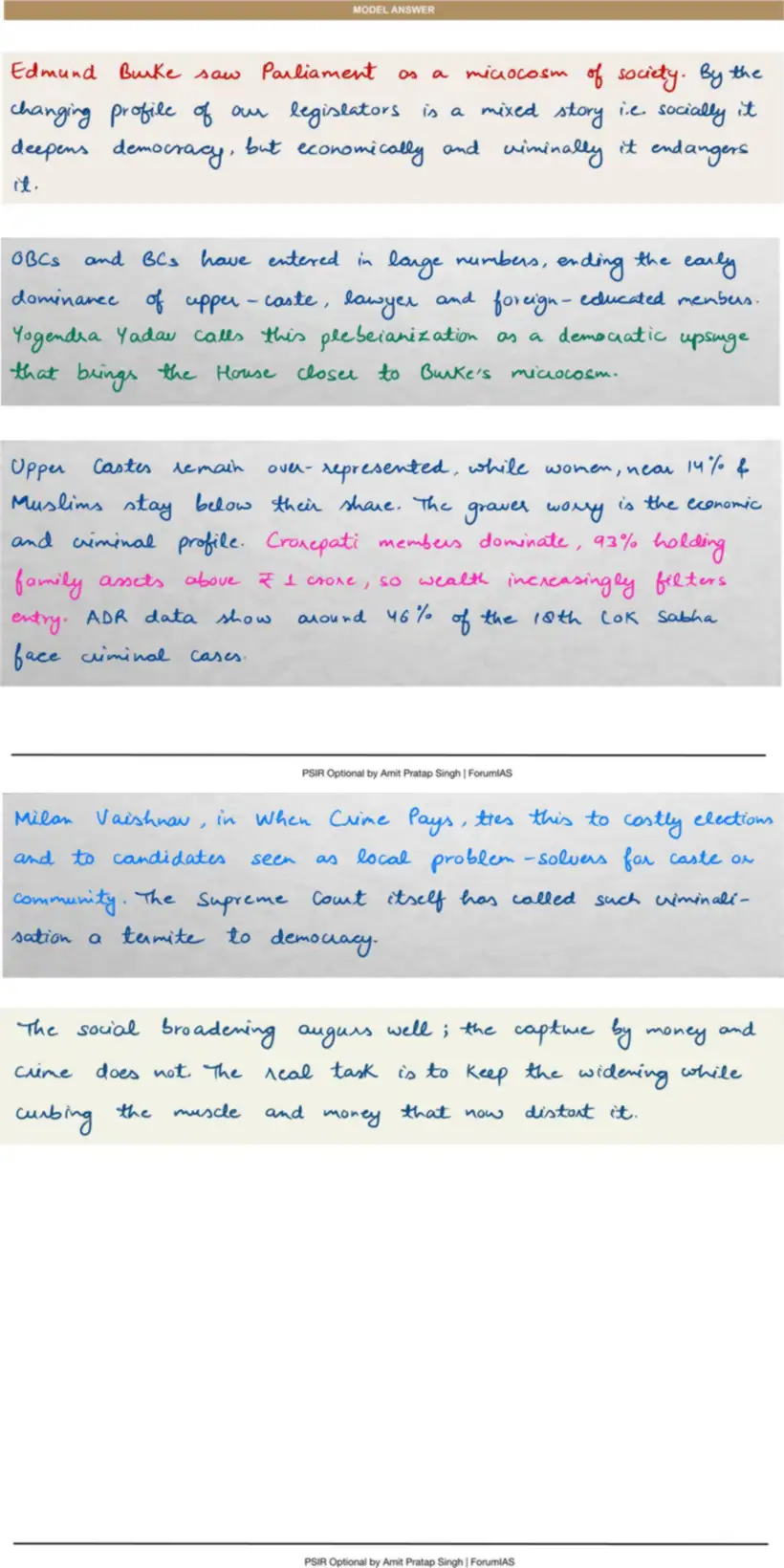
Model answer
Handwritten, in the form it would be written in the examination hall.
Also asked on this head
Party System — 18 questions in the Vault.
- Elucidate the prominent trends in voting behaviour in contemporary India, and discuss how astroturfing affects the scenario.
- When there are multiple stakeholders of power, conversation and consensus become the natural ingredients of governance. Analyze with respect to coalition politics.
- Critically assess the role of pressure groups in the decision-making process of the government.
How this is taught
The same flow snapshot, built for every head of the syllabus, with the answer written in class.
The first session of Foundation 2027 is published in full.
Six programmes across three levels.