
Electoral behaviour of voters is governed more by the social and economic factors than the political factors. Explain.
How the answer moves
The flow snapshot — the routes in, the body, the counter-view and the routes out.
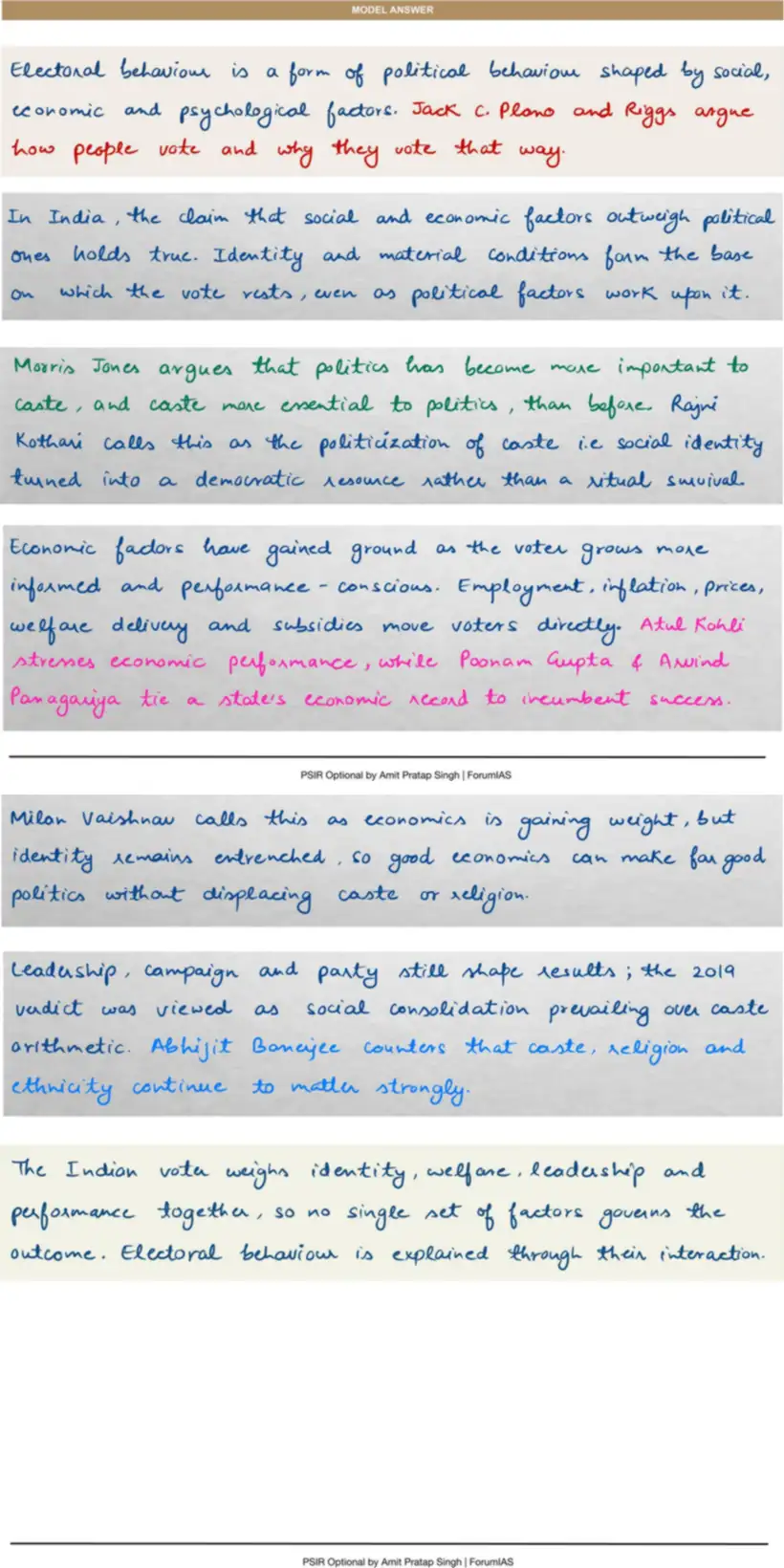
Route 1 define electoral behaviour (Plano & Riggs) → social + economic form the base, political works upon it
Route 2 claim holds substantially → identity + material conditions anchor the vote
social factors deepest (caste / religion / region → Morris Jones: caste–politics reciprocity → Kothari’s politicization of caste) → economic factors rising (informed, performance-conscious voter → jobs / inflation / welfare → Kohli, Gupta & Panagariya → Vaishnav: economics up, identity entrenched) → political factors not passive (leadership / campaign → 2019 social consolidation over caste arithmetic)
Banerjee: caste, religion, ethnicity still matter strongly → economics has not displaced identity
Route 1 no single set governs → interaction decides
Route 2 voter weighs identity + welfare + leadership + performance together → claim partly true; interaction the truer reading
Model answer
Handwritten, in the form it would be written in the examination hall.
Also asked on this head
Party System — 18 questions in the Vault.
- Elucidate the prominent trends in voting behaviour in contemporary India, and discuss how astroturfing affects the scenario.
- When there are multiple stakeholders of power, conversation and consensus become the natural ingredients of governance. Analyze with respect to coalition politics.
- Critically assess the role of pressure groups in the decision-making process of the government.
How this is taught
The same flow snapshot, built for every head of the syllabus, with the answer written in class.
The first session of Foundation 2027 is published in full.
Six programmes across three levels.