
The decision to conduct Population Census-2027 has
How the answer moves
The flow snapshot — the routes in, the body, the counter-view and the routes out.
Route 1 delimitation not routine → sets each state’s Lok Sabha share → decides who holds power in a federation
Route 2 decades-long freeze on seats → 2027 census lifts it → contest is population vs federal trust
delimitation = boundaries + seat distribution → Commissions 1952 / 1963 / 1973 / 2002 → 42nd + 84th Amendment freeze (until first census after 2026) → seats fixed while population grew → disparities: North grew faster, large + urban constituencies, unequal vote value, heavy service burden → 2027 turns it political → North may gain / South fears penalty for population control → reserved seats + women’s reservation recalibrated → fairness reaches within states, not just across them
strict democratic equality (seats track population) vs federal trust + unfairness of penalising states that met a national goal
Route 1 balance democratic equality, federal trust and population justice
Route 2 let representation follow population without breaking federal trust
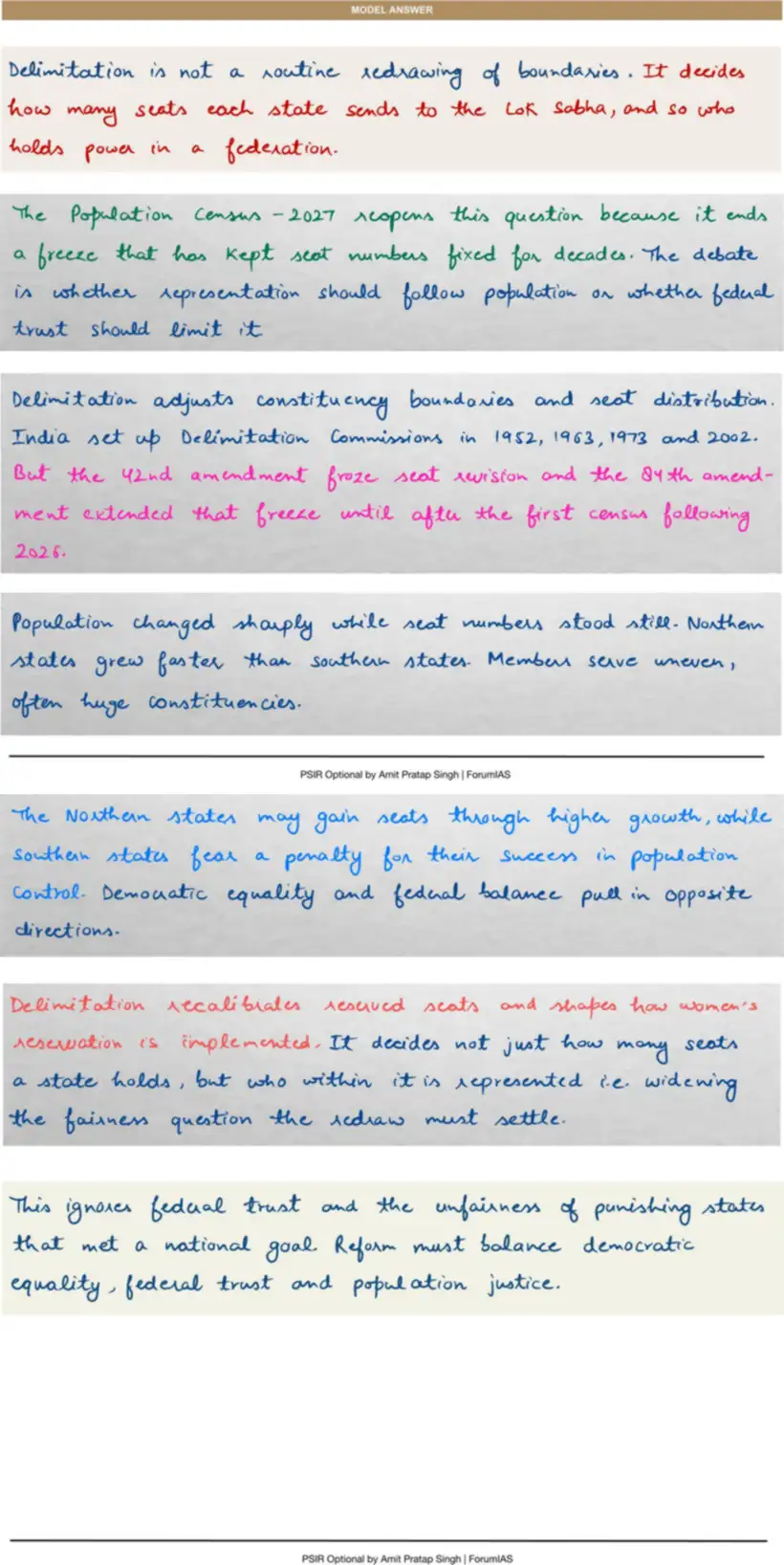
Model answer
Handwritten, in the form it would be written in the examination hall.
Also asked on this head
Party System — 18 questions in the Vault.
- Elucidate the prominent trends in voting behaviour in contemporary India, and discuss how astroturfing affects the scenario.
- When there are multiple stakeholders of power, conversation and consensus become the natural ingredients of governance. Analyze with respect to coalition politics.
- Critically assess the role of pressure groups in the decision-making process of the government.
How this is taught
The same flow snapshot, built for every head of the syllabus, with the answer written in class.
The first session of Foundation 2027 is published in full.
Six programmes across three levels.