
To what extent has the inadequate intra-party democracy affected the functioning of Indian democracy?
How the answer moves
The flow snapshot — the routes in, the body, the counter-view and the routes out.
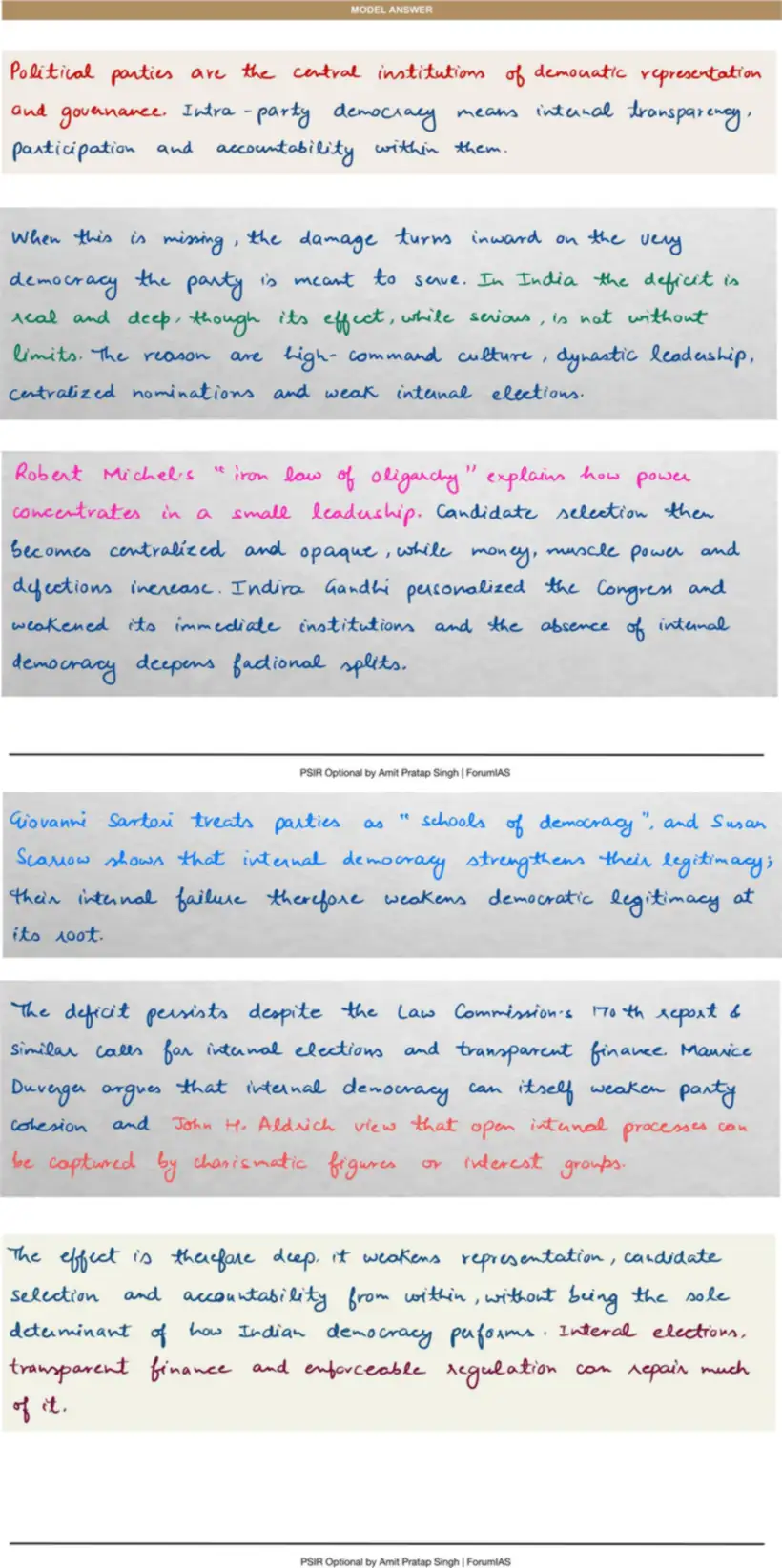
Route 1 parties = core of representation & governance → intra-party democracy = transparency / participation / accountability → its absence turns the damage inward
Route 2 in India the deficit is real and deep → but “to what extent” → serious, yet not without limits (stake the degree)
structural problem set (high-command, dynasty, centralized nominations, weak internal elections) → Michels “iron law of oligarchy” → opaque candidate selection + money / muscle / defections → personalization (Indira → Congress, intermediate institutions weakened) → factional splits → why it matters: Sartori “schools of democracy” + Scarrow legitimacy → internal failure erodes democratic legitimacy → weak regulation (Section 29A, RPA) → reform calls (Law Commission 170th Report, internal elections, transparent finance)
internal democracy is not costless → Duverger (weakens cohesion) + Aldrich (capture by charismatic leaders / interest groups) → the deficit alone cannot carry all the blame
Route 1 deep but not total → weakens representation / candidate selection / accountability from within, not the sole determinant of performance
Route 2 reform path → internal elections + transparent finance + enforceable regulation repairs much of it
Model answer
Handwritten, in the form it would be written in the examination hall.
Also asked on this head
Party System — 18 questions in the Vault.
- Elucidate the prominent trends in voting behaviour in contemporary India, and discuss how astroturfing affects the scenario.
- When there are multiple stakeholders of power, conversation and consensus become the natural ingredients of governance. Analyze with respect to coalition politics.
- Critically assess the role of pressure groups in the decision-making process of the government.
How this is taught
The same flow snapshot, built for every head of the syllabus, with the answer written in class.
The first session of Foundation 2027 is published in full.
Six programmes across three levels.