
Comment on the emergence of Backward classes in the Indian Politics.
How the answer moves
The flow snapshot — the routes in, the body, the counter-view and the routes out.
Route 1 Backward Class rise = Kothari’s “politicisation of caste” → social presence turned into bargaining power
Route 2 emergence read as democratic upsurge → representation widens, but unevenly
socio-economic roots: zamindari abolition + Green Revolution → intermediate peasant castes → Rudolph “bullock capitalists” → two channels: Charan Singh kisan politics / Lohia quota politics → Karpoori Thakur, Janata Dal → Mandal 27% → V.P. Singh 1990 → Jaffrelot “silent revolution” (leaders from own milieu)
OBCs not cohesive → Yadav dominance vs MBC exclusion → Hindu nationalism as competing identity → BJP social engineering absorbs non-dominant OBCs
Route 1 Kaviraj: hierarchy of castes → “democracy of castes”
Route 2 representation widened, justice still pending
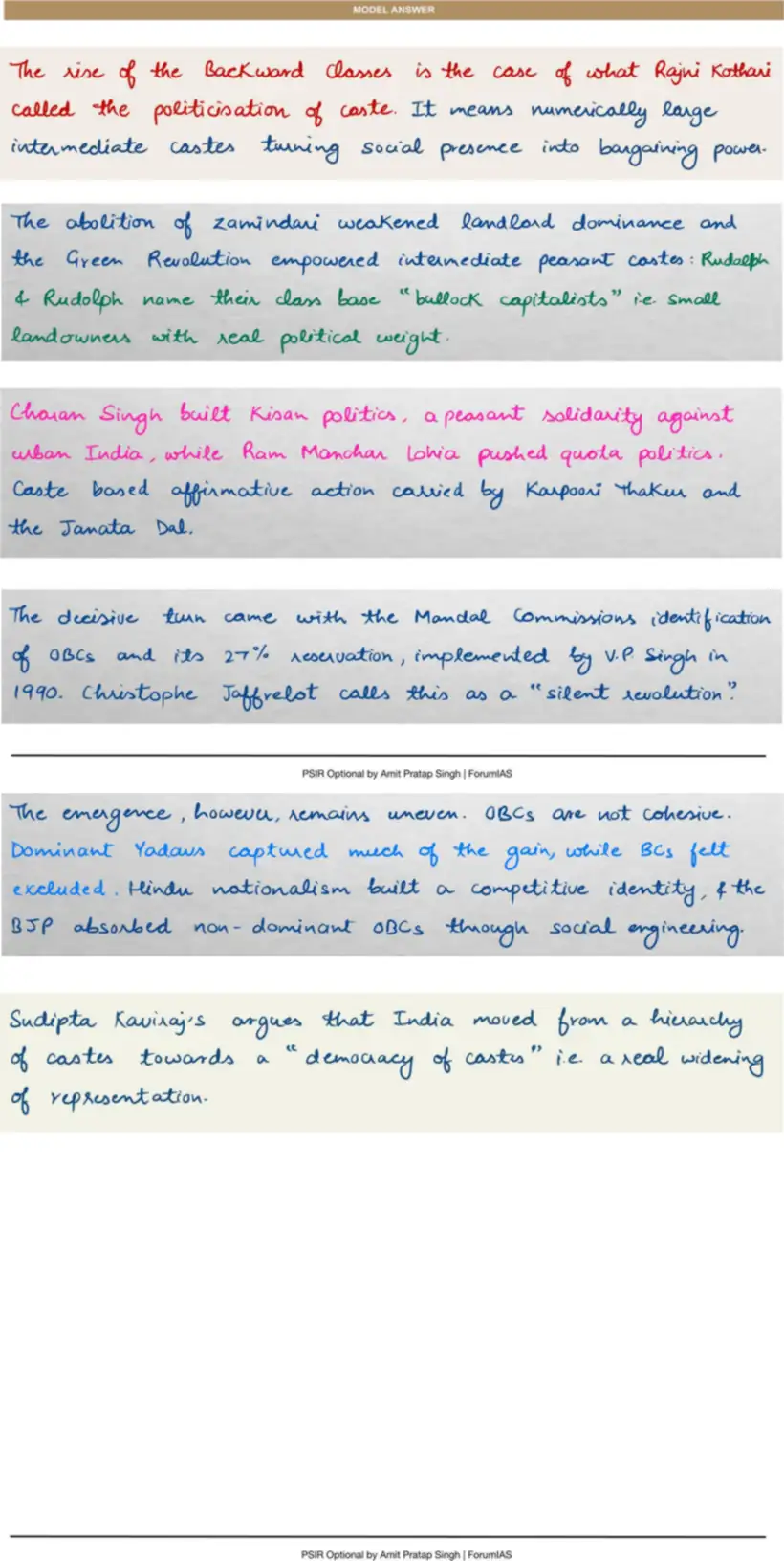
Model answer
Handwritten, in the form it would be written in the examination hall.
Also asked on this head
Party System — 18 questions in the Vault.
- Elucidate the prominent trends in voting behaviour in contemporary India, and discuss how astroturfing affects the scenario.
- When there are multiple stakeholders of power, conversation and consensus become the natural ingredients of governance. Analyze with respect to coalition politics.
- Critically assess the role of pressure groups in the decision-making process of the government.
How this is taught
The same flow snapshot, built for every head of the syllabus, with the answer written in class.
The first session of Foundation 2027 is published in full.
Six programmes across three levels.