
The decade 1989-1999 has created an epochal shift in the Indian party system at the national level. Identify the major national trends in the party system during this era.
How the answer moves
The flow snapshot — the routes in, the body, the counter-view and the routes out.
Route 1 1989 ends Kothari’s “Congress System” → M. P. Singh’s federal coalition phase opens
Route 2 epochal shift = one passage, single-party dominance → coalition order; trends read as its facets
end of Congress dominance → fragmented mandate (National Front / V. P. Singh 1989, minority & short-lived govts) → Mandal 1990 → OBC / social-justice base → Babri demolition + Hindutva → BJP as national alternative → regional parties central (United Front / Deve Gowda–Gujral) → 1991 liberalization changes agenda
coalitions not new + instability till 1999 → “epochal rupture” claim qualified
Route 1 shift epochal as durable arrival of federal coalition politics
Route 2 less a sudden break, more a churn that stabilises at the decade’s close (1999 NDA)
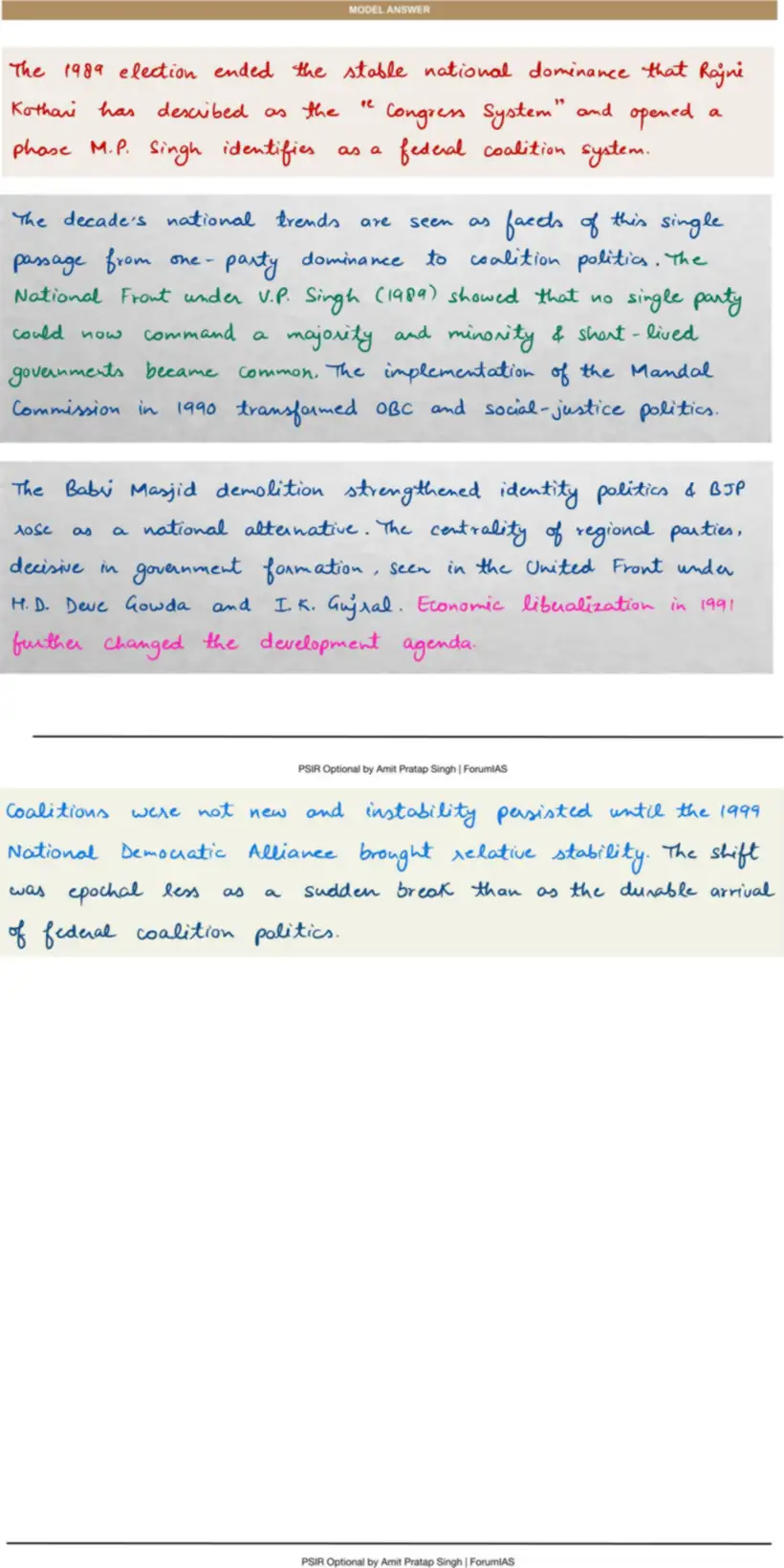
Model answer
Handwritten, in the form it would be written in the examination hall.
Also asked on this head
Party System — 18 questions in the Vault.
- Elucidate the prominent trends in voting behaviour in contemporary India, and discuss how astroturfing affects the scenario.
- When there are multiple stakeholders of power, conversation and consensus become the natural ingredients of governance. Analyze with respect to coalition politics.
- Critically assess the role of pressure groups in the decision-making process of the government.
How this is taught
The same flow snapshot, built for every head of the syllabus, with the answer written in class.
The first session of Foundation 2027 is published in full.
Six programmes across three levels.