
Neo-liberalism lightened neo-realism’s dark view of international politics. Comment.
How the answer moves
The flow snapshot — the routes in, the body, the counter-view and the routes out.
Route 1 shared premise: anarchy + rational states → opposite verdicts on cooperation → claim holds: same start, minus the pessimism
Route 2 neo-realism asks “how to survive” → neo-liberalism asks “how to cooperate” → same anarchy, softer reading
Waltz: structure = anarchy + distribution of capabilities → survival central → cooperation blocked by insecurity (intentions unverifiable) + relative gains → Mearsheimer: institutions reflect power, war a constant risk → neo-liberalism accepts anarchy, denies it is determinative → absolute gains → economic interdependence (Keohane & Nye) → institutions: share information, cut transaction costs, enable reciprocity → mitigate cheating → states pool resources, cede some sovereignty
Grieco: states still weigh relative gains (“who will gain more?”) → the lightening is only partial
Route 1 gap narrows into a Neo-Neo Synthesis → dark view softened, not dispelled
Route 2 institutions soften but do not abolish the security dilemma → neo-liberalism lightens the darkness rather than removing it
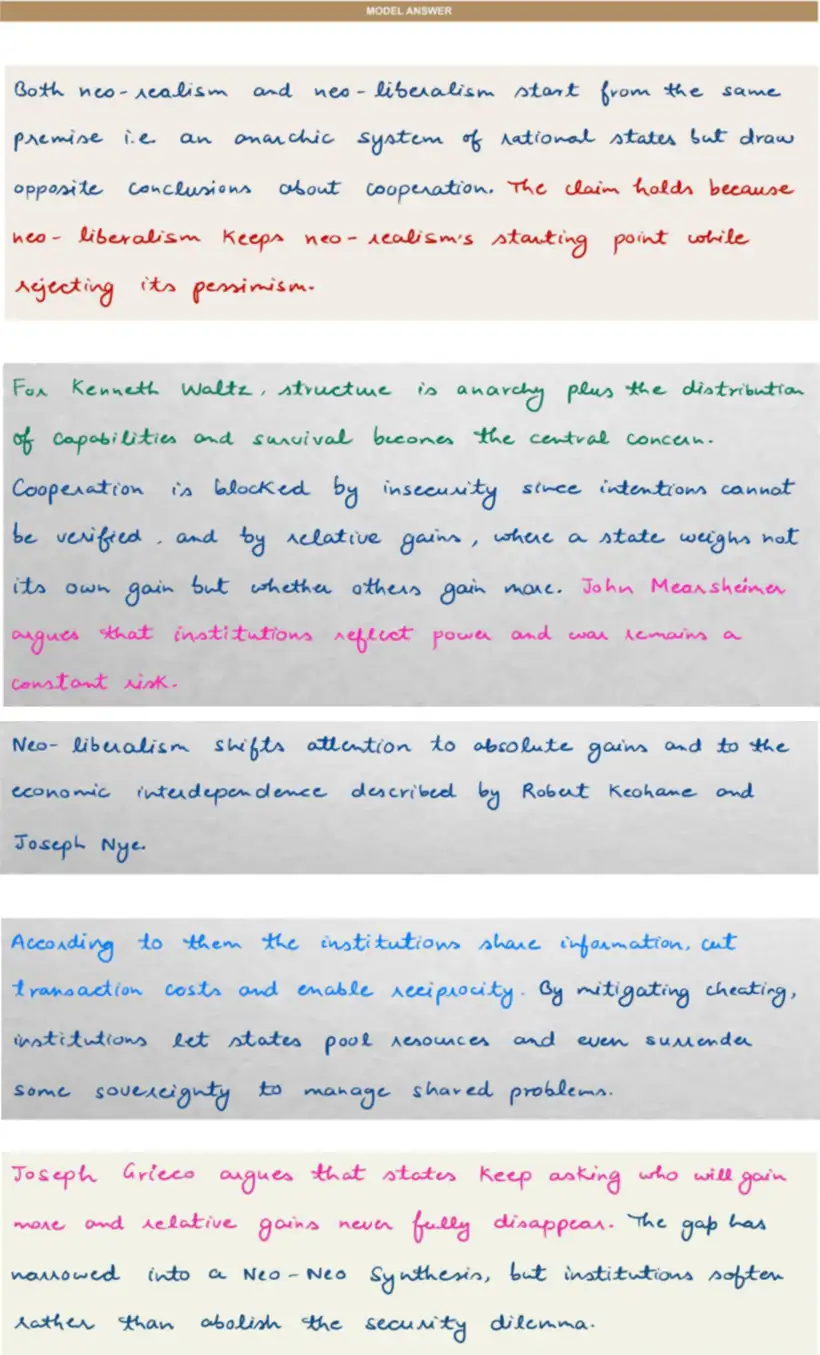
Model answer
Handwritten, in the form it would be written in the examination hall.
Also asked on this head
Approaches to the Study of International Relations — 18 questions in the Vault.
- Theories of international relations which claim objectivity inevitably harbour subjective biases. Elucidate.
- What role does identity and technology play in the conceptualisation of Defensive realism? (150 words)
- “The Gramscian theory of hegemony provides many valuable insights into the nature of global power.” Comment.
How this is taught
The same flow snapshot, built for every head of the syllabus, with the answer written in class.
The first session of Foundation 2027 is published in full.
Six programmes across three levels.