
In what ways does the functionalist approach in international relations help in maintaining peace and order in global politics?
How the answer moves
The flow snapshot — the routes in, the body, the counter-view and the routes out.
Route 1 high politics keeps failing to secure peace → Mitrany’s “peace by pieces” → order built from below, not imposed
Route 2 peace as the outcome of cooperation on shared needs → function precedes politics
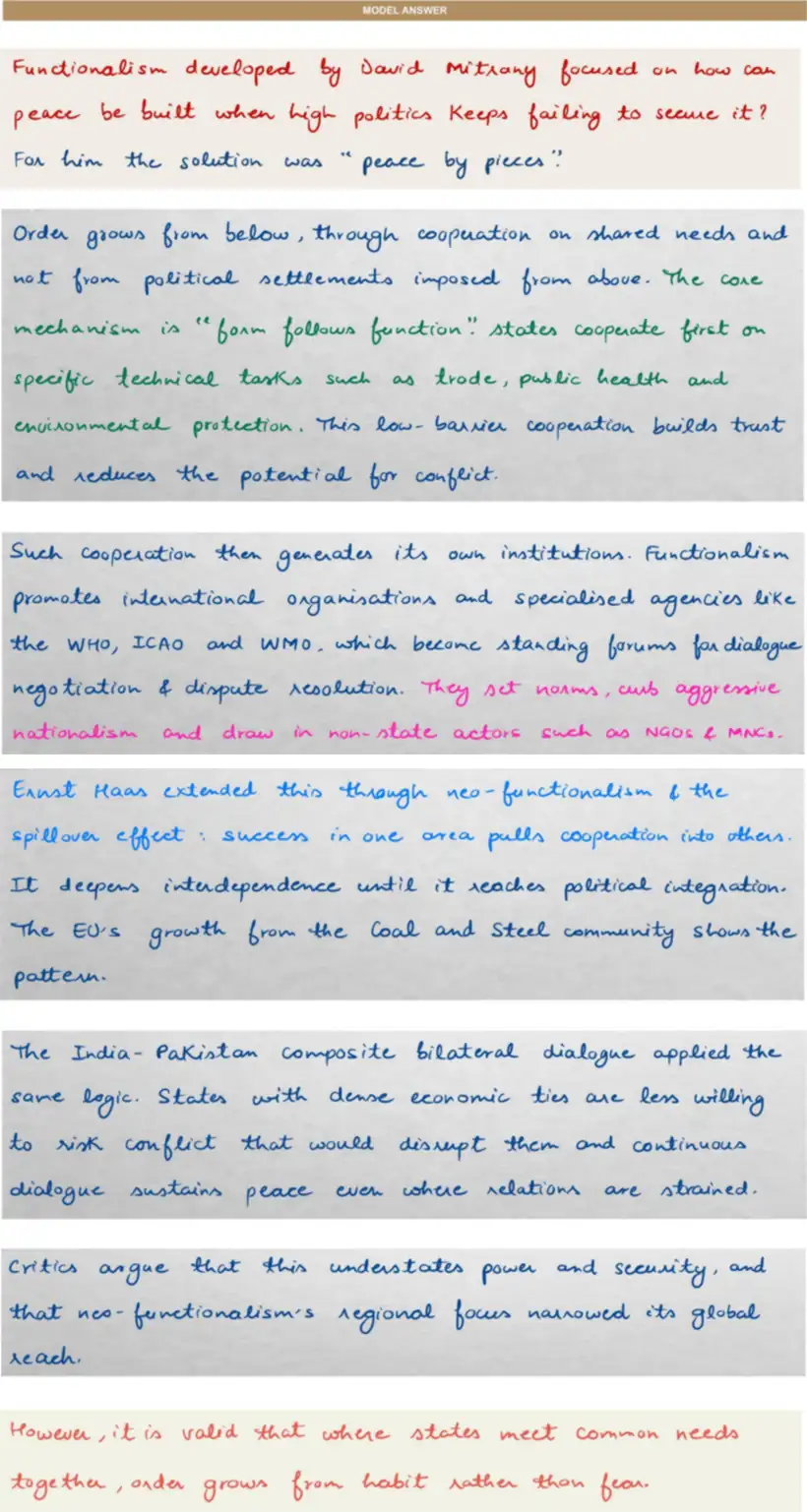
“form follows function” → cooperate first on technical tasks (trade / health / environment), done better together → trust built, conflict-potential reduced, expert-led start on least-contested ground → cooperation generates institutions → IOs + specialised agencies (WHO / ICAO / WMO) as forums for dialogue, negotiation, dispute resolution → norm-setting, aggressive nationalism curbed, non-state actors (NGOs / MNCs), wider global identity → Haas: neo-functionalism + spillover → interdependence deepens → political integration → EU (Coal & Steel), India–Pakistan Composite Dialogue → dense economic ties deter conflict → continuous dialogue sustains peace despite strained relations
understates power and security → neo-functionalism’s regional focus narrows global reach
Route 1 insight holds: shared needs met together → order from habit, not fear
Route 2 peace grown through function, not imposed by design
Model answer
Handwritten, in the form it would be written in the examination hall.
Also asked on this head
Approaches to the Study of International Relations — 18 questions in the Vault.
- Theories of international relations which claim objectivity inevitably harbour subjective biases. Elucidate.
- What role does identity and technology play in the conceptualisation of Defensive realism? (150 words)
- “The Gramscian theory of hegemony provides many valuable insights into the nature of global power.” Comment.
How this is taught
The same flow snapshot, built for every head of the syllabus, with the answer written in class.
The first session of Foundation 2027 is published in full.
Six programmes across three levels.