
What are the core assumptions of idealism as an approach to study international relations? Explain its continuing relevance in peace building.
How the answer moves
The flow snapshot — the routes in, the body, the counter-view and the routes out.
Route 1 interwar liberal thought = idealism → Enlightenment faith: humans rational, world reformable → war removable, peace reachable
Route 2 idealist optimism vs realist pessimism → good nature + shared interests → these very premises still drive peace-building
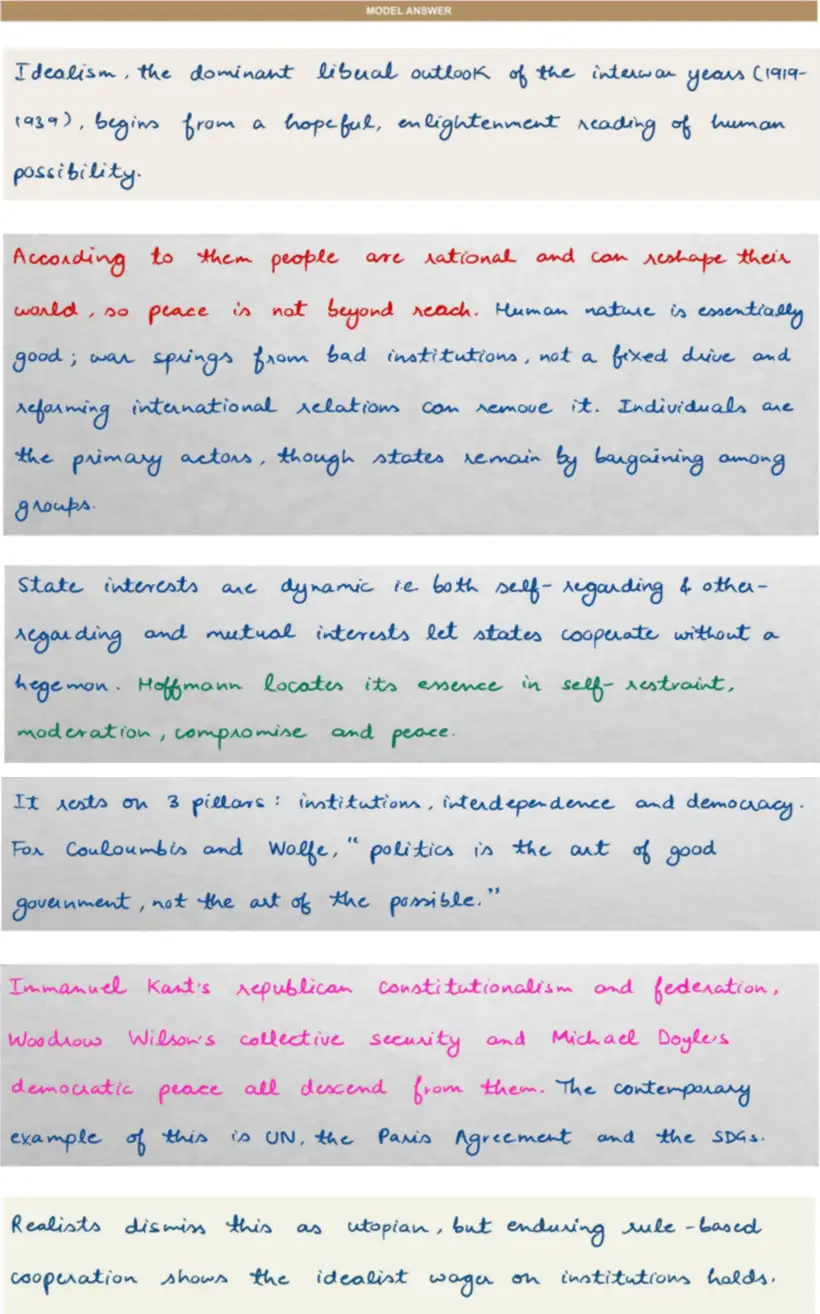
human nature good → war from bad institutions, not fixed drive → reform removes it → individuals primary, states pluralistic (group bargaining) → interests dynamic (self- + other-regarding) → mutual interests → cooperation without a hegemon → Hoffmann: self-restraint / moderation / compromise / peace → three pillars (institutions, interdependence, democracy) → Couloumbis & Wolfe: “art of good government” → pillars carried into practice → Kant (republican constitutionalism + federation) → Wilson (collective security) → Doyle (democratic peace) → contemporary survival: UN, Paris Agreement, SDGs
realists brand idealism utopian → its harmony-of-interests optimism doubted
Route 1 assumptions are no utopian relic → enduring rule-based cooperation vindicates the institutional wager
Route 2 idealism survives as the working logic of institution-based peace — sharpened by realism, not defeated by it
Model answer
Handwritten, in the form it would be written in the examination hall.
Also asked on this head
Approaches to the Study of International Relations — 18 questions in the Vault.
- Theories of international relations which claim objectivity inevitably harbour subjective biases. Elucidate.
- What role does identity and technology play in the conceptualisation of Defensive realism? (150 words)
- “The Gramscian theory of hegemony provides many valuable insights into the nature of global power.” Comment.
How this is taught
The same flow snapshot, built for every head of the syllabus, with the answer written in class.
The first session of Foundation 2027 is published in full.
Six programmes across three levels.