
“Marxist approach to the study of international relations has lost its relevance in the post-cold war era. Comment.
How the answer moves
The flow snapshot — the routes in, the body, the counter-view and the routes out.
Route 1 Marxism as class/capital (IPE) lens → anti-imperialism + core–periphery → predicted collapse never came → decline thesis has force
Route 2 post-Cold War liberal triumph → socialism abandoned in practice → is class analysis still usable?
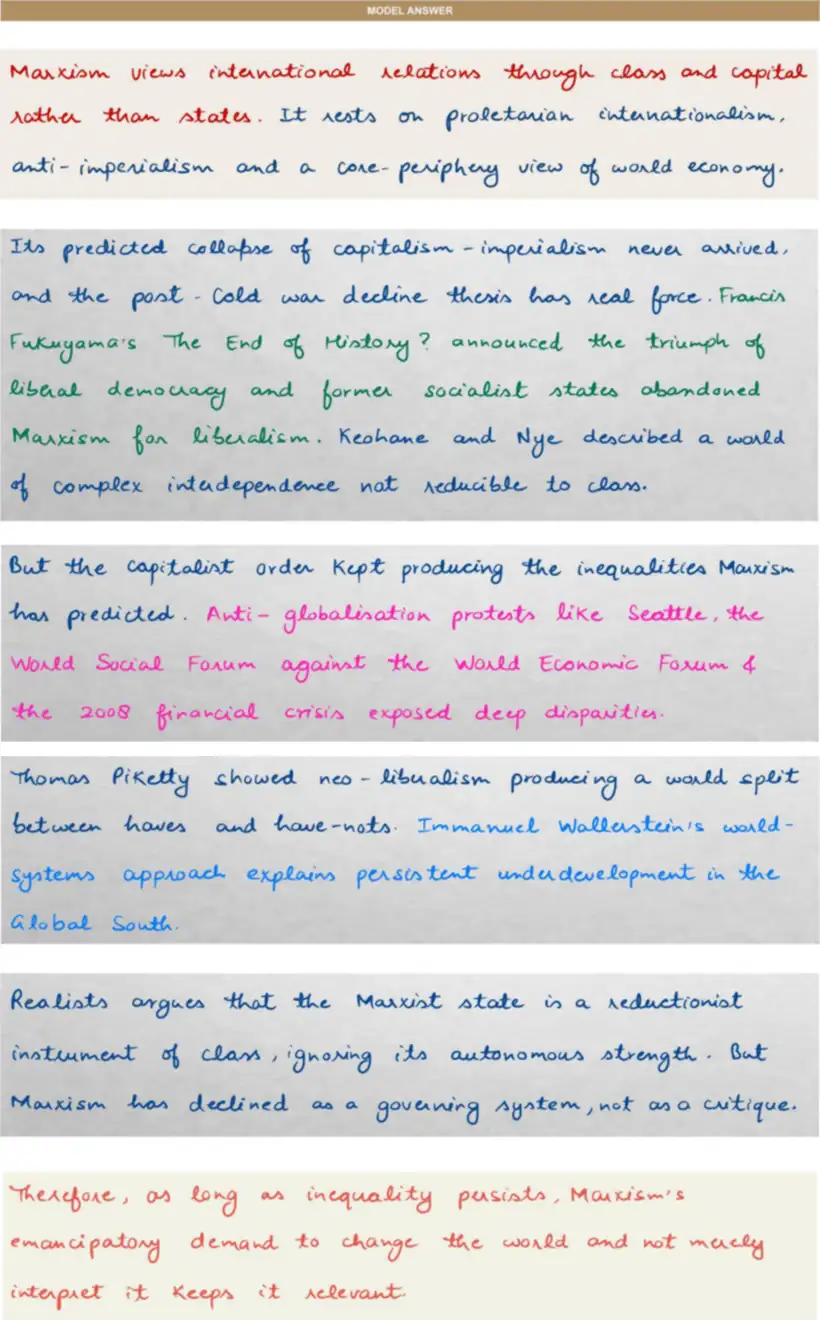
decline thesis: Fukuyama’s end of history / socialist states → liberalism / Keohane and Nye complex interdependence, not class → but capitalism keeps generating predicted inequality → Seattle + WSF vs WEF + 2008 crisis → Piketty haves vs have-nots → Wallerstein world-systems still explains Southern underdevelopment
realist charge: Marxist state is reductionist, ignores autonomous state strength → true only in part
Route 1 declined as governing system, not as critique → inequality persists → emancipatory purpose (change, not just interpret) keeps it relevant
Route 2 relevance shifts from blueprint to diagnostic tool → survives wherever global inequality endures
Model answer
Handwritten, in the form it would be written in the examination hall.
Also asked on this head
Approaches to the Study of International Relations — 18 questions in the Vault.
- Theories of international relations which claim objectivity inevitably harbour subjective biases. Elucidate.
- What role does identity and technology play in the conceptualisation of Defensive realism? (150 words)
- “The Gramscian theory of hegemony provides many valuable insights into the nature of global power.” Comment.
How this is taught
The same flow snapshot, built for every head of the syllabus, with the answer written in class.
The first session of Foundation 2027 is published in full.
Six programmes across three levels.