
Explain the central tenets of the World-Systems Theory.
How the answer moves
The flow snapshot — the routes in, the body, the counter-view and the routes out.
Route 1 global inequality is structural, not a gap between isolated nations → one capitalist world-economy since the sixteenth century
Route 2 Wallerstein’s single social system → global division of labour → unequal distribution of wealth and power
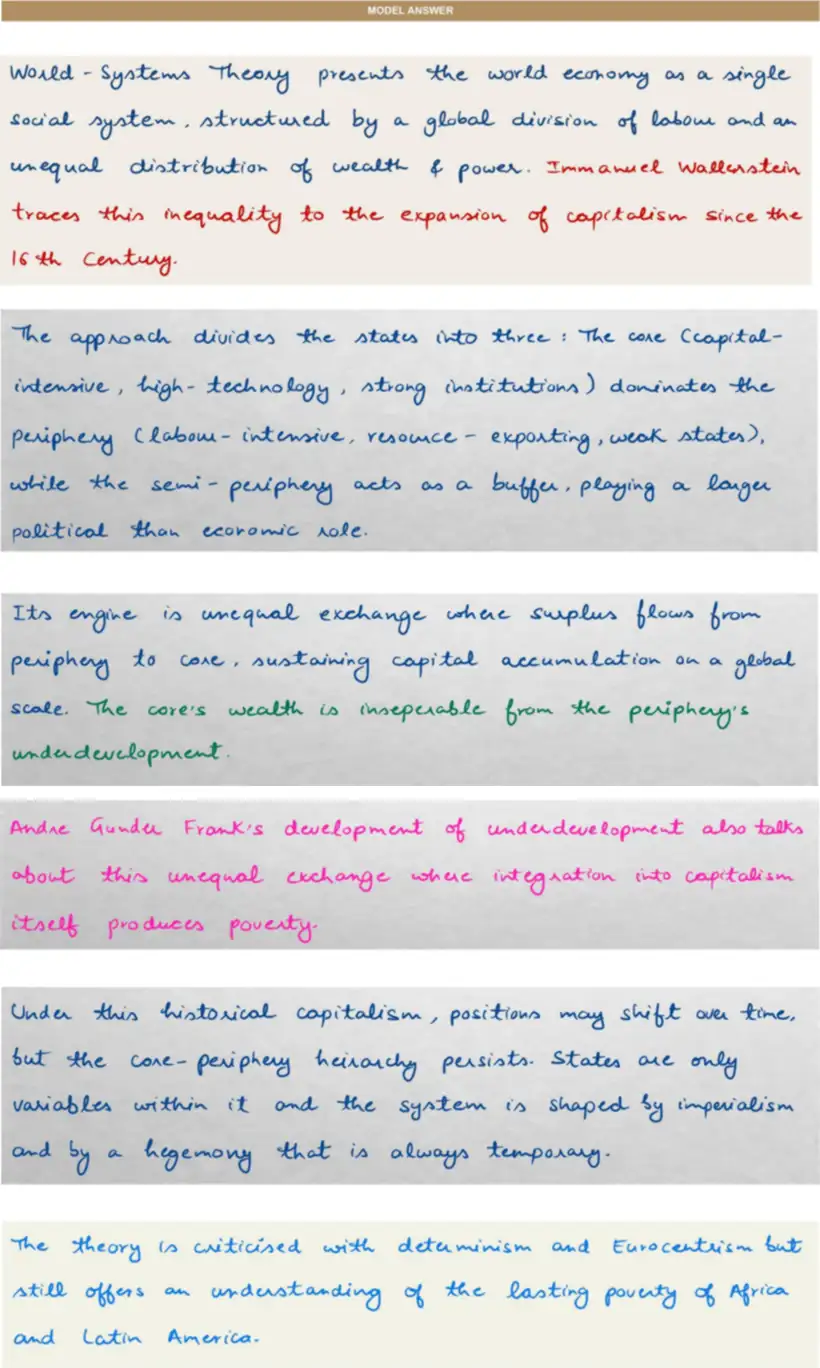
single world-system → core / periphery / semi-periphery (buffer, political > economic) → unequal exchange, surplus periphery → core, capital accumulation → core’s wealth ↔ periphery’s underdevelopment → Frank’s development of underdevelopment → historical capitalism: positions shift, hierarchy persists → states as variables → imperialism + temporary hegemony
charges of determinism and Eurocentrism
Route 1 concede determinism / Eurocentrism → still a sharp lens on Africa and Latin America
Route 2 hierarchy persists under global capitalism → theory keeps explaining the periphery’s continued poverty
Model answer
Handwritten, in the form it would be written in the examination hall.
Also asked on this head
Approaches to the Study of International Relations — 18 questions in the Vault.
- Theories of international relations which claim objectivity inevitably harbour subjective biases. Elucidate.
- What role does identity and technology play in the conceptualisation of Defensive realism? (150 words)
- “The Gramscian theory of hegemony provides many valuable insights into the nature of global power.” Comment.
How this is taught
The same flow snapshot, built for every head of the syllabus, with the answer written in class.
The first session of Foundation 2027 is published in full.
Six programmes across three levels.