
What do you mean by offensive and defensive realism?
How the answer moves
The flow snapshot — the routes in, the body, the counter-view and the routes out.
Route 1 both neorealist strands → shared anarchy / self-help / survival → split on how much power = security
Route 2 realism’s puzzle “how much power is enough?” → two answers inside structural realism → security-sufficient vs power-maximum
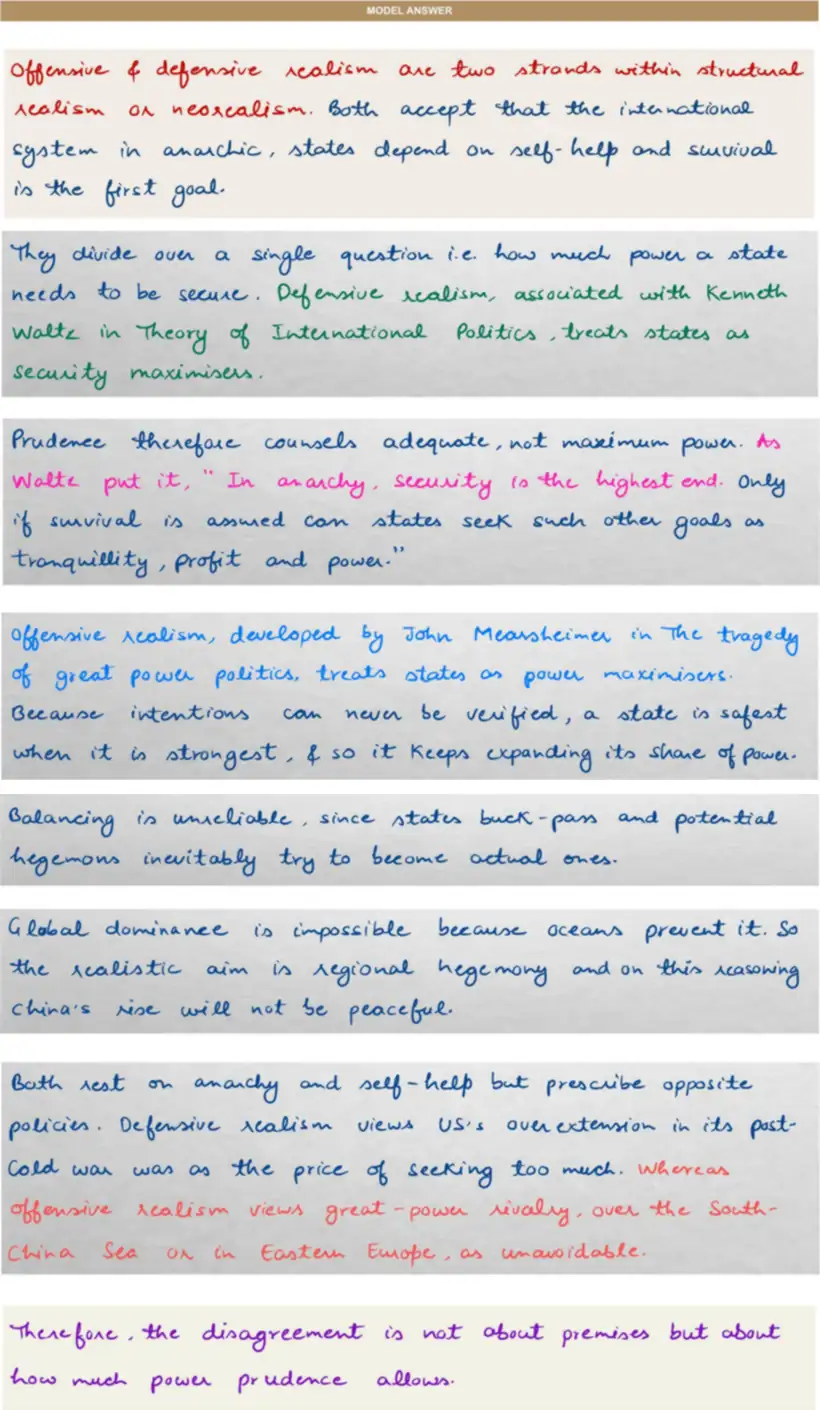
shared neorealist premises → Defensive (Waltz): security maximisers → equilibrium not hegemony → excess power provokes balancing + conquest costly (nationalism) → prudence = adequate power → Waltz quote → Offensive (Mearsheimer): power maximisers → safest when strongest (intentions unverifiable) → balancing unreliable (buck-passing) → potential hegemons become actual → regional not global hegemony (oceans) → China’s rise not peaceful
same premises, opposite prescriptions → restraint / equilibrium (defensive) vs pursuit of dominance (offensive) → US post-Cold War overextension read as the cost of too much power vs great-power rivalry (South China Sea, Eastern Europe) read as unavoidable
Route 1 disagreement is not over premises but over prudence — how much power is enough
Route 2 the two strands together map realism’s range of state behaviour, restraint to dominance
Model answer
Handwritten, in the form it would be written in the examination hall.
Also asked on this head
Approaches to the Study of International Relations — 18 questions in the Vault.
- Theories of international relations which claim objectivity inevitably harbour subjective biases. Elucidate.
- What role does identity and technology play in the conceptualisation of Defensive realism? (150 words)
- “The Gramscian theory of hegemony provides many valuable insights into the nature of global power.” Comment.
How this is taught
The same flow snapshot, built for every head of the syllabus, with the answer written in class.
The first session of Foundation 2027 is published in full.
Six programmes across three levels.