
Discuss the commonalities between the Marxist and Realist approach to the study of International Politics.
How the answer moves
The flow snapshot — the routes in, the body, the counter-view and the routes out.
Route 1 ideological opposites → yet both read world politics as material + conflict, not ideals/morality
Route 2 open on the shared lens → materialist, structural, conflict-driven reading → morality set aside
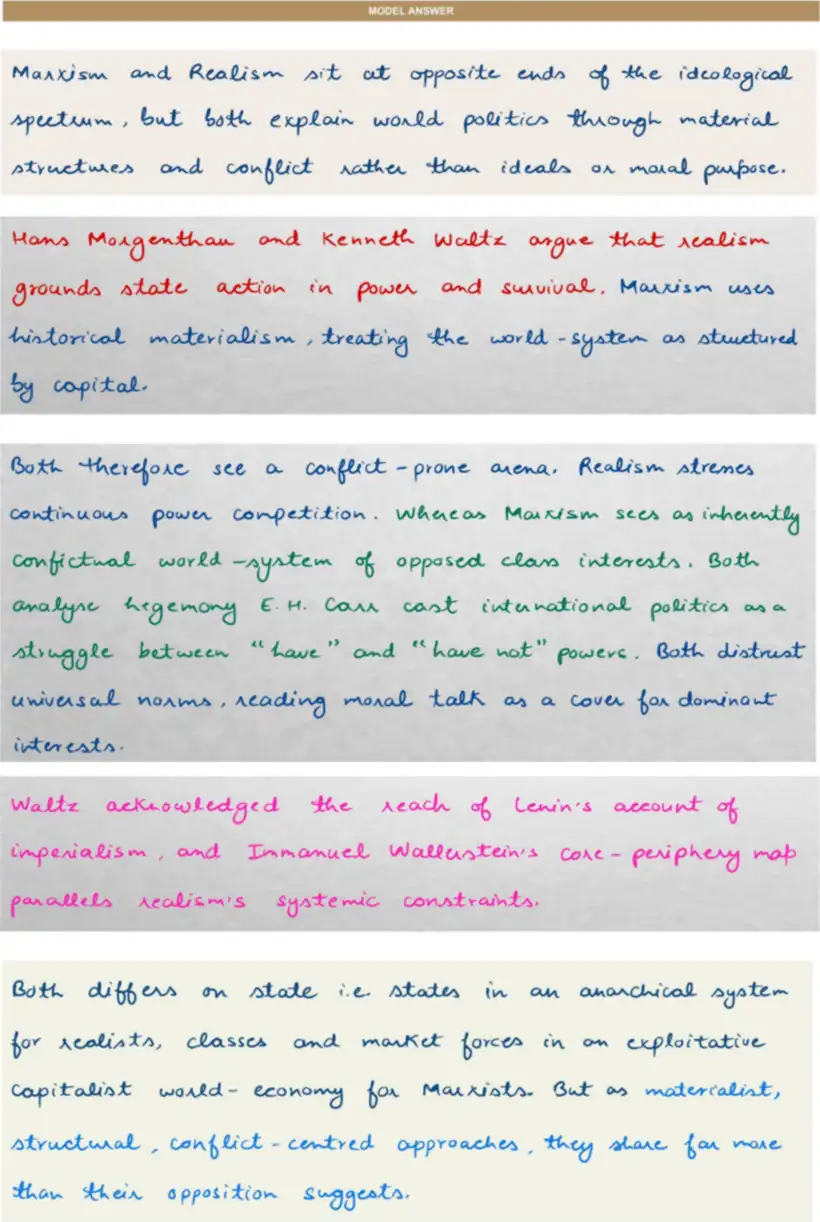
materialism (realism: power & survival — Morgenthau, Waltz ↔ Marxism: historical materialism, world-system as capital) → conflict-prone arena (continuous power competition ↔ opposed class interests) → hegemony & world order (Carr: “have” vs “have not” powers) → scepticism of universal norms (moral talk masks dominant interests) → structural convergence (Waltz concedes Lenin on imperialism; Wallerstein’s core–periphery ‖ realism’s systemic constraints)
central actor splits them → states in anarchy (realism) vs classes & market forces in an exploitative capitalist world-economy (Marxism)
Route 1 different actors, shared method → convergence runs deeper than the rivalry
Route 2 materialism + structure + conflict unite them → they part only on who acts and what the system is
Model answer
Handwritten, in the form it would be written in the examination hall.
Also asked on this head
Approaches to the Study of International Relations — 18 questions in the Vault.
- Theories of international relations which claim objectivity inevitably harbour subjective biases. Elucidate.
- What role does identity and technology play in the conceptualisation of Defensive realism? (150 words)
- “The Gramscian theory of hegemony provides many valuable insights into the nature of global power.” Comment.
How this is taught
The same flow snapshot, built for every head of the syllabus, with the answer written in class.
The first session of Foundation 2027 is published in full.
Six programmes across three levels.