
Critically examine the functional and system approaches to the study international relations.
How the answer moves
The flow snapshot — the routes in, the body, the counter-view and the routes out.
Route 1 both products of the behavioural turn → push IR past human nature → one to cooperation, one to structure
Route 2 two modern reactions against realism → institutions vs structure as the new lens
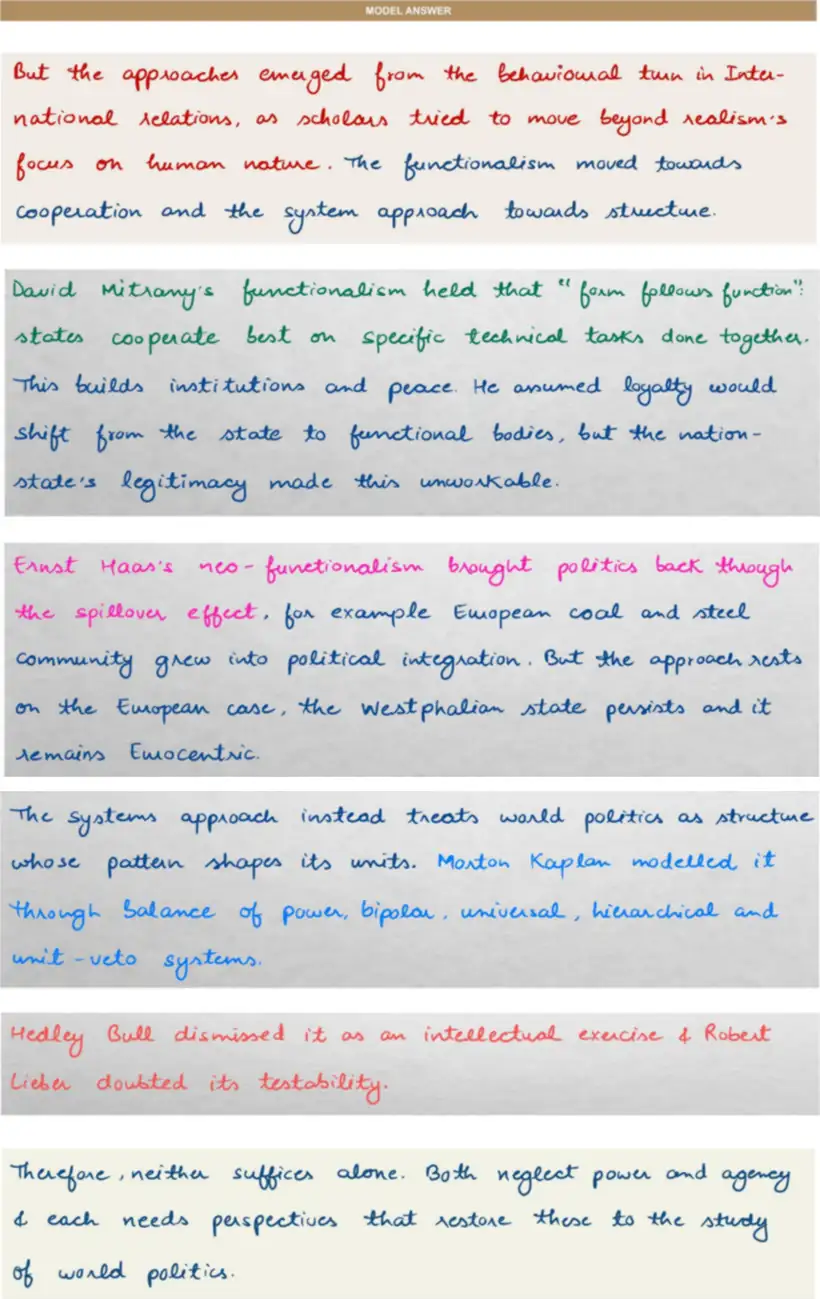
Mitrany, “form follows function” → technical tasks build institutions + peace → loyalty-transfer assumption fails (nation-state legitimacy) → Haas neo-functionalism + spillover → ECSC → political integration → limits: European-only, Westphalian state persists, Eurocentric → systems approach: structure shapes units → Kaplan’s models (BoP / bipolar / universal / hierarchical / unit-veto) → critics: Bull (intellectual exercise), Lieber (testability)
both remote from power, domestic politics, agency → systems too abstract and untestable; functionalism idealises cooperation and stays Eurocentric
Route 1 neither sufficient alone → functionalism reads cooperation, systems reads structure
Route 2 complement both by restoring power, history and agency
Model answer
Handwritten, in the form it would be written in the examination hall.
Also asked on this head
Approaches to the Study of International Relations — 18 questions in the Vault.
- Theories of international relations which claim objectivity inevitably harbour subjective biases. Elucidate.
- What role does identity and technology play in the conceptualisation of Defensive realism? (150 words)
- “The Gramscian theory of hegemony provides many valuable insights into the nature of global power.” Comment.
How this is taught
The same flow snapshot, built for every head of the syllabus, with the answer written in class.
The first session of Foundation 2027 is published in full.
Six programmes across three levels.