
Explain the various facets of the idealist approach to the study of international relations. Comment on its contemporary relevance.
How the answer moves
The flow snapshot — the routes in, the body, the counter-view and the routes out.
Route 1 idealism = interwar liberal dominance → politics around morality, cooperation, peace, not power
Route 2 set against realist power politics → rejects zero-sum world → morality and cooperation can reorder relations
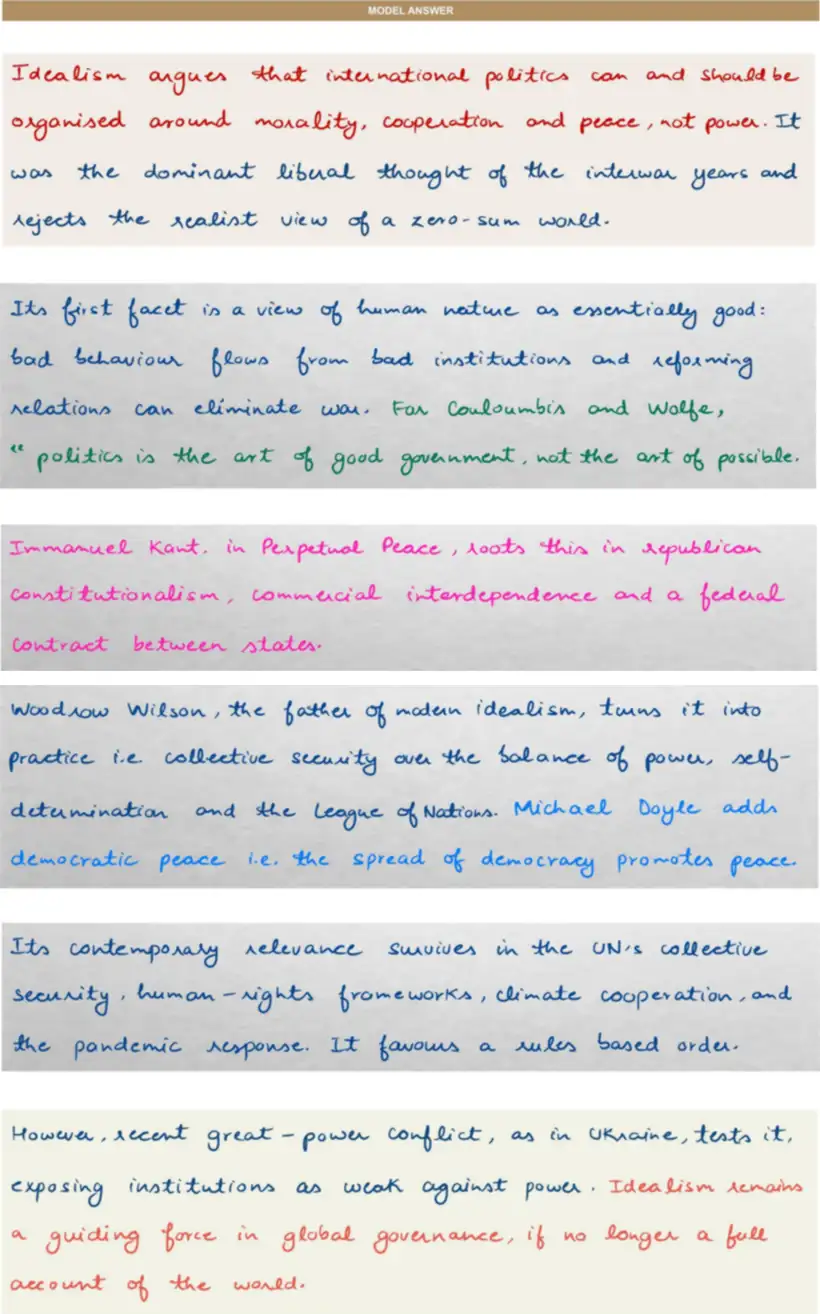
human nature good → war from bad institutions, reform can end it (Couloumbis & Wolfe: good government, not the art of the possible) → Kant, Perpetual Peace: republican constitutionalism + commercial interdependence + federal contract → Wilson (father of modern idealism): collective security over balance of power, self-determination, League of Nations → Doyle: democratic peace, spread of democracy promotes peace
realist rejoinder → great-power conflict (Ukraine) + institutions weak against power → limits of the idealist faith
Route 1 relevance affirmed → survives in UN collective security, human rights, climate, pandemic → rules-based order lives on
Route 2 relevance qualified → guiding force in global governance, not a full account of the world
Model answer
Handwritten, in the form it would be written in the examination hall.
Also asked on this head
Approaches to the Study of International Relations — 18 questions in the Vault.
- Theories of international relations which claim objectivity inevitably harbour subjective biases. Elucidate.
- What role does identity and technology play in the conceptualisation of Defensive realism? (150 words)
- “The Gramscian theory of hegemony provides many valuable insights into the nature of global power.” Comment.
How this is taught
The same flow snapshot, built for every head of the syllabus, with the answer written in class.
The first session of Foundation 2027 is published in full.
Six programmes across three levels.