
Bring out the major differences between the Classical Realism of Hans Morgenthau and the Neorealism of Kenneth Waltz.
How the answer moves
The flow snapshot — the routes in, the body, the counter-view and the routes out.
Route 1 common realist ground (power, anarchy, self-help) → one root difference: the source of the power-struggle
Route 2 both realist → disagree on where power politics begins → that root drives every other difference
Morgenthau: cause in human nature (Politics Among Nations, objective laws from that nature) → Waltz: cause in system structure (Theory of International Politics, anarchy + distribution of capabilities; leaders/human nature downplayed, structure compels) → purpose of power: end (classical) vs means to survival (neorealism) → method: subjective/philosophical vs systematic/scientific, modelled on microeconomics → ethics: prudence present in Morgenthau vs largely absent in Waltz
despite the differences, both stay within realism → shared self-help + balance of power → a reworking of the foundation, not a break
Route 1 evolution from a human-centric to a system-centric account of IR
Route 2 structural rigour gained, but Morgenthau’s attention to statecraft and ethics set aside
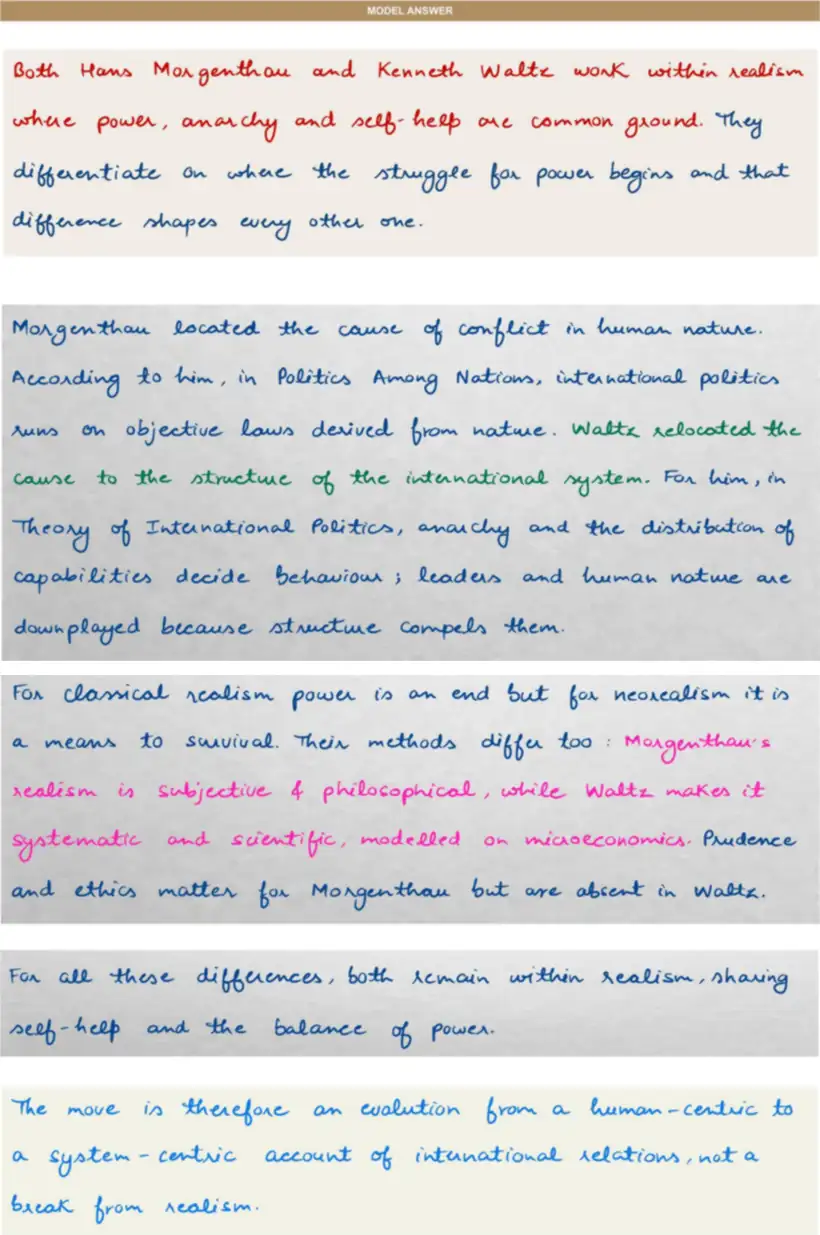
Model answer
Handwritten, in the form it would be written in the examination hall.
Also asked on this head
Approaches to the Study of International Relations — 18 questions in the Vault.
- Theories of international relations which claim objectivity inevitably harbour subjective biases. Elucidate.
- What role does identity and technology play in the conceptualisation of Defensive realism? (150 words)
- “The Gramscian theory of hegemony provides many valuable insights into the nature of global power.” Comment.
How this is taught
The same flow snapshot, built for every head of the syllabus, with the answer written in class.
The first session of Foundation 2027 is published in full.
Six programmes across three levels.