
How does the regionalism shape the world politics? Explain with examples.
How the answer moves
The flow snapshot — the routes in, the body, the counter-view and the routes out.
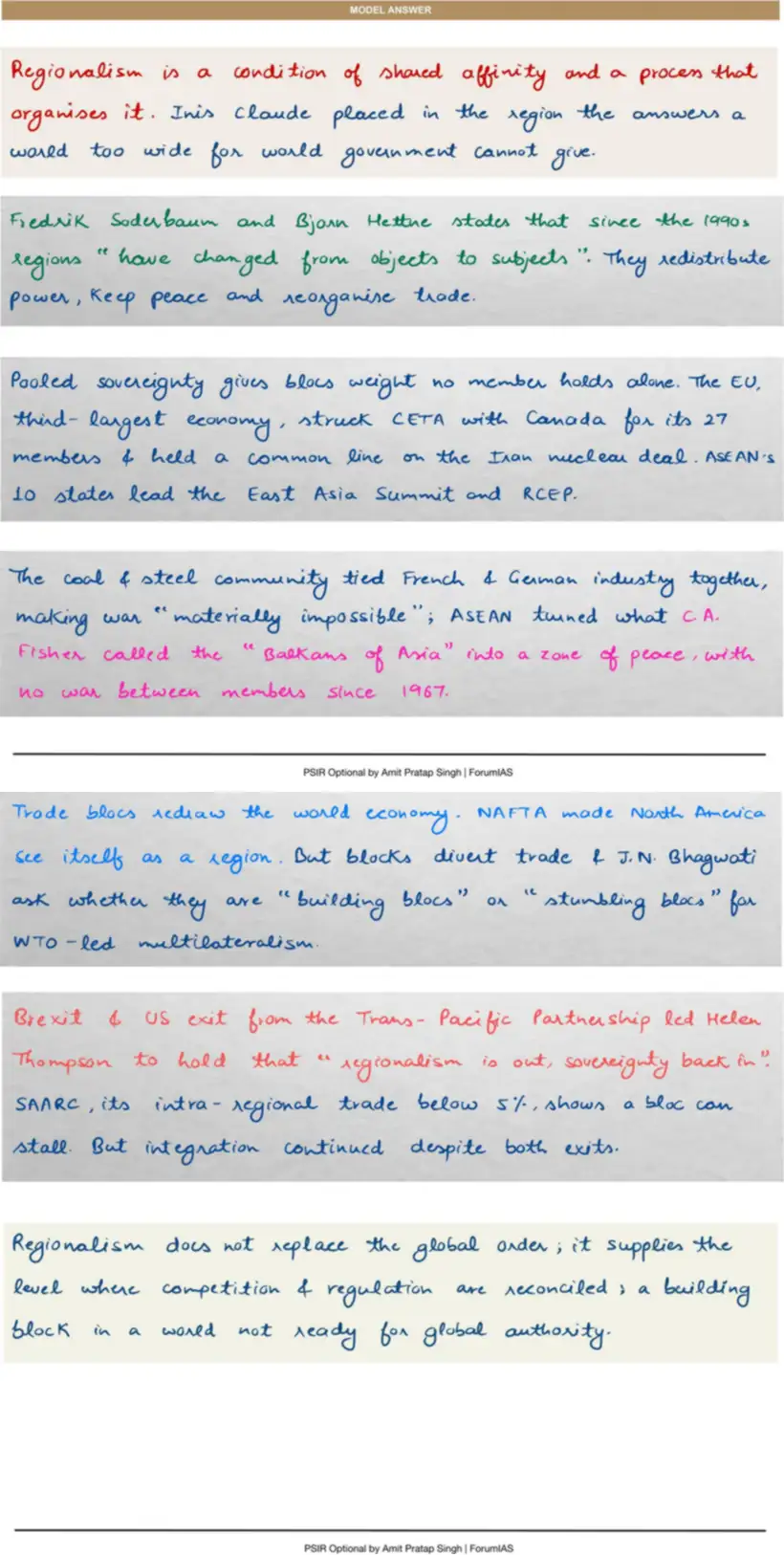
Route 1 regionalism = condition + process → Inis Claude: world too wide for world government → region is where the answers lie → since the 1990s, regions “objects → subjects” /
Route 2 new regionalism, post-Cold War second coming → region stops being the arena of world politics, becomes an actor in it → three arenas: power, peace, trade
pooled sovereignty → bloc weight no single member has → EU (third-largest economy, CETA, Iran deal, 27 members) → ASEAN’s ten small states leading EAS + RCEP → collective bargaining → multipolarity → peace function → ECSC makes war “materially impossible” → Fisher: “Balkans of Asia” → zone of peace, no war since 1967 → trade function → NAFTA makes North America see itself as a region → trade diversion → Bhagwati’s question: building blocks or stumbling blocks?
sovereignty backlash → Brexit + US exit from TPP → Helen Thompson: “regionalism is out, sovereignty back in” → SAARC stalls, intra-regional trade below 5% → but integration continued despite both exits
Route 1 answer Bhagwati → building blocks, not stumbling blocks /
Route 2 regionalism does not replace the global order → it supplies the level where competition and regulation are reconciled, in a world not ready for global authority
Model answer
Handwritten, in the form it would be written in the examination hall.
Also asked on this head
Regionalisation of World Politics — 14 questions in the Vault.
- QUAD requires more robust architecture than the summit driven mode to tide over the current challenges. Elaborate.
- Explain the success of ASEAN as a regional organisation.
- American President Donald Trump’s proposal to withdraw from the ‘NAFTA’ would bring unforeseen consequences to the regionalisation of world politics. Elaborate. (150 words)
How this is taught
The same flow snapshot, built for every head of the syllabus, with the answer written in class.
The first session of Foundation 2027 is published in full.
Six programmes across three levels.