
The world currently has been in the throes of a twin process of ‘democratic backsliding’ and ‘democratic backlash. How would you explain this paradox?
How the answer moves
The flow snapshot — the routes in, the body, the counter-view and the routes out.
Route 1 democracy more championed than ever, yet more eroding than in decades → the paradox stated
Route 2 Held: nations embrace democracy just as the nation-state’s efficacy is questioned → read as globalisation’s double edge
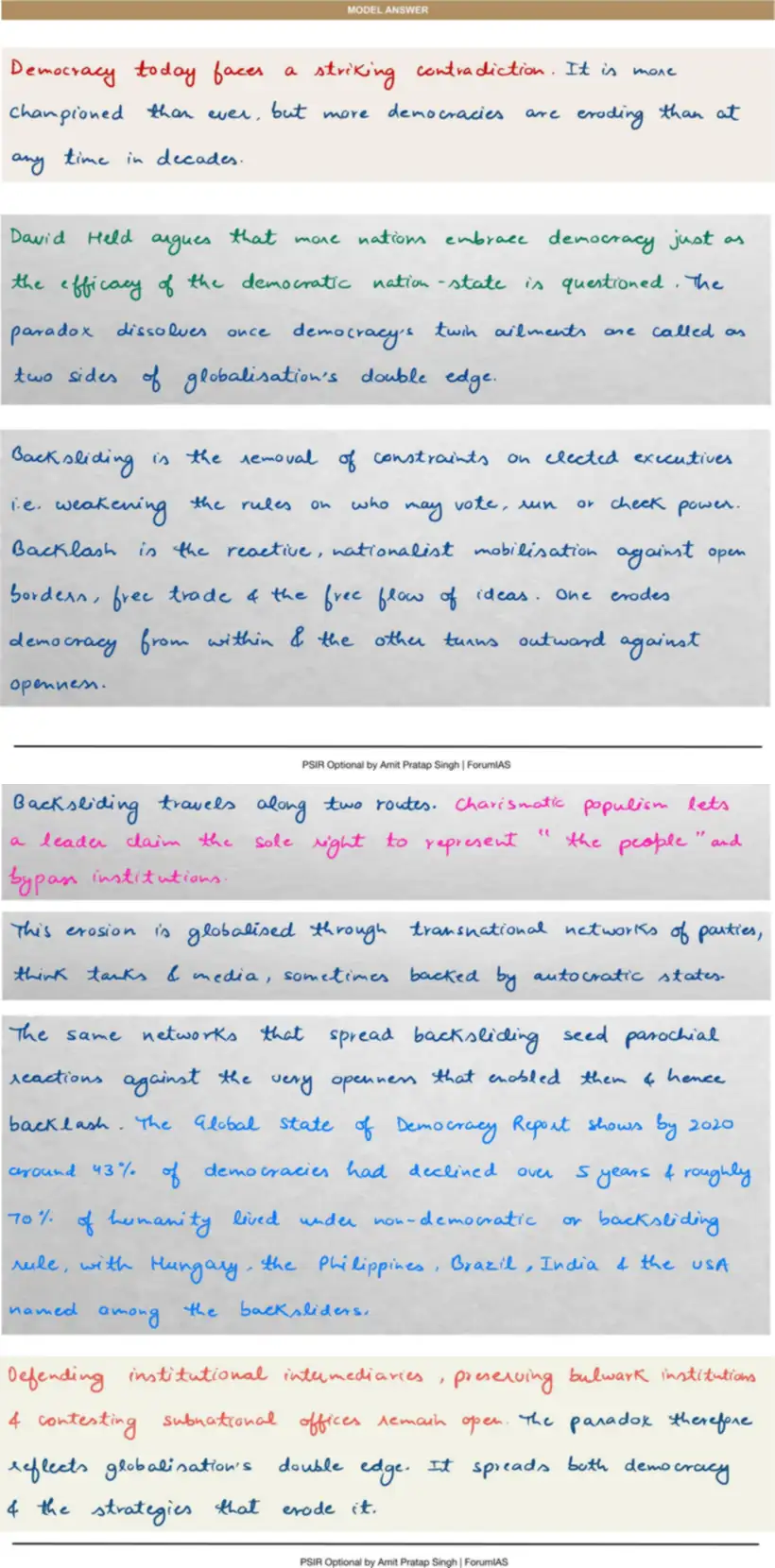
define backsliding (erosion of executive constraints) + backlash (nationalist reaction against openness), advancing together → two vectors of backsliding: charismatic populism (Erdoğan, Orbán, Trump, Chávez) + partisan degradation (party abandons rules, captures courts / checks / election machinery) → backsliding globalised via transnational networks (parties, think tanks, media; autocratic backing) → same networks seed parochial backlash against the openness that enabled them → Global State of Democracy Report (43% declined over five years; 70% under non-democratic/backsliding rule; Hungary, Philippines, Brazil, India, USA)
erosion is not terminal → recovery routes remain: defend institutional intermediaries, preserve bulwark institutions, contest subnational offices even where national ones are captured
Route 1 the paradox = globalisation’s double edge: it spreads both democracy and the tools that erode it
Route 2 openness is at once democracy’s vehicle and its vulnerability → the “twin process” is one phenomenon, not two
Model answer
Handwritten, in the form it would be written in the examination hall.
Also asked on this head
Contemporary Global Concerns — 22 questions in the Vault.
- International Human Rights frameworks are hostage to politics among nations. Comment.
- How does the regime change and political crisis in Myanmar threaten regional security and peace?
- Discuss the five proposals made by India in the recent COP-26 conference held in Glasgow. (150 words)
How this is taught
The same flow snapshot, built for every head of the syllabus, with the answer written in class.
The first session of Foundation 2027 is published in full.
Six programmes across three levels.