
Explain the non-traditional security threats in the context of food and environmental crises.
How the answer moves
The flow snapshot — the routes in, the body, the counter-view and the routes out.
Route 1 security once state-centred / military → non-traditional turn → welfare threatened by non-military, transnational sources (Caballero-Anthony) → food + environment as the clearest cases
Route 2 the widening of “security” beyond the state → food and environmental crises named as non-traditional threats → both erode livelihoods and stability
non-traditional security defined (Caballero-Anthony) → food crisis: reduced supply, rising staple prices, hunger (Timmer) → scale: ~258m / 58 countries / 2022; ~9m hunger deaths a year (WFP) → unequal burden: women, children, poor households, small producers → environment amplifies: climate extremes cut farm labour productivity (up to 14% in low-income tropics) → Homer-Dixon: supply / demand / structural scarcity → resource capture + ecological marginalisation → state capacity weakened → insurgency, communal violence → responses: equity-centred adaptation, rights-based access, flexible transboundary governance
food and environmental stress as a “development” concern vs a genuine “security” threat → Homer-Dixon’s scarcity–conflict link settles it on the security side
Route 1 these are security threats precisely because they hit livelihoods, weaken states and breed conflict
Route 2 the durable answer is equity-centred, rights-based and transboundary — not military
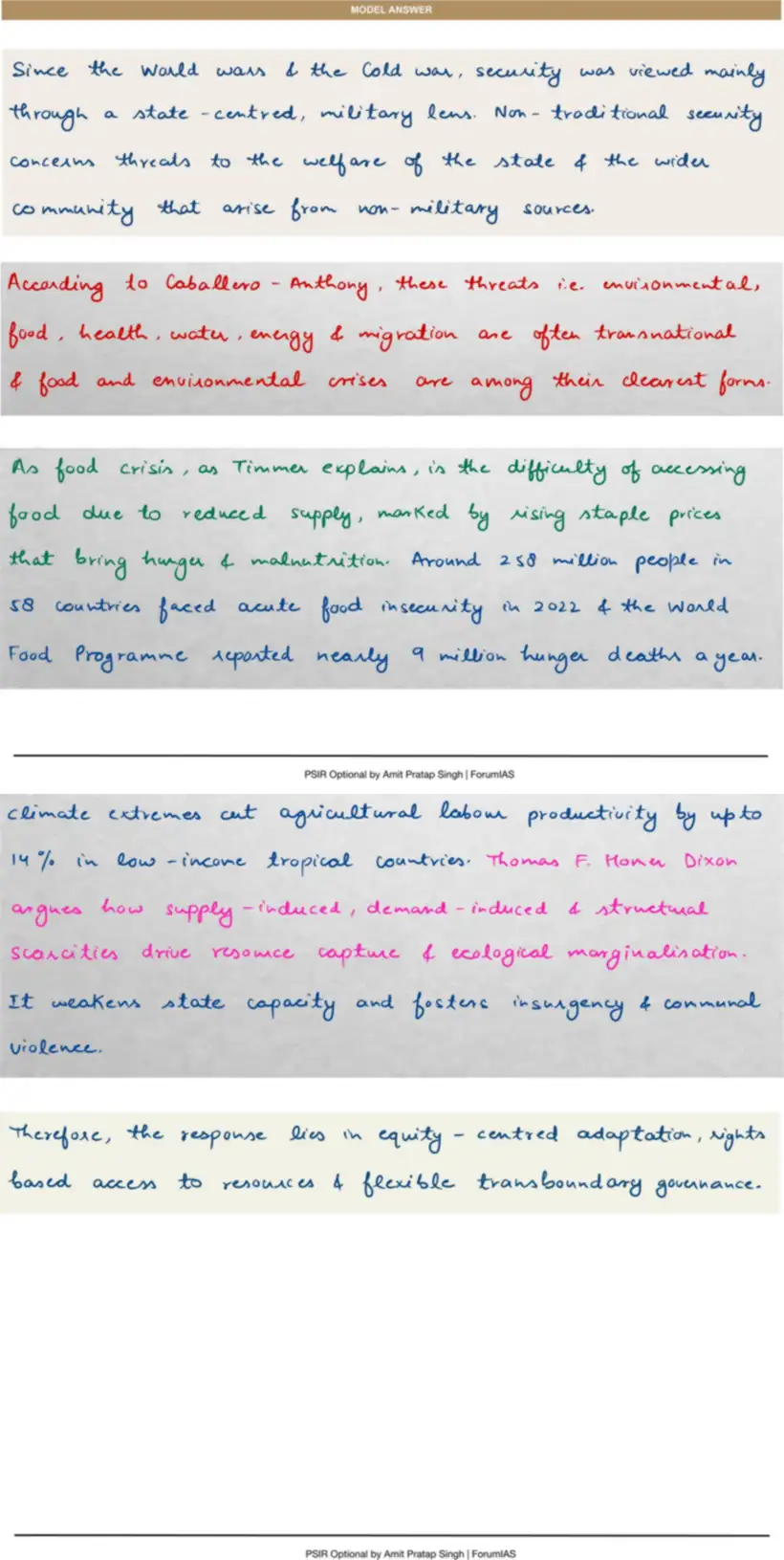
Model answer
Handwritten, in the form it would be written in the examination hall.
Also asked on this head
Contemporary Global Concerns — 22 questions in the Vault.
- International Human Rights frameworks are hostage to politics among nations. Comment.
- How does the regime change and political crisis in Myanmar threaten regional security and peace?
- Discuss the five proposals made by India in the recent COP-26 conference held in Glasgow. (150 words)
How this is taught
The same flow snapshot, built for every head of the syllabus, with the answer written in class.
The first session of Foundation 2027 is published in full.
Six programmes across three levels.