
Would you agree that the on-going debates on international environmental politics continue to be marred by a new North-South ideological divide over historical responsibility and developmental model? Illustrate your answer with suitable examples.
How the answer moves
The flow snapshot — the routes in, the body, the counter-view and the routes out.
Route 1 agree → environmental politics = a new arena of the old North–South conflict → Dauvergne’s two goals (improve environment vs reform an unfair system)
Route 2 since Stockholm 1972 the blocs diverge → G-8 vs G-77 → the divide is ideological, not technical
historical responsibility (North’s 150 yrs of emissions vs South’s equity) → CBDR + Kyoto Annex I / non-Annex I → Guha (deep ecology vs empty-stomach environmentalism; victim without representation) → developmental model (right to develop vs shared restraint) → Indira Gandhi (poverty as polluter) → EU “good cop” / US “bad cop” + US quits Paris → Paris (2015) dilution + Katowice finance unclear
C. Raja Mohan (South “suboptimal,” “defensive,” reactive) → the divide is sustained by both sides
Route 1 the proposition holds → the divide still mars the debate
Route 2 eases only via redistributive justice → Prebisch’s 1% GNP transfer
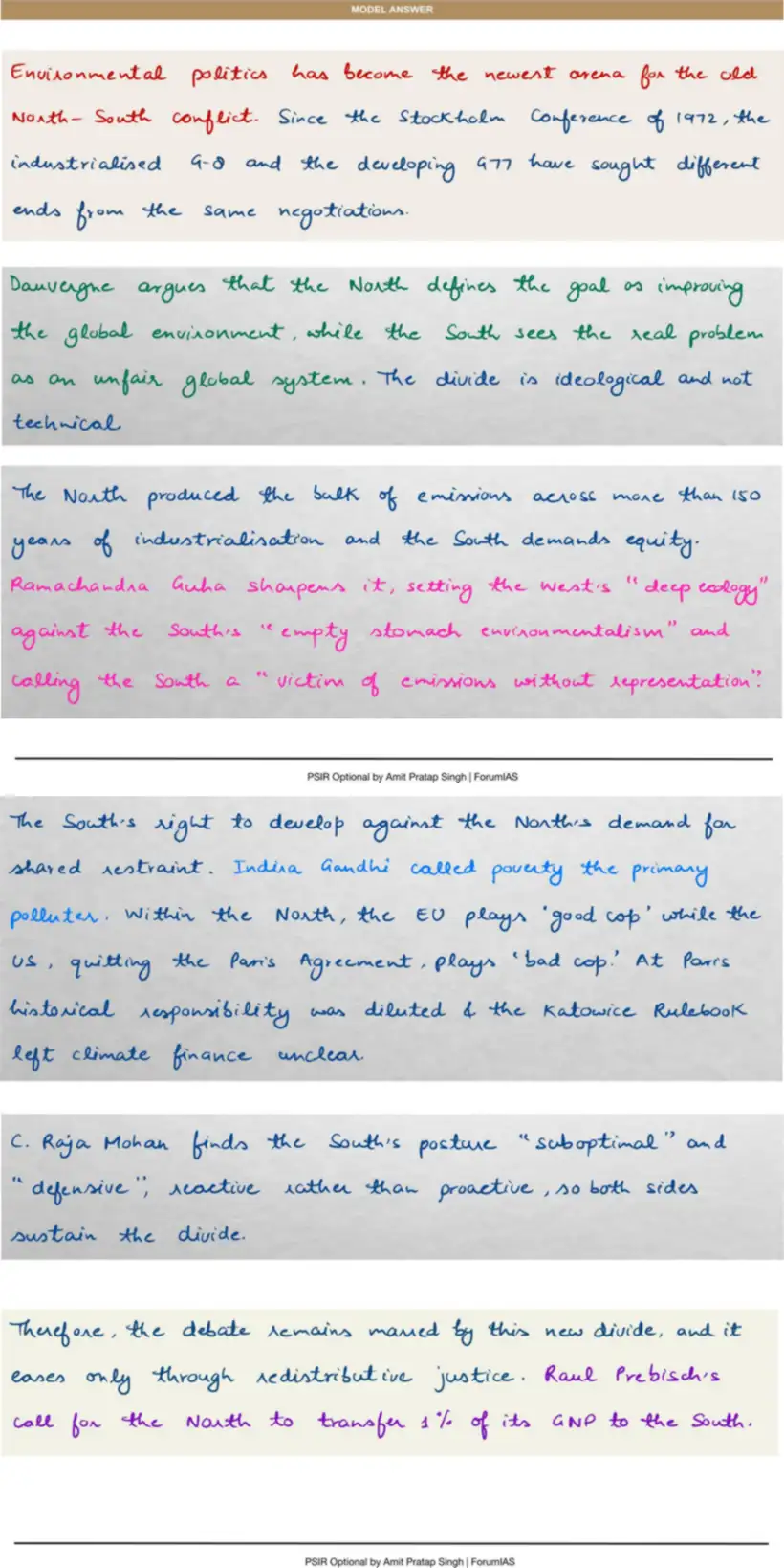
Model answer
Handwritten, in the form it would be written in the examination hall.
Also asked on this head
Contemporary Global Concerns — 22 questions in the Vault.
- International Human Rights frameworks are hostage to politics among nations. Comment.
- How does the regime change and political crisis in Myanmar threaten regional security and peace?
- Discuss the five proposals made by India in the recent COP-26 conference held in Glasgow. (150 words)
How this is taught
The same flow snapshot, built for every head of the syllabus, with the answer written in class.
The first session of Foundation 2027 is published in full.
Six programmes across three levels.