
How has the electoral democracy augmented the participation of people in the democratic process?
How the answer moves
The flow snapshot — the routes in, the body, the counter-view and the routes out.
Route 1 modern vs ancient democracy = representation → Tocqueville: more participation, more democratic → elections the route people entered public life
Route 2 electoral democracy = a free/fair choice of representatives → the vehicle that widened popular participation → real augmentation, but uneven
franchise + secret ballot + open contest → equal say, subjects → participants → participation beyond the vote (office, parties, RTI, civic engagement) → widening real but uneven → Dalton’s participation gap (better-off engage, poor under-mobilised) → Peruzzotti (populists ride electoral legitimacy → undermine liberal democracy) → electoral victory can mask shrinking real participation
elections widen participation vs the participation gap + populist instrumentalisation → electoral success ≠ meaningful participation
Route 1 inclusive reforms → Lijphart’s proportional systems + civic education + participatory–deliberative forums inside institutions
Route 2 electoral democracy necessary but not sufficient → participation meaningful only when entrenched in institutions
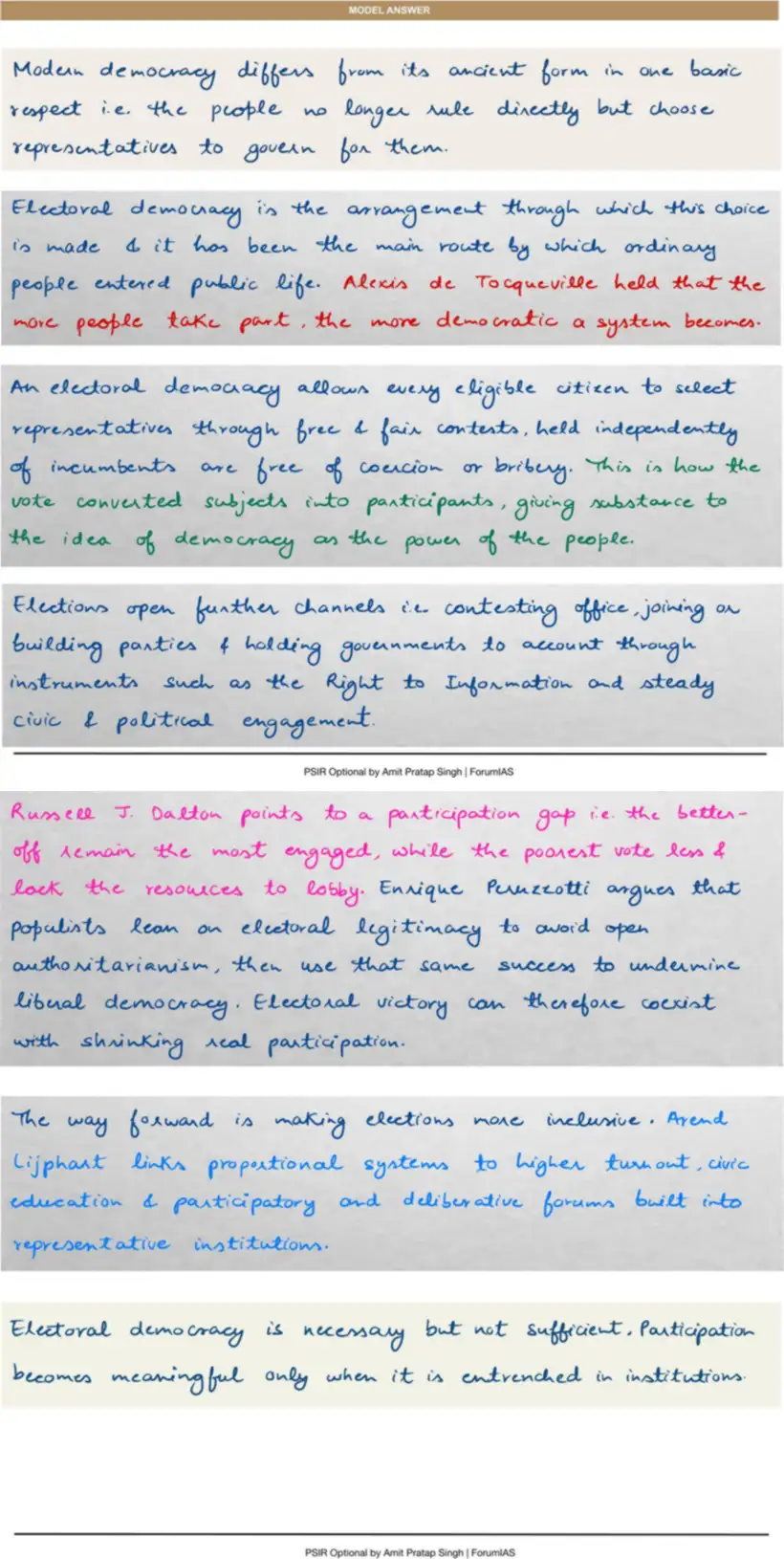
Model answer
Handwritten, in the form it would be written in the examination hall.
Also asked on this head
Contemporary Global Concerns — 22 questions in the Vault.
- International Human Rights frameworks are hostage to politics among nations. Comment.
- How does the regime change and political crisis in Myanmar threaten regional security and peace?
- Discuss the five proposals made by India in the recent COP-26 conference held in Glasgow. (150 words)
How this is taught
The same flow snapshot, built for every head of the syllabus, with the answer written in class.
The first session of Foundation 2027 is published in full.
Six programmes across three levels.