
Is democracy promotion in developing countries a feasible idea?
How the answer moves
The flow snapshot — the routes in, the body, the counter-view and the routes out.
Route 1 can democracy be exported? → the record is mixed → feasibility turns on method, not goal → feasible as facilitation from within, not coercion
Route 2 democracy’s universal appeal (Locke: safeguard of rights) → method decides feasibility → feasible only where change is organic
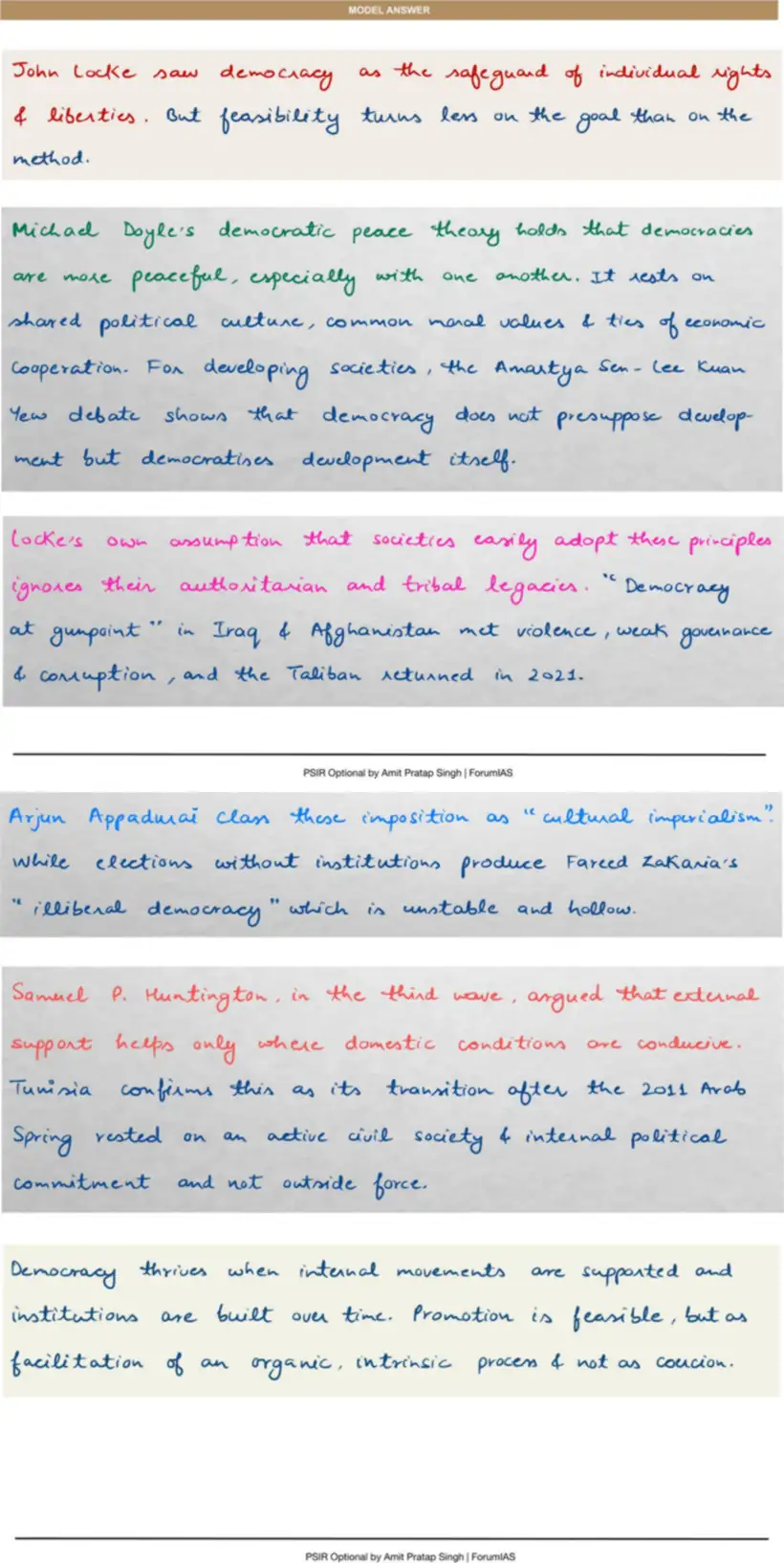
case for promotion: Doyle’s democratic peace (democracies more peaceful, esp. with each other; political culture + moral values + economic ties) → Sen vs Lee Kuan Yew: democracy democratises development → but imposition counter-productive: Locke’s blind spot (authoritarian/tribal legacies) → “democracy at gunpoint” Iraq/Afghanistan → violence, weak governance, corruption, Taliban 2021 → “cultural imperialism” (Appadurai) → “illiberal democracy” (Zakaria): elections without institutions, unstable/hollow → Huntington’s Third Wave: support works only where conditions are conducive → Tunisia (2011 Arab Spring, civil society, internal commitment)
coercive external imposition (“democracy at gunpoint”) vs organic, internally-driven democratisation
Route 1 democracy thrives when internal movements are supported + institutions built over time
Route 2 feasible as facilitation of an organic, intrinsic process, not coercion
Model answer
Handwritten, in the form it would be written in the examination hall.
Also asked on this head
Contemporary Global Concerns — 22 questions in the Vault.
- International Human Rights frameworks are hostage to politics among nations. Comment.
- How does the regime change and political crisis in Myanmar threaten regional security and peace?
- Discuss the five proposals made by India in the recent COP-26 conference held in Glasgow. (150 words)
How this is taught
The same flow snapshot, built for every head of the syllabus, with the answer written in class.
The first session of Foundation 2027 is published in full.
Six programmes across three levels.