
Examine the role of the United Nations Framework convention on climate change (UNFCCC) and other major efforts by the UN to address the global environmental crisis.
How the answer moves
The flow snapshot — the routes in, the body, the counter-view and the routes out.
Route 1 environmental crisis = archetypal global issue, crosses borders → collective UN governance the natural site
Route 2 Eckersley: state-centric realism → ecocentric cosmopolitanism → architecture strong in norms, weak in enforcement
Rio 1992 → UNFCCC (equity + CBDR + historical responsibility) → Kyoto 1997 (binding targets, carbon credits) → 2013 bottom-up turn: INDCs → Paris 2015 (major emitters pledge cuts) → IPCC (WMO + UNEP → science) → SDGs 13, 14, 15
limits: collective good vs national interest → US & Canada outside → no binding enforcement → IPCC (pledges too weak, 1.5°C budget gone by 2030) → equity itself contested (Dauvergne: North = improve environment vs South = fix an unfair order)
Route 1 role real but structural → builds norms, science, participation → cannot compel
Route 2 progress depends on aligning the collective good with national interest
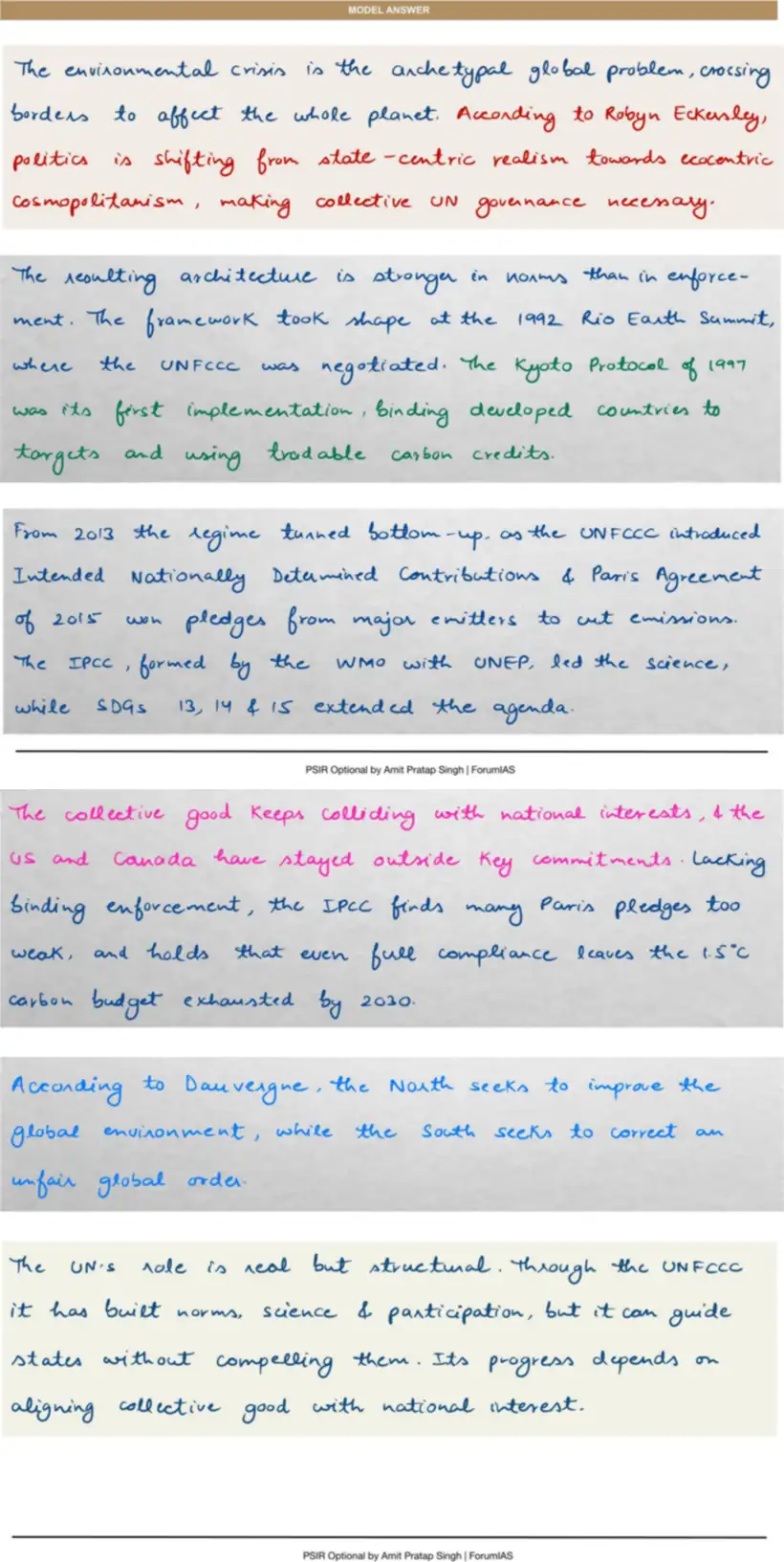
Model answer
Handwritten, in the form it would be written in the examination hall.
Also asked on this head
Contemporary Global Concerns — 22 questions in the Vault.
- International Human Rights frameworks are hostage to politics among nations. Comment.
- How does the regime change and political crisis in Myanmar threaten regional security and peace?
- Discuss the five proposals made by India in the recent COP-26 conference held in Glasgow. (150 words)
How this is taught
The same flow snapshot, built for every head of the syllabus, with the answer written in class.
The first session of Foundation 2027 is published in full.
Six programmes across three levels.