
Examine the main problems and challenges involved in looking after environmental concerns in world politics.
How the answer moves
The flow snapshot — the routes in, the body, the counter-view and the routes out.
Route 1 environment once peripheral → now the archetypal borderless global issue → Buzan: central to the security agenda
Route 2 a borderless problem handled through a state system → each government answers to national interest first → managing it is structurally hard
Hardin’s tragedy of the commons → responsibility diffused, states free-ride → no consensus across development levels → short-term gain vs long-term sustainability → North–South divide → Dauvergne: improve the environment vs reform an unfair system → Guha: empty-stomach environmentalism, emissions without representation → historical responsibility + CBDR
agreements are reached and institutions do exist (cooperation not impossible) → but weak enforcement, diluted responsibility (CSE: Paris, Katowice finance) and US withdrawal (Ban Ki-moon) blunt them
Route 1 obstacles are political, not technical → reconciling national interest with a shared planet
Route 2 IPCC: 1.5°C budget exhausted by 2030 even under Paris → urgency demands a common-good, differentiated approach
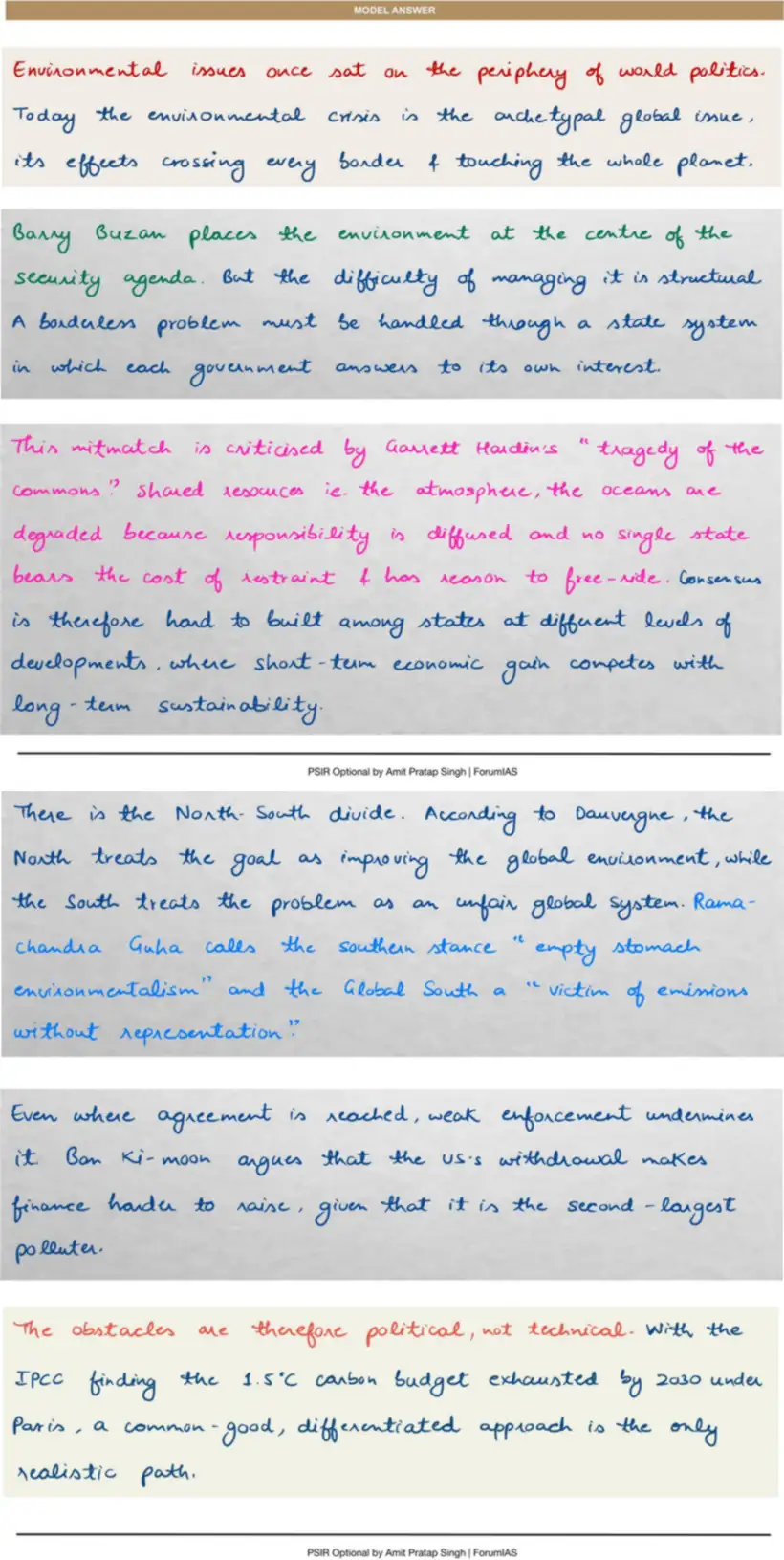
Model answer
Handwritten, in the form it would be written in the examination hall.
Also asked on this head
Contemporary Global Concerns — 22 questions in the Vault.
- International Human Rights frameworks are hostage to politics among nations. Comment.
- How does the regime change and political crisis in Myanmar threaten regional security and peace?
- Discuss the five proposals made by India in the recent COP-26 conference held in Glasgow. (150 words)
How this is taught
The same flow snapshot, built for every head of the syllabus, with the answer written in class.
The first session of Foundation 2027 is published in full.
Six programmes across three levels.