
“India is often said to have a rich strategic culture.’ Discuss.
How the answer moves
The flow snapshot — the routes in, the body, the counter-view and the routes out.
Route 1 Snyder defines strategic culture → whether India has one is contested
Route 2 India acts strategically, yet is charged with lacking strategic culture (Tanham) → sets up the rebuttal
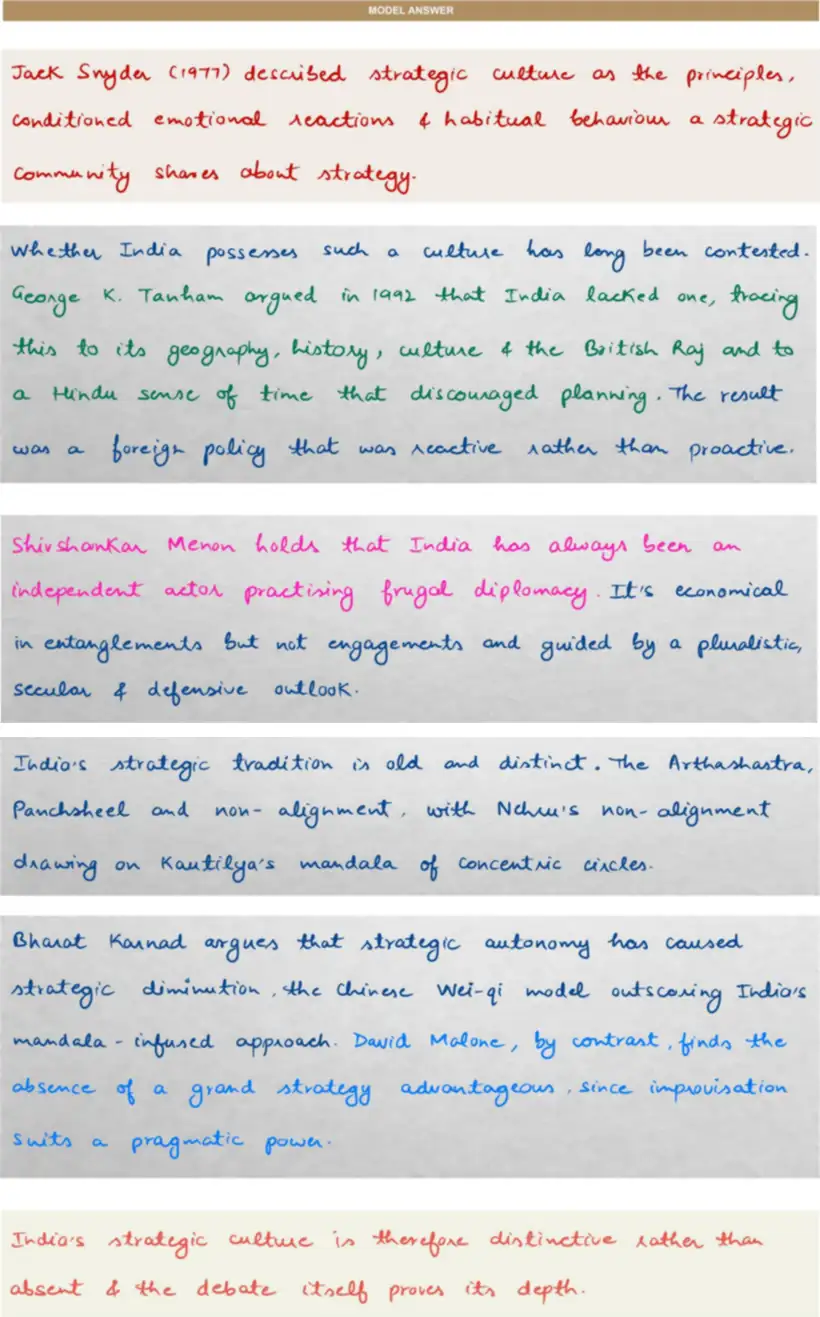
Snyder’s definition → Tanham’s 1992 denial (geography / history / culture / Raj + Hindu ‘time’ → reactive foreign policy) → Menon’s rebuttal (independent actor, frugal diplomacy, pluralistic–secular–defensive) → India’s own tradition (Arthashastra, Panchsheel, non-alignment; Kautilya’s mandala behind Nehru’s non-alignment)
Karnad (strategic autonomy → strategic diminution; Wei-qi outscores mandala) vs Malone (no grand strategy = advantage; improvisation suits a pragmatic power)
Route 1 distinctive, not absent → the debate itself proves its depth
Route 2 not the Western grand-strategy type, but a Kautilyan, pluralistic tradition → richness lies in adaptability, not a fixed doctrine
Model answer
Handwritten, in the form it would be written in the examination hall.
Also asked on this head
Indian Foreign Policy — 17 questions in the Vault.
- India has adopted multi-alignment to fulfill its core values and interests in International relations. Discuss.
- What are the external determinants of the Foreign Policy of a State?
- How do the constituent states influence the foreign policy making process in India?
How this is taught
The same flow snapshot, built for every head of the syllabus, with the answer written in class.
The first session of Foundation 2027 is published in full.
Six programmes across three levels.