
“India’s current foreign policy marks significant qualitative shifts from that of previous regimes”. Discuss.
How the answer moves
The flow snapshot — the routes in, the body, the counter-view and the routes out.
Route 1 shift is real → but measured in ambition, pace, risk-appetite → not a break with core interests
Route 2 question tests rupture vs evolution → stake: qualitative shift genuine, yet grounded in continuity
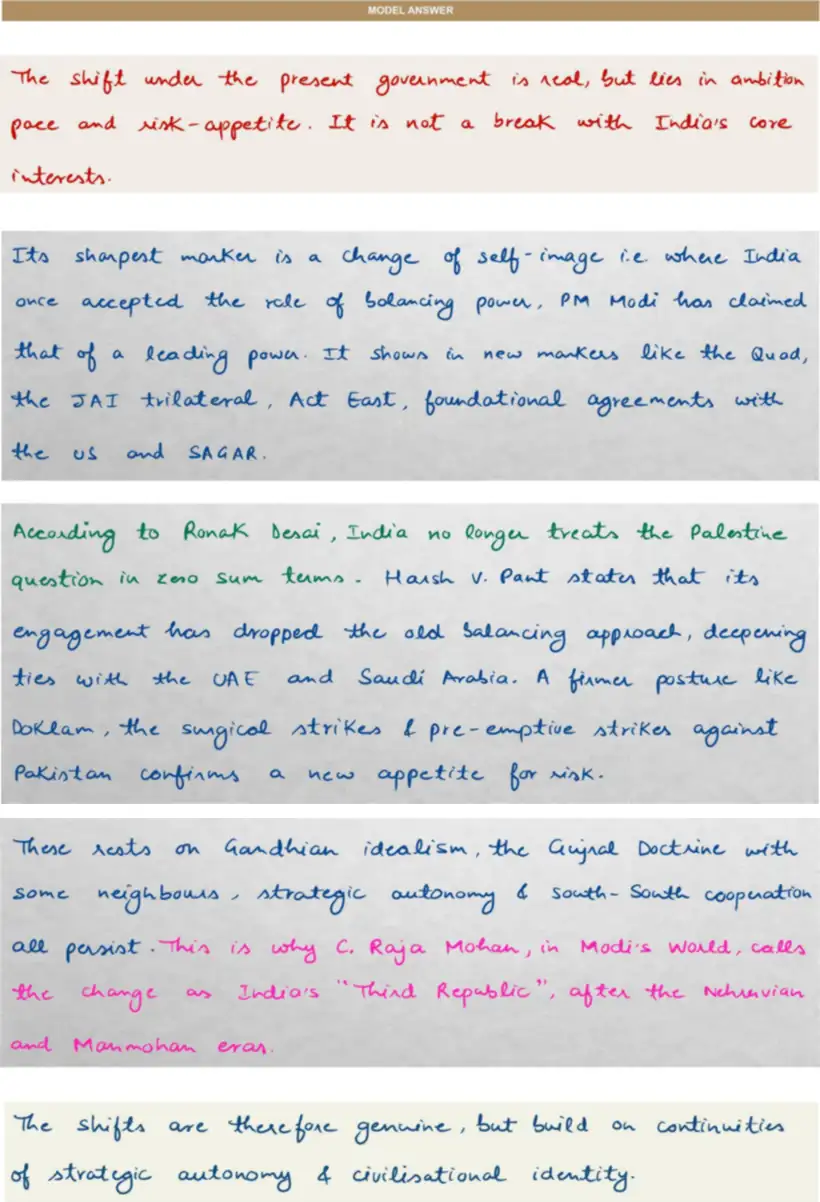
change of self-image: balancing power → leading power → institutional markers (Quad, JAI trilateral, Act East, foundational agreements with US, SAGAR) → West Asia recalibration: Desai (Palestine no longer zero-sum) → Pant (old balancing dropped, UAE/Saudi ties) → firmer posture (Doklam, surgical + pre-emptive strikes) → new risk-appetite
continuities persist → Gandhian idealism, Gujral Doctrine with some neighbours, strategic autonomy, South–South cooperation
Route 1 Raja Mohan’s ‘Third Republic’ → new chapter after Nehruvian and Manmohan eras
Route 2 shifts genuine but build on strategic autonomy + civilisational identity → evolution, not rupture
Model answer
Handwritten, in the form it would be written in the examination hall.
Also asked on this head
Indian Foreign Policy — 17 questions in the Vault.
- India has adopted multi-alignment to fulfill its core values and interests in International relations. Discuss.
- What are the external determinants of the Foreign Policy of a State?
- How do the constituent states influence the foreign policy making process in India?
How this is taught
The same flow snapshot, built for every head of the syllabus, with the answer written in class.
The first session of Foundation 2027 is published in full.
Six programmes across three levels.