
Explain the major features of India’s Foreign Policy in the 2ist century.
How the answer moves
The flow snapshot — the routes in, the body, the counter-view and the routes out.
Route 1 21st-century IFP breaks from Cold War non-alignment → proactive engagement on many fronts
Route 2 defining feature = multi-alignment → strategic autonomy held with many partners at once (Raja Mohan)
multi-alignment (Raja Mohan: US, Russia, France, Japan, ASEAN) → Neighbourhood First (co-existence, connectivity, development) → Act East (from Look East, balance China) → economic diplomacy (Pant: Make in India, Digital India, FTAs) → multilateral activism (Tharoor: UN, BRICS, G20, SCO, UNSC bid) → security (Quad, maritime, counter-terror) → soft power (vaccine diplomacy, ISA, diaspora, Indo-Pacific)
features look like a qualitative break, but rest on continuity → autonomy now pursued through engagement, not distance (new means, old value)
Route 1 many new instruments, one constant thread — strategic autonomy
Route 2 move from reactive non-alignment to proactive multi-alignment reads as evolution, not rupture — old principles carried into new priorities
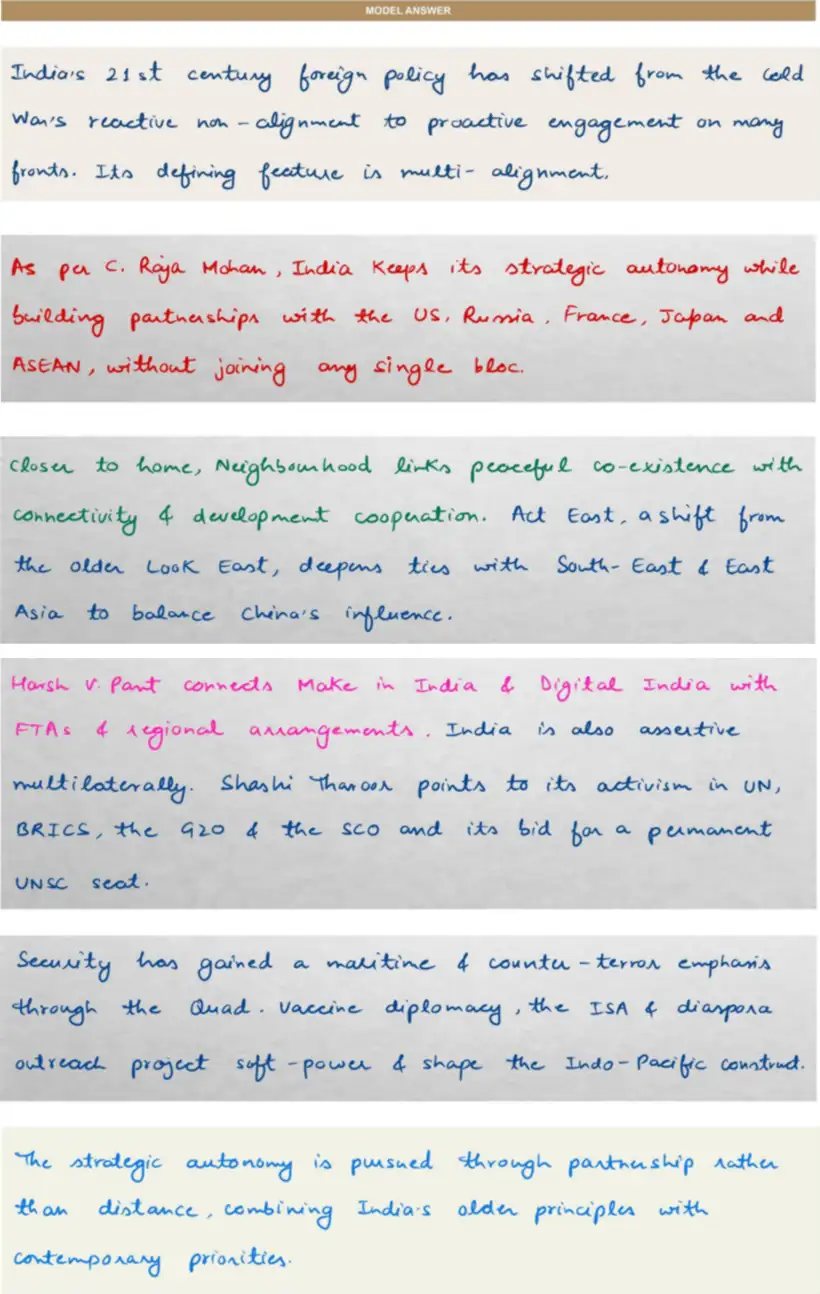
Model answer
Handwritten, in the form it would be written in the examination hall.
Also asked on this head
Indian Foreign Policy — 17 questions in the Vault.
- India has adopted multi-alignment to fulfill its core values and interests in International relations. Discuss.
- What are the external determinants of the Foreign Policy of a State?
- How do the constituent states influence the foreign policy making process in India?
How this is taught
The same flow snapshot, built for every head of the syllabus, with the answer written in class.
The first session of Foundation 2027 is published in full.
Six programmes across three levels.