
Peaceful co-existence remains the cornerstone of India’s foreign policy. Comment.
How the answer moves
The flow snapshot — the routes in, the body, the counter-view and the routes out.
Route 1 core task of foreign policy = security + territorial integrity + peaceful environment → India pursues it by reconciliation, not revenge
Route 2 Appadorai’s pacifism as deliberate method → taproot in Vasudhaiva Kutumbakam + Buddhism + Gandhian non-violence
Panchsheel (1954) → Five Principles → basis for non-alignment + concrete form of UN Charter → principle still guides conduct → China (Himalayas / Indian Ocean → amicable resolution) → Pakistan (UN + democratic means on cross-border terror) → Ukraine crisis (co-existence + strategic autonomy) → constructive role → rival blocs together + pandemic global good
co-existence now paired with a firmer, more risk-taking posture
Route 1 continuity of principle alongside pragmatic adaptation
Route 2 cornerstone holds; practice turns more assertive
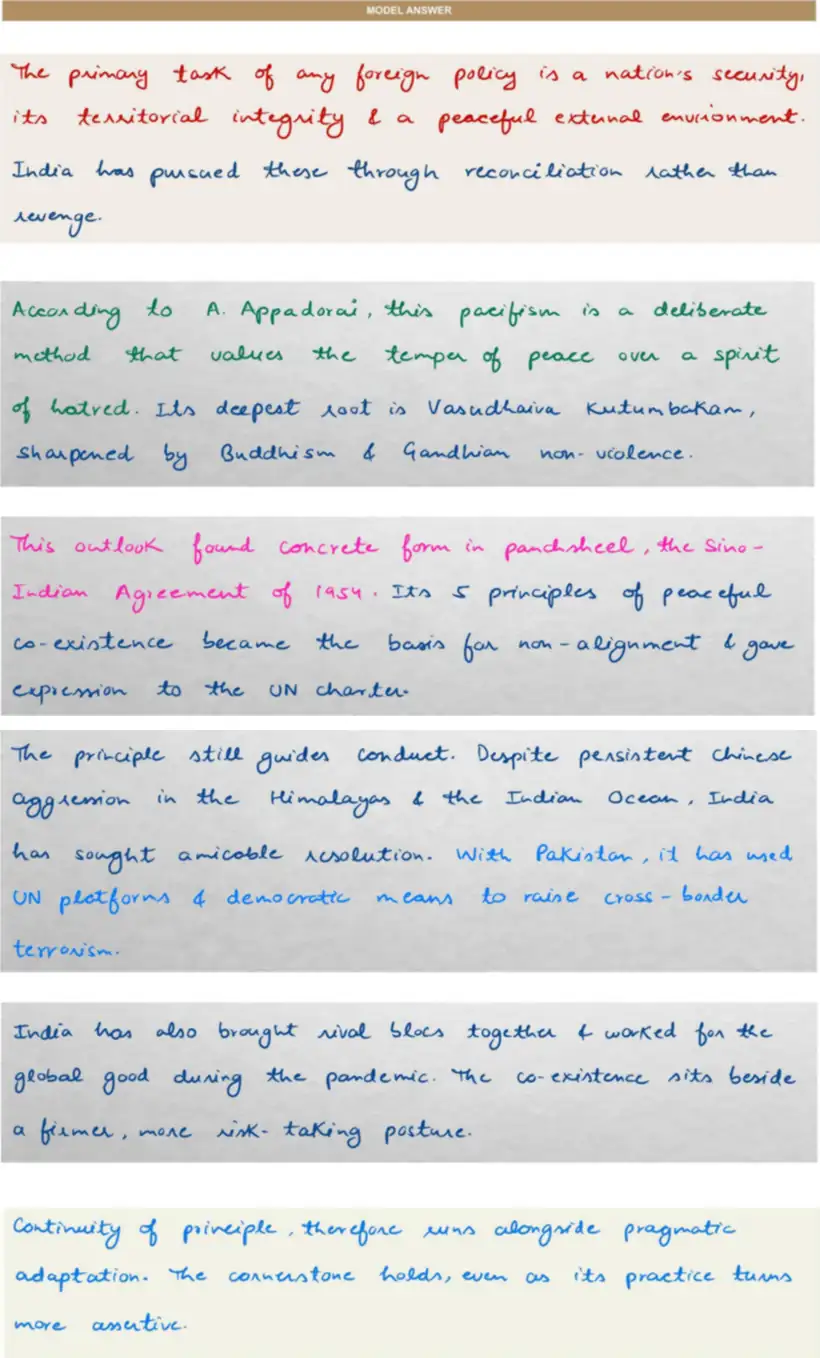
Model answer
Handwritten, in the form it would be written in the examination hall.
Also asked on this head
Indian Foreign Policy — 17 questions in the Vault.
- India has adopted multi-alignment to fulfill its core values and interests in International relations. Discuss.
- What are the external determinants of the Foreign Policy of a State?
- How do the constituent states influence the foreign policy making process in India?
How this is taught
The same flow snapshot, built for every head of the syllabus, with the answer written in class.
The first session of Foundation 2027 is published in full.
Six programmes across three levels.