
Examine the increasing significance of maritime security in India’s foreign policy.
How the answer moves
The flow snapshot — the routes in, the body, the counter-view and the routes out.
Route 1 largest littoral state + Indian Ocean = busiest sea lane → Mahan: sea power / choke points → Indo-Pacific shift raises salience → maritime security moving to the centre
Route 2 India’s continental, defensive mindset → the sea long under-weighted → rising maritime focus corrects a neglected destiny
Mahan (sea power / choke points) → Indo-Pacific shift → Tanham (charge of no strategic culture yet his own record of naval denial + blue-water navy) → Panikkar & Menon (geography compels naval presence) → peninsular projection / Indian Ocean control → Act East + net security provider → Bajpai (widened security = global commons, freedom of high seas) → operationalised: SAGAR, Quad, BIMSTEC, Project Mausam, IORA → contest for choke points (Duqm, Sabang, 2018) → Rao (strategic autonomy driven by maritime security)
Pant: strategic thought still inconsistent → net-security-provider = aspiration > capability → continental pull (China pressure in the Indian Ocean and the Himalayas) tests the ambition
Route 1 margin to centre → maritime security now a defining pillar, integral to strategic autonomy and the net-security-provider identity
Route 2 significance real but transition incomplete → ambition ahead of capability → a defining yet still-maturing maritime turn
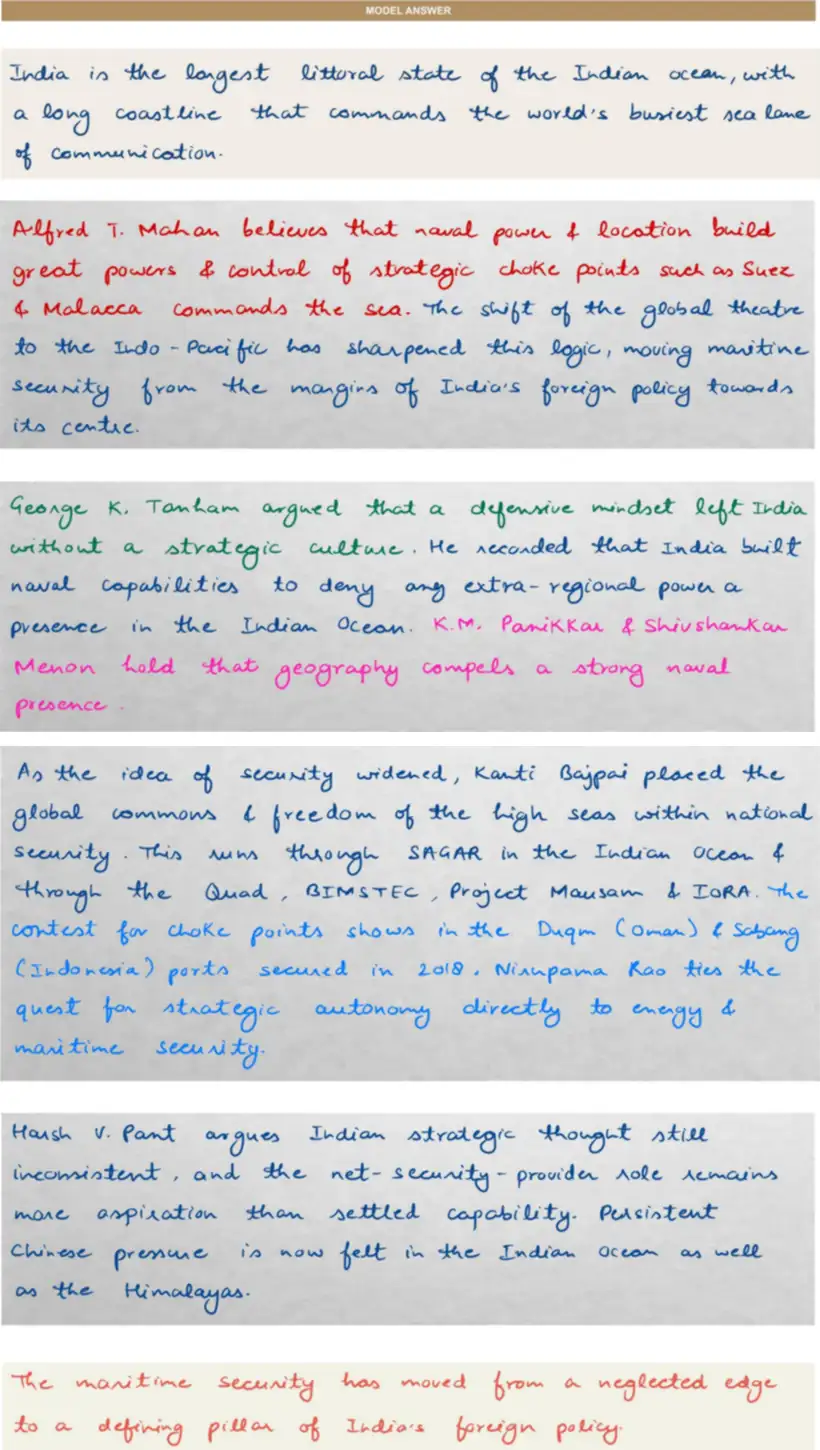
Model answer
Handwritten, in the form it would be written in the examination hall.
Also asked on this head
Indian Foreign Policy — 17 questions in the Vault.
- India has adopted multi-alignment to fulfill its core values and interests in International relations. Discuss.
- What are the external determinants of the Foreign Policy of a State?
- How do the constituent states influence the foreign policy making process in India?
How this is taught
The same flow snapshot, built for every head of the syllabus, with the answer written in class.
The first session of Foundation 2027 is published in full.
Six programmes across three levels.