
Examine the role of ‘parliamentary diplomacy’ in India’s foreign policy.
How the answer moves
The flow snapshot — the routes in, the body, the counter-view and the routes out.
Route 1 parliamentary diplomacy = legislators acting beyond the executive → through delegations & dialogues → a democratic layer, but bounded
Route 2 executive holds the defining role → legislative reach widens external engagement → works within clear limits
Tharoor: democratic/representative dimension, bipartisan bridge → committees (foreign affairs & defence) scrutinise & influence in national interest → IPU + CPA → multilateralism + democratic values projected abroad → Raja Mohan: amplifies India’s voice, cultivates bilateral/regional ties → MP-to-MP understanding on climate change, terrorism, development
Chaudhuri: Parliament limits but does not dictate → no legal requirement for approval → practice underutilised, executive dominates
Route 1 integrates democratic oversight + enhances soft power, yet potential constrained by executive primacy
Route 2 a supporting instrument, not a driver → democratic reach is real but bounded by executive dominance
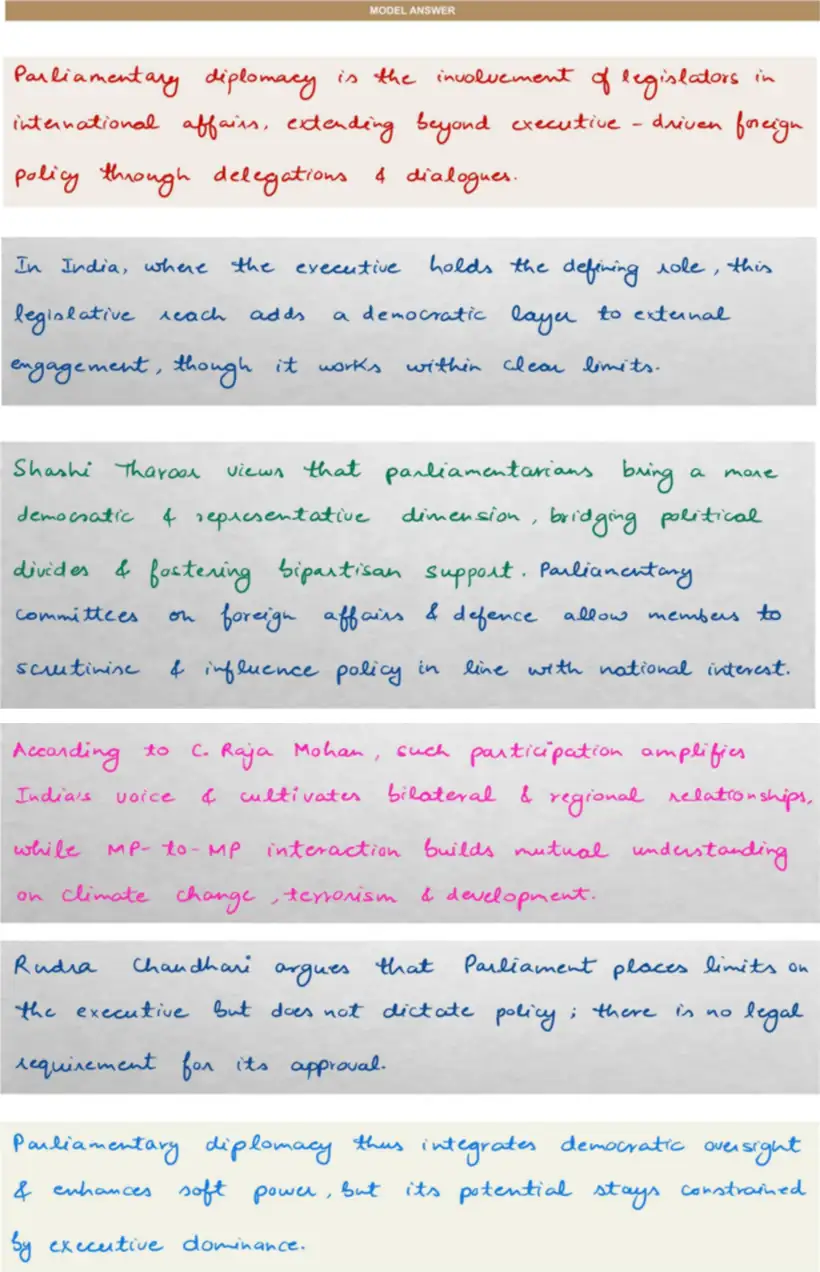
Model answer
Handwritten, in the form it would be written in the examination hall.
Also asked on this head
Indian Foreign Policy — 17 questions in the Vault.
- India has adopted multi-alignment to fulfill its core values and interests in International relations. Discuss.
- What are the external determinants of the Foreign Policy of a State?
- How do the constituent states influence the foreign policy making process in India?
How this is taught
The same flow snapshot, built for every head of the syllabus, with the answer written in class.
The first session of Foundation 2027 is published in full.
Six programmes across three levels.